Antibacterial Activity Test of Pandan Wangi Leaf Extract (Pandanus amaryllifolius Roxb.) against Growth of the Staphylococcus aureus and Escherichia coli
Abstract
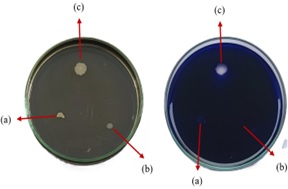
Antibiotic resistance has encouraged the exploration of alternative antibacterial agents from natural sources, including the leaves of pandan wangi (Pandanus amaryllifolius Roxb.), which contain bioactive compounds such as flavonoids, alkaloids, and saponins. This study aimed to determine the antibacterial activity of pandan wangi leaf extract against Staphylococcus aureus and Escherichia coli, to identify the most effective extract concentration, to compare the inhibitory activity between Gram-positive and Gram-negative bacteria, and evaluate the amylase enzyme activity of both bacteria. The antibacterial test was conducted using the disc diffusion method with extract concentrations of 25%, 50%, 75%, and 100%. Chloramphenicol and sterile distilled water were used as positive and negative controls, respectively. The results showed that pandan wangi leaf extract exhibited higher antibacterial activity against E. coli than S. aureus. The highest inhibition against E. coli was observed at 75% concentration with an inhibition zone diameter of 7.22 mm, categorized as moderate inhibition. In contrast, the inhibitory activity against S. aureus was very weak with the highest inhibition zone of 0.97 mm at 100% concentration. In the amylase activity test, both bacteria did not produce clear zones on starch medium after iodine application, indicating the absence of amylase enzyme activity. These findings suggest that pandan wangi leaf extract has potential as a natural antibacterial agent, particularly against Gram-negative bacteria.
Downloads
References
Bubonja-Šonje, M., Knežević, S., & Abram, M. (2020). Challenges to antimicrobial susceptibility testing of plant-derived polyphenolic compounds. Arhiv za Higijenu Rada i Toksikologiju, 71(4), 300-311.
Dewanti, N. I., & Sofian, F. F. (2017). Review artikel: Aktivitas farmakologi ekstrak daun pandan wangi (Pandanus amaryllifolius Roxb.). Farmaka, 15(2), 186-193.
Dewi, D. G. D. P., Mastra, N., & Jirna, I. N. (2018). Perbedaan zona hambat pertumbuhan Staphylococcus aureus pada berbagai konsentrasi ekstrak etanol daun biduri secara in vitro. Meditory, 6(5), 39-45.
Dumoal, O. S. R., Alaras, L. B., Dahilan, K. G., Sarah, Dapadua, A. A., & Pulmones, C. J. G. (2010). In vitro activity of pandan (Pandanus amaryllifolius) leaves crude extract against selected bacterial isolates. National Peer Reviewed Journal, 4(103).
Eshrati, B., Soureshjani, E. K., Nasehi, M., Janani, L., Baradaran, H. R., Bitaraf, S., & Kogani, M. (2025). Evaluation of emerging antimicrobial resistance in nosocomial infections caused by Escherichia coli: The comparison results of observed cases and compartmental model. Interdisciplinary Perspectives on Infectious Diseases, (1), 2-8.
Foster, T. J. (2017). Antibiotic resistance in Staphylococcus aureus: Current status and future prospects. FEMS Microbiology Reviews, 41(3), 430-449.
Kiyato, P., Kamu, V. S., Revolta, M., & Runtuwene, J. (2022). Skrining fitokimia dan uji aktivitas antioksidan fraksi pelarut dari ekstrak metanol batang pandan wangi (Pandanus amaryllifolius Roxb.). Jurnal LPPM Bidang Sains dan Teknologi, 7(2), 1-7.
Madigan, M. T., Bender, K. S., Buckley, D. H., Sattley, W. M., & Stahl, D. A. (2018). Brock biology of microorganisms (15th ed.). Pearson.
Mardiyaningsih, A., & Aini, R. (2014). Pengembangan potensi ekstrak daun pandan (Pandanus amaryllifolius Roxb.) sebagai agen antibakteri. Pharmaciana, 4(2), 185-192.
Nurkhalika, R., Puspitasari, I., & Nuryastuti, T. (2021). Trend pola resistensi antimikroba pada pasien sepsis di intensive care unit: Studi retrospektif selama 5 tahun. Majalah Farmaseutik, 19(4), 498-503.
Yadav, S., & Kapley, A. (2021). Antibiotic resistance: Global health crisis and metagenomics. Biotechnology Reports, 29, 1–9.
Zhydzetski, A., Głowacka-Grzyb, Z. M., Bukowski, T., Żądło, E., Bonar, B., & Władyka. (2024). Agents targeting the bacterial cell wall as tools to combat Gram-positive pathogens. Molecules, 29(17), 4065.
Copyright (c) 2026 Anissa Sabilla, Sri Wahyuningsih, Salman Farisi, Sumardi Sumardi

This work is licensed under a Creative Commons Attribution-NonCommercial-ShareAlike 4.0 International License.
Authors who publish with BIOEDUPAT: Pattimura Journal of Biology and Learning agree to the following terms:
- Authors retain copyright and grant the journal right of first publication with the work simultaneously licensed under a Creative Commons Attribution License (CC BY-NC-SA 4.0) that allows others to share the work with an acknowledgment of the work's authorship and initial publication in this journal.
- Authors are able to enter into separate, additional contractual arrangements for the non-exclusive distribution of the journal's published version of the work (e.g., post it to an institutional repository or publish it in a book), with an acknowledgment of its initial publication in this journal.
- Authors are permitted and encouraged to post their work online (e.g., in institutional repositories or on their website) prior to and during the submission process, as it can lead to productive exchanges, as well as earlier and greater citation of published work.













 This work is licensed under a