Antibacterial Activity Test of African Leaf Extract (Gymnanthemum amygdalinum Del.) against the Growth of Staphylococcus aureus and Escherichia coli
Abstract
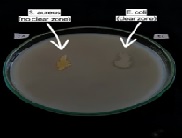
The increasing threat of antibiotic-resistant bacterial infections has encouraged the search for safer and more effective natural alternatives. One potential medicinal plant is African leaf, which contains bioactive compounds such as flavonoids and saponins with antibacterial properties. These compounds work by inhibiting bacterial cell wall synthesis and damaging cell membranes. This study aimed to determine the protease enzyme activity of Staphylococcus aureus and Escherichia coli, evaluate the antibacterial activity of African leaf extract, identify the most effective extract concentration, and compare its inhibitory effects on both bacteria. The study used a qualitative protease test with Skim Milk Agar (SMA) media and an antibacterial assay using the disc diffusion method at concentrations of 20%, 40%, 60%, and 80%. The results showed that E. coli exhibited protease activity, indicated by the formation of a clear zone, whereas S. aureus did not. African leaf extract inhibited the growth of both bacteria, with stronger activity against E. coli. The inhibitory effect increased with higher extract concentrations, reaching optimal activity at 80%.
Downloads
References
Bestari, R. (2021). Senyawa fitokimia dan aktivitas farmakologis daun Afrika (Vernonia amygdalina Del.) sebagai kandidat obat herbal. Jurnal Kedokteran STM (Sains dan Teknologi Medik). 4(1): 63-74.
Efendi, Y., Yusra, & Efendi, V. O. (2017). Optimasi potensi bakteri Bacillus subtilis Sebagai sumber enzim protease. Jurnal Akuatika Indonesia. 2(1): 87-94.
Erwanda, B. A., Siregar, M. S., & Fuadi, M. (2024). Uji efektivitas antimikroba formulasi ekstrak daun pepaya (Carica papaya L.) dan daun rambutan (Nephelium lappaceum L.) terhadap bakteri Staphylococus Aureus. Jurnal Teknologi Pertanian. 13(2): 46-51.
Jayanthi, I. A. A., Tarini, A. M. N., & Praharsini, A. A. G. I. (2020). Staphylococcus aureus sebagai agen penyebab infeksi pada kasus erisipelas kruris dekstra dengan liken simpleks kronikus. Intisari Sains Medis. 11(3): 1482-1491.
Khameneh, B., Iranshahy, M., Soheili, V., & Bazzaz, B. S. F. (2019). Review on plant antimicrobials: A mechanistic viewpoint. Antimicrobial Resistance and Infection Control. 8(1): 118.
Mbira, C. (2024). Influence of substrate concentration on enzyme activity in bio catalysis. Journal Chem. 3(1): 48-58.
Nasri, N., Kaban, V. E., Rani, Z., Suci, N., Ferendina, I., & Tania, C. G. (2025). Potential antioxidant and antibacterial activity of curry leaf ethanol extract (Murraya koenigii) against Propionibacterium acnes. Journal of Pharmaceutical and Sciences. 8(4) 2398-2408.
Novard, M. F. A., Suhart, N. & Rasyid, R. (2019). Gambaran bakteri penyebab infeksi pada anak berdasarkan jenis spesimen dan pola resistensinya di laboratorium RSUP Dr. M. Djamil Padang Tahun 2014-2016. Jurnal Kesehatan Andalas. 8(2): 26-32.
Nurhayati, L. S., Yahdiyani, N. & Hidayatulloh, A. (2020). Perbandingan pengujian aktivitas antibakteri starter yogurt dengan metode difusi sumuran dan metode difusi cakram. Jurnal Teknologi Hasil Peternakan. 1(2): 41-46.
Pratama, H. P. A., Syah, P. I. & Royhan, I. (2025). Aktivitas ekoenzim kulit nanas (Ananas comosus (L). Merr) varietas tangkit sebagai antiseptik alami terhadap Escherichia coli dan Staphylococcus aureus. Biospecies. 18(1): 7-15.
Prihatini, I., & Dewi, R. K. (2021). Kandungan enzim papain pada pepaya (Carica papaya L) terhadap metabolisme tubuh. Jurnal Tadris IPA Indonesia. 1(3): 449-458.
Purniasih, N. K. P., Ginting, E. L., & Wullur, S. (2022). Aktivitas antibakteri dari bakteri simbion lamun Enhalus acoroides asal Perairan Tiwoho, Kecamatan Wori, Sulawesi Utara. Jurnal Ilmiah PLATAX. 10(2): 402-414.
Vijayaraghavan, P., Arasu, M. V., Rajan, R. A., & Al-Dhabi, N. A. (2019). Enhanced production of fibrinolytic enzyme by a new Xanthomonas oryzae IND3 using low-cost culture medium by response surface methodology. Saudi Journal of Biological Sciences. 26(2): 217-224.
Winahyu, P., Sulistyaningtyas, A. R. & Darmawati, S. (2019). Isolasi bakteri indigenous penghasil enzim protease
dari limbah cair industri tempe. In Prosiding Seminar Nasional Mahasiswa Unimus. 2.
Copyright (c) 2026 Firly Pradianita, Sri Wahyuningsih, Salman Farisi, Sumardi Sumardi

This work is licensed under a Creative Commons Attribution-NonCommercial-ShareAlike 4.0 International License.
Authors who publish with BIOEDUPAT: Pattimura Journal of Biology and Learning agree to the following terms:
- Authors retain copyright and grant the journal right of first publication with the work simultaneously licensed under a Creative Commons Attribution License (CC BY-NC-SA 4.0) that allows others to share the work with an acknowledgment of the work's authorship and initial publication in this journal.
- Authors are able to enter into separate, additional contractual arrangements for the non-exclusive distribution of the journal's published version of the work (e.g., post it to an institutional repository or publish it in a book), with an acknowledgment of its initial publication in this journal.
- Authors are permitted and encouraged to post their work online (e.g., in institutional repositories or on their website) prior to and during the submission process, as it can lead to productive exchanges, as well as earlier and greater citation of published work.













 This work is licensed under a