The Antioxidant Test of Ecoenzymes from Various Fruit Peel Wastes
Abstract
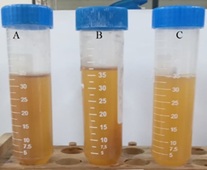
Indonesia is a country with a large population and rapid industrial growth, facing serious challenges related to waste management. Waste is the remains produced by human activities. One interesting solution to handle the problem is the production of ecoenzymes through the fermentation process of natural organic waste materials. Ecoenzymes are biotechnology products that produce various types of enzymes and organic chemicals that are useful for various applications. Apart from that, laboratory tests also revealed the presence of antioxidant activity in these ecoenzymes, for Ecoenzyme A (IC50 = 13735.9 μg/mL) about 0.4 mL of ecoenzyme solution could inhibit 50% of radical activity, and for Ecoenzyme B (IC50 = 12029.4 μg/mL) about 0.3 mL solution could inhibit 50% of radical activity, and for Ecoenzyme C (IC50 = 15765.1 μg /mL) about 0.4 mL ecoenzyme could inhibit 50% of radical activity, which, although categorized as weak, is because the volume of ecoenzyme produced is very much greater (2 L) than the volume used for antioxidant testing, this product is much more economical and has enormous potential to be developed into cosmetic ingredients and other industrial products.
Downloads
Copyright (c) 2026 Happy Chelsy Betaria Napitupulu, Misael Ivan Pangela, Hepy Terima Telaumbanua, Joy Sisokhi Putra Lase, Candra Yulius Tahya, Sisilya Siringo Ringo

This work is licensed under a Creative Commons Attribution-NonCommercial-NoDerivatives 4.0 International License.
Authors who publish with this journal agree to the following terms:
- Copyright on any article is retained by the author(s).
- The author grants the journal, the right of first publication with the work simultaneously licensed under a Creative Commons Attribution License that allows others to share the work with an acknowledgment of the work’s authorship and initial publication in this journal.
- Authors are able to enter into separate, additional contractual arrangements for the non-exclusive distribution of the journal’s published version of the work (e.g., post it to an institutional repository or publish it in a book), with an acknowledgment of its initial publication in this journal.
- Authors are permitted and encouraged to post their work online (e.g., in institutional repositories or on their website) prior to and during the submission process, as it can lead to productive exchanges, as well as earlier and greater citation of published work.
- The article and any associated published material is distributed under the Creative Commons Attribution-NonCommercial-NoDerivatives 4.0 International License.




_copy1.png)