Modification of Lead Adsorbent from Activated Carbon of Cassava Peel Waste (Manihot esculenta) using Sodium Alginate
Abstract
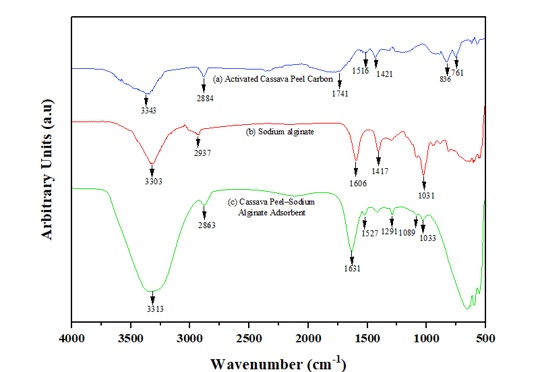
The study aimed to address lead (Pb) contamination in aquatic environments by utilizing an adsorbent derived from cassava peel waste. The adsorbent was prepared by carbonizing cassava peel at 350 °C, followed by chemical activation using NaOH. To enhance its adsorption performance, the activated carbon was modified with sodium alginate. The adsorption process was evaluated to determine optimum conditions, including variations in adsorbent mass, solution pH, and contact time. Experimental results showed that the optimum conditions for Pb removal were achieved at pH 6, with 0.1 g of adsorbent and a contact time of 30 minutes. Under these conditions, the adsorbent exhibited an efficiency of 99.33% and an adsorption capacity of 1.9827 mg/g. The process followed the Langmuir isotherm model, and regeneration studies showed low recovery percentages ranging from 0.2% to 0.6%. These results indicate that cassava peel waste modified with sodium alginate is a promising, low-cost material for the removal of Pb from contaminated water systems.
Downloads
Copyright (c) 2026 Aliyah Zahra Fauziyyah, Mohamad Alief Ramdhan

This work is licensed under a Creative Commons Attribution-NonCommercial-NoDerivatives 4.0 International License.
Authors who publish with this journal agree to the following terms:
- Copyright on any article is retained by the author(s).
- The author grants the journal, the right of first publication with the work simultaneously licensed under a Creative Commons Attribution License that allows others to share the work with an acknowledgment of the work’s authorship and initial publication in this journal.
- Authors are able to enter into separate, additional contractual arrangements for the non-exclusive distribution of the journal’s published version of the work (e.g., post it to an institutional repository or publish it in a book), with an acknowledgment of its initial publication in this journal.
- Authors are permitted and encouraged to post their work online (e.g., in institutional repositories or on their website) prior to and during the submission process, as it can lead to productive exchanges, as well as earlier and greater citation of published work.
- The article and any associated published material is distributed under the Creative Commons Attribution-NonCommercial-NoDerivatives 4.0 International License.



_copy1.png)