Formulation and Characterization of Uncaria gambir (U. gambir) Extract Cream as an Anti-Psoriasis Candidate: In Silico and In Vitro Studies
Abstract
Background: Psoriasis is a chronic inflammatory skin disorder in which oxidative stress and COX-2–mediated pathways contribute to disease progression. Conventional topical therapies, particularly corticosteroids, are effective but associated with adverse effects and limited mechanistic targeting. Objective: This study investigated Uncaria gambir
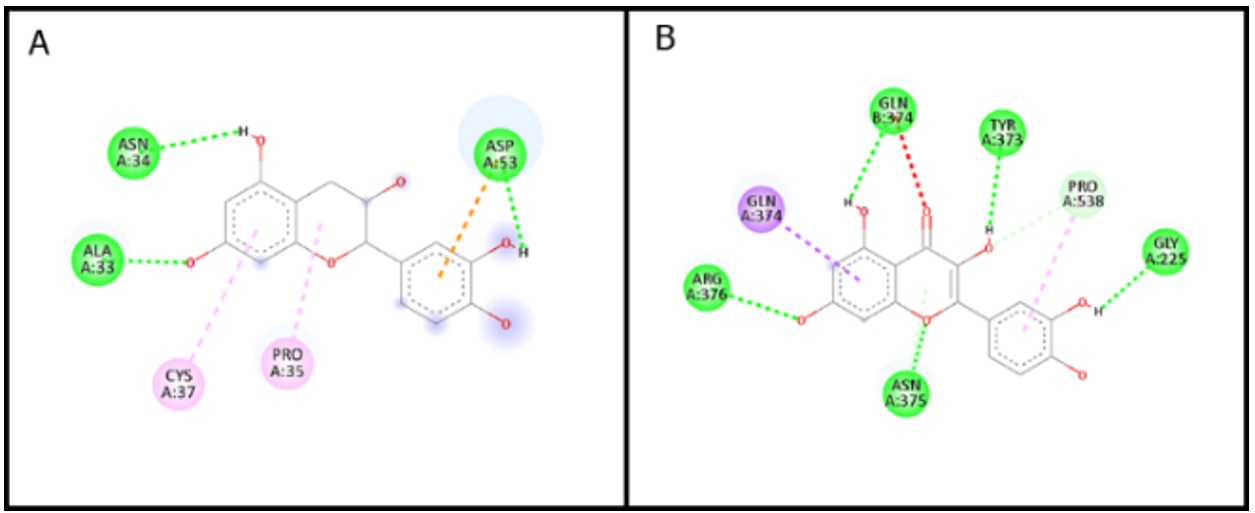
(U. gambir) extract as a natural anti-psoriasis candidate in a topical cream formulation through phytochemical, antioxidant, in silico, and physicochemical evaluations. Methods: The extract was screened for phenolic and flavonoid content and evaluated for DPPH radical scavenging activity (IC₅₀). Molecular docking of catechin against the COX-2 receptor was performed using quercetin as a reference. Cream formulations containing varying extract concentrations were assessed for pH, spreadability, and adhesiveness. Results: U. gambir extract exhibited very strong antioxidant activity (IC₅₀ = 6.84 ppm), falling within the range of highly active antioxidants, although less potent than vitamin C. Catechin showed stable COX-2 binding (−4.76 kcal/mol). The 4.5% cream formulation (F2) demonstrated optimal properties, with a skin-compatible pH (~7.5) and good spreadability (~5.5 cm). Conclusion: U. gambir extract shows promising potential as a natural topical agent targeting oxidative stress and inflammation in psoriasis, supporting further in vivo and clinical validation.
Downloads
Copyright (c) 2026 Khoirul Rista Abidin, Ariffialdi Nurhidayattulloh, Febrina Siregar, Abdurrafi Maududi Dermawan, Fath Dwisari, Oktaviria Oktaviria, Suchi Suchi, Melly Indriani, Firda Aulia Putri, Hernyati Prasetyaningsi, Shofia Shofia

This work is licensed under a Creative Commons Attribution-NonCommercial-NoDerivatives 4.0 International License.
Authors who publish with this journal agree to the following terms:
- Copyright on any article is retained by the author(s).
- The author grants the journal, the right of first publication with the work simultaneously licensed under a Creative Commons Attribution License that allows others to share the work with an acknowledgment of the work’s authorship and initial publication in this journal.
- Authors are able to enter into separate, additional contractual arrangements for the non-exclusive distribution of the journal’s published version of the work (e.g., post it to an institutional repository or publish it in a book), with an acknowledgment of its initial publication in this journal.
- Authors are permitted and encouraged to post their work online (e.g., in institutional repositories or on their website) prior to and during the submission process, as it can lead to productive exchanges, as well as earlier and greater citation of published work.
- The article and any associated published material is distributed under the Creative Commons Attribution-NonCommercial-NoDerivatives 4.0 International License.



_copy1.png)