Cytotoxicity of Kamandin Saebo Glossocardia leschenaultii [Cass.] Veldkamp Extract with Various Solvents on T47D Cells
Abstract
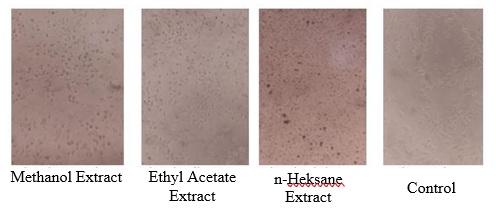
In Indonesia, cancer is one of the diseases with a high mortality rate. In 2018, there were 348,809 cases of cancer, with 16.7% of all cases being breast cancer. In Indonesia, breast and cervical cancer are the most common types. The purpose of this study was to determine the secondary metabolite content of compounds and the anticancer activity of kamandin saebo extract against T47D breast cancer cells from kamandin saebo (Glossocardia leschenaultii [Cass.] Veldkamp) samples using various types of solvents. The methods used were sample preparation, moisture content analysis, extraction using the ultrasonic method, secondary metabolite analysis using reagents, and anticancer testing against T47D breast cancer cells. The plants were washed thoroughly to obtain powder and sieved with a 60 mesh, with a moisture content of 11.5% (w/w), and the extraction results obtained concentrated extracts from various types of solvents. The secondary metabolite content of kamandin saebo is flavonoids, steroids, alkaloids, and tannins. The anticancer activity of methanol, ethyl acetate, and n-hexane extracts, with IC50 values of 340, 272, and 107 µg/ml, respectively. The n-hexane extract has anticancer potential compared to ethyl acetate and methanol extracts.
Downloads
Copyright (c) 2026 Ulfatun Hasanah, Ratno Budiyanto, Novi Triwahyuni, Hanim Istatik Badi’ah

This work is licensed under a Creative Commons Attribution-NonCommercial-NoDerivatives 4.0 International License.
Authors who publish with this journal agree to the following terms:
- Copyright on any article is retained by the author(s).
- The author grants the journal, the right of first publication with the work simultaneously licensed under a Creative Commons Attribution License that allows others to share the work with an acknowledgment of the work’s authorship and initial publication in this journal.
- Authors are able to enter into separate, additional contractual arrangements for the non-exclusive distribution of the journal’s published version of the work (e.g., post it to an institutional repository or publish it in a book), with an acknowledgment of its initial publication in this journal.
- Authors are permitted and encouraged to post their work online (e.g., in institutional repositories or on their website) prior to and during the submission process, as it can lead to productive exchanges, as well as earlier and greater citation of published work.
- The article and any associated published material is distributed under the Creative Commons Attribution-NonCommercial-NoDerivatives 4.0 International License.



_copy1.png)