Intermolecular Characterization of Chitosan from the Exoskeleton of Windu Prawn (Penaeus monodon) and Mangrove Crab (Scylla sp.)
Abstract
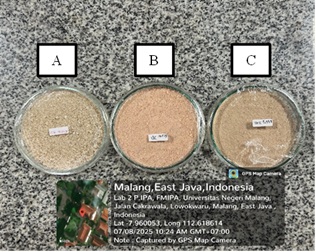
Chitosan (C6H11NO4)n is a chitin-derived polymer that has good biocompatibility, biodegradability, and bioabsorbability properties. This compound can be obtained from exoskeleton waste such as mangrove crabs and Windu prawn. This study aims to evaluate the comparison of chitosan levels based on the degree of deacetylation (%DD) from the waste shell, head, and leg of Windu prawn and mangrove crab shell waste obtained from the coastal area of Pasuruan, East Java. The extraction method was carried out through the stages of deproteinization, demineralization, and deacetylation using an alkaline solution, and then the characterization of molecular structure and %DD was carried out using an FTIR spectrophotometer. The results showed that chitosan from Windu prawn shell had the highest %DD of 73.0%, while mangrove crab shell and prawn head and leg showed lower values of 55.3% and 63.9%. This difference in %DD value indicates a variation in the success rate of deacetylation due to differences in biomaterial composition. The results of SEM testing showed that the use of the type of material in the manufacture of chitosan would affect the results of the surface morphology produced, where the Windu prawn shell produced the flattest surface.
Downloads
Copyright (c) 2026 Rini Anggi Arista, Dian Nugraheni, Eka Nurul Qomaliyah, Yayuk Mulyati, Jibril Maulana, Kadek Risa Rivana Dewi, Shahira Qistan A'yuni

This work is licensed under a Creative Commons Attribution-NonCommercial-NoDerivatives 4.0 International License.
Authors who publish with this journal agree to the following terms:
- Copyright on any article is retained by the author(s).
- The author grants the journal, the right of first publication with the work simultaneously licensed under a Creative Commons Attribution License that allows others to share the work with an acknowledgment of the work’s authorship and initial publication in this journal.
- Authors are able to enter into separate, additional contractual arrangements for the non-exclusive distribution of the journal’s published version of the work (e.g., post it to an institutional repository or publish it in a book), with an acknowledgment of its initial publication in this journal.
- Authors are permitted and encouraged to post their work online (e.g., in institutional repositories or on their website) prior to and during the submission process, as it can lead to productive exchanges, as well as earlier and greater citation of published work.
- The article and any associated published material is distributed under the Creative Commons Attribution-NonCommercial-NoDerivatives 4.0 International License.




_copy1.png)