Synthesis of Silica from Chitosan-Modified Sugarcane Bagasse and GPTMS Binding Compound as an Adsorbent for Remazol Yellow Dye Waste
Abstract
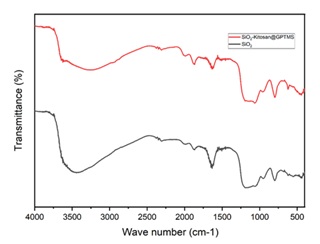
Remazol Yellow, a synthetic dye waste, is carcinogenic and mutagenic, necessitating waste treatment. One of the methods used is adsorption with silica adsorbents and sugarcane bagasse. Silica has unusual features, including mechanical stability at high temperatures, strong ion-exchange capacity, and a large surface area with broad pores. The inclusion of chitosan increases the number of active sites on silica as an adsorbent. The inclusion of the binding agent glycidoxypropyltrimethoxysilane (GPTMS) can improve the link between silica and chitosan as the dye adsorbent concentration increases. The FTIR characterization results indicate absorption bands at 451 cm-1, 796 cm-1, and 958 cm-1, corresponding to the spectra of silica and chitosan chemical groups. The XRD analysis revealed crystalline silica in the form of the cristobalite phase. SEM analysis revealed that the binding chemical increased the surface porosity of the silica-chitosan adsorbent. The optimal adsorption conditions for utilizing chitosan-modified silica adsorbent are a pH of 2 and a contact time of 2 hours. An adsorbent mass of 0.5 g, with an adsorption capacity value of 2.17 mmol/g, influences the growth in adsorption capacity, as does an adsorbate concentration of 80 ppm, with an adsorption capacity value of 2.8 mmol/g.
Downloads
Copyright (c) 2026 Ayu Qurota A'yun, Yuni Susanti, Aulia Rifki Maulana Yusuf, Hilmi Naufal Human, Lintang Miftahul Rizki

This work is licensed under a Creative Commons Attribution-NonCommercial-NoDerivatives 4.0 International License.
Authors who publish with this journal agree to the following terms:
- Copyright on any article is retained by the author(s).
- The author grants the journal, the right of first publication with the work simultaneously licensed under a Creative Commons Attribution License that allows others to share the work with an acknowledgment of the work’s authorship and initial publication in this journal.
- Authors are able to enter into separate, additional contractual arrangements for the non-exclusive distribution of the journal’s published version of the work (e.g., post it to an institutional repository or publish it in a book), with an acknowledgment of its initial publication in this journal.
- Authors are permitted and encouraged to post their work online (e.g., in institutional repositories or on their website) prior to and during the submission process, as it can lead to productive exchanges, as well as earlier and greater citation of published work.
- The article and any associated published material is distributed under the Creative Commons Attribution-NonCommercial-NoDerivatives 4.0 International License.




_copy1.png)