Utilization of Lignin from Oil Palm Empty Fruit Bunches (OPEFB) for the Fabrication of Eco-Friendly Superhydrophobic Sponges
Abstract
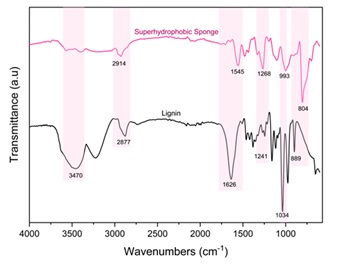
The escalation of crude oil exploitation poses significant risks of leakage and oil spills in the oceans. Therefore, this research aims to synthesize superhydrophobic sponges utilizing lignin derived from Oil Palm Empty Fruit Bunch (OPEFB) waste. Lignin was isolated from OPEFB with the addition of 15% NaOH, followed by neutralization and purification using H₂SO₄, which yielded a recovery of 30.3%. Subsequently, melamine sponges were modified via a facile dip-coating technique using a mixture of lignin, Polydimethylsiloxane (PDMS), and (3-aminopropyl)triethoxysilane (APTES). The physicochemical properties and material performance were characterized using 1H-NMR, FTIR, and Water Contact Angle (WCA) measurements. 1H-NMR analysis confirmed the successful isolation of the lignin structure, while FTIR spectra verified the effective deposition of the silane-lignin layer on the sponge skeleton. Contact angle analysis results indicated a significant surface transformation, where the sponge shifted from a superhydrophilic nature 0° to a highly superhydrophobic state (170.91°). With such performance, this material holds great potential as an effective, eco-friendly adsorbent for oil spill remediation in aquatic environments.
Downloads
Copyright (c) 2026 Meiyanti Ratna Kumalasari, Yuni Damayanti Nainggolan, Jesika Nababan, Anastasya Isaura, Wenika Simbolon, Hana Esrani Togatorop, Rizki Rachmad Saputra, Siti Unvaresi Misonia Beladona, Ozi Adi Saputra

This work is licensed under a Creative Commons Attribution-NonCommercial-NoDerivatives 4.0 International License.
Authors who publish with this journal agree to the following terms:
- Copyright on any article is retained by the author(s).
- The author grants the journal, the right of first publication with the work simultaneously licensed under a Creative Commons Attribution License that allows others to share the work with an acknowledgment of the work’s authorship and initial publication in this journal.
- Authors are able to enter into separate, additional contractual arrangements for the non-exclusive distribution of the journal’s published version of the work (e.g., post it to an institutional repository or publish it in a book), with an acknowledgment of its initial publication in this journal.
- Authors are permitted and encouraged to post their work online (e.g., in institutional repositories or on their website) prior to and during the submission process, as it can lead to productive exchanges, as well as earlier and greater citation of published work.
- The article and any associated published material is distributed under the Creative Commons Attribution-NonCommercial-NoDerivatives 4.0 International License.




_copy1.png)