Morphological Study and Characterization of Chitosan/Graphene Quantum Dots/TiO2 Composite Film as a Modified Electrode Material
Abstract
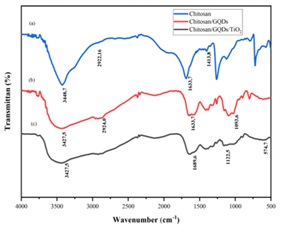
This study investigates the morphological and structural characteristics of chitosan/graphene quantum dots/titanium dioxide (CS/GQDs/TiO₂) composite films with TiO₂ concentrations of 50–250 mg/L as coating materials for modified working electrodes. The films were prepared using ionic gelation and stirring methods. Characterization was performed using Fourier Transform Infrared Spectroscopy (FTIR), X-Ray Diffraction (XRD), and Scanning Electron Microscopy (SEM). FTIR analysis confirmed hydrogen bonding and coordination interactions among chitosan, GQDs, and TiO₂ through the shift of –OH/–NH₂ bands and the appearance of Ti–O–Ti and C–O–Ti bands. XRD analysis showed an increase in crystallinity from 20.82% to 41.35%, indicating improved structural ordering after TiO₂ incorporation. SEM observations revealed morphological transformation from the rough surface of pure chitosan to a more compact and homogeneous structure at moderate TiO₂ concentrations, while agglomeration appeared at higher concentrations. These results demonstrate that the incorporation of GQDs and TiO₂ enhances the structural stability and morphology of the chitosan matrix, making the composite promising for electrochemical electrode coating applications.
Downloads
Copyright (c) 2026 Astri Anjelina Nasution, Irwana Nainggolan, Andriayani Andriayani, Nessa Gina Sonia

This work is licensed under a Creative Commons Attribution-NonCommercial-NoDerivatives 4.0 International License.
Authors who publish with this journal agree to the following terms:
- Copyright on any article is retained by the author(s).
- The author grants the journal, the right of first publication with the work simultaneously licensed under a Creative Commons Attribution License that allows others to share the work with an acknowledgment of the work’s authorship and initial publication in this journal.
- Authors are able to enter into separate, additional contractual arrangements for the non-exclusive distribution of the journal’s published version of the work (e.g., post it to an institutional repository or publish it in a book), with an acknowledgment of its initial publication in this journal.
- Authors are permitted and encouraged to post their work online (e.g., in institutional repositories or on their website) prior to and during the submission process, as it can lead to productive exchanges, as well as earlier and greater citation of published work.
- The article and any associated published material is distributed under the Creative Commons Attribution-NonCommercial-NoDerivatives 4.0 International License.




_copy1.png)