Evaluation of 5,5’-Oxybis(1,3,7-Trihydroxy-9H-Xanthen-9-One) as an Anticancer Agent Through In Vitro and In Silico Tests
Abstract
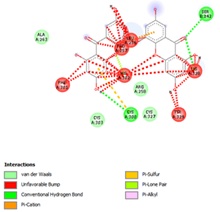
Breast cancer is among the most common malignancies globally and continues to be a primary cause of cancer-related deaths in women. Modern chemotherapeutic agents often exhibit resistance and lack of selectivity for healthy cells, leading to significant side effects. Consequently, several strategies are essential to overcome resistance and enhance the selectivity and efficacy of chemotherapeutic drugs derived from natural sources. This study investigates the anticancer activity of a new bis-xanthone compound, 5,5'-Oxybis(1,3,7-trihydroxy-9H-xanthen-9-one), in MCF-7 breast cancer cells using a combination of in vitro and in silico approaches. The compound exhibited cytotoxicity against MCF-7 breast cancer cells, with an IC50 value of 30.47 µg/mL. The pharmacokinetic characteristics of bis-xanthone compounds were evaluated using absorption, distribution, metabolism, excretion, and toxicity (ADMET) tests, demonstrating a more favorable profile than that of doxorubicin, a standard anticancer drug.
Downloads
Copyright (c) 2026 Ayu Nadila Safitri, Aldillah Herlambang, Muhammad Irhash Shalihin, Nurul Pratiwi, Putri Dwi Mulyani, Nania Septiyani, Muktaf Wando Saputra

This work is licensed under a Creative Commons Attribution-NonCommercial-NoDerivatives 4.0 International License.
Authors who publish with this journal agree to the following terms:
- Copyright on any article is retained by the author(s).
- The author grants the journal, the right of first publication with the work simultaneously licensed under a Creative Commons Attribution License that allows others to share the work with an acknowledgment of the work’s authorship and initial publication in this journal.
- Authors are able to enter into separate, additional contractual arrangements for the non-exclusive distribution of the journal’s published version of the work (e.g., post it to an institutional repository or publish it in a book), with an acknowledgment of its initial publication in this journal.
- Authors are permitted and encouraged to post their work online (e.g., in institutional repositories or on their website) prior to and during the submission process, as it can lead to productive exchanges, as well as earlier and greater citation of published work.
- The article and any associated published material is distributed under the Creative Commons Attribution-NonCommercial-NoDerivatives 4.0 International License.



_copy1.png)