Molecular Dynamics Study of Electrolyte Effects on Carbon Electrode in Supercapacitors
Abstract
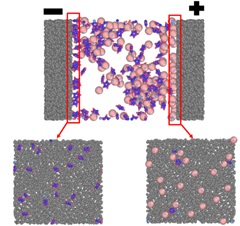
The demand for efficient and sustainable global energy sources continues to increase alongside technological developments. In this case, the development of electrical energy storage devices, such as supercapcitor, is essential. Supercapacitors have a fairly high capacitance, large power density, fast charging and discharging processes, and good durability. Computational studies through molecular dynamics simulations were conducted to understand the properties and dynamics of a supercapacitor system with activated carbon-based electrodes. This study aims to observe the effect of electrolyte types on the properties of activated carbon as a supercapacitor electrode based on the dynamic movement of electrolyte ions in the system molecular dynamics simulations using Large Scale Atomic/Molecular Massively Parallel Simulator (LAMMPS) software with OPLS-AA force field parameters were carried out to study the supercapacitor system. The variations of electrolyte systems studied include C₃H₅N₂⁺/BF₄⁻, C₃H₅N₂⁺/CH₃COO⁻, and K+/OH- in acetonitrile (ACN) solvent. Simulation results show that the system with C₃H₅N₂⁺/BF₄⁻ electrolyte has the best performance as a supercapacitor system. This is seen from the interface interaction with the electrode and good ion diffusion, the highest ion diffusion coefficient value of 18,4×10⁻¹¹ m2/s, and the highest specific capacitance value of 199,86 μF/cm2.
Downloads
Copyright (c) 2026 Syifa Salsabina, Raissa Raissa, Muttaqin Muttaqin, Tirta Rona Mayangsari

This work is licensed under a Creative Commons Attribution-NonCommercial-NoDerivatives 4.0 International License.
Authors who publish with this journal agree to the following terms:
- Copyright on any article is retained by the author(s).
- The author grants the journal, the right of first publication with the work simultaneously licensed under a Creative Commons Attribution License that allows others to share the work with an acknowledgment of the work’s authorship and initial publication in this journal.
- Authors are able to enter into separate, additional contractual arrangements for the non-exclusive distribution of the journal’s published version of the work (e.g., post it to an institutional repository or publish it in a book), with an acknowledgment of its initial publication in this journal.
- Authors are permitted and encouraged to post their work online (e.g., in institutional repositories or on their website) prior to and during the submission process, as it can lead to productive exchanges, as well as earlier and greater citation of published work.
- The article and any associated published material is distributed under the Creative Commons Attribution-NonCommercial-NoDerivatives 4.0 International License.




_copy1.png)