Antibacterial Sulfonated Hydroxyxanthone Derivatives: Synthesis, In Vitro Evaluation, and Molecular Docking Studies
Abstract
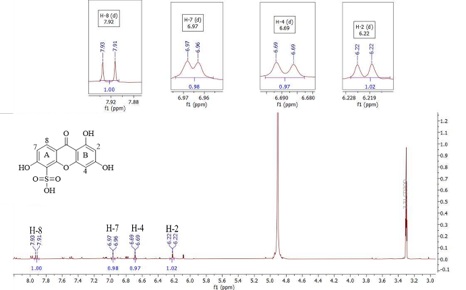
The emergence of antibiotic resistance and the declining drug effectiveness make it imperative to identify potential drug candidates. This study aims to synthesize hydroxyxanthone derivatives as antibacterial candidates. Activity tests were carried out in vitro using Staphylococcus aureus and Escherichia coli, and in silico using molecular docking. Sulfonated hydroxyxanthone derivatives (2a and 2b) were synthesized from 1,3,7- and 1,3,6-trihydroxyxanthones (1a and 1b) through the sulfonation method, yielding 41% and 44%, respectively. The compounds showed greater efficacy against Escherichia coli, with maximum inhibition zones of 14.33 mm (1a) and 15.00 mm (1b), while the sulfonated compound 2b showed relatively better activity against Staphylococcus aureus with an inhibition zone of 14.00 mm, highlighting the impact of molecular structure on antibacterial performance. Molecular docking analysis against penicillin-binding protein 1A (PBP1A) revealed that sulfonated compounds (2a and 2b) exhibited the lowest binding affinity (−7.9 kcal/mol), stronger than the native ligand (penicillin G, -7.4 kcal/mol) and the positive control (amoxicillin, −7.7 kcal/mol), with key interactions with residues Ser487, Thr670, and Thr672, indicating high complex stability and potential inhibitory activity against PBP1A.
Downloads
Copyright (c) 2026 Emmy Yuanita, Zuriatun Toyyibah, Maulida Septiyana, Ni Komang Tri Dharmayani, Baiq Ike Nursofia, Ima Arum Lestarini, Faris Hermawan, Baiq Nila Sari Ningsih

This work is licensed under a Creative Commons Attribution-NonCommercial-NoDerivatives 4.0 International License.
Authors who publish with this journal agree to the following terms:
- Copyright on any article is retained by the author(s).
- The author grants the journal, the right of first publication with the work simultaneously licensed under a Creative Commons Attribution License that allows others to share the work with an acknowledgment of the work’s authorship and initial publication in this journal.
- Authors are able to enter into separate, additional contractual arrangements for the non-exclusive distribution of the journal’s published version of the work (e.g., post it to an institutional repository or publish it in a book), with an acknowledgment of its initial publication in this journal.
- Authors are permitted and encouraged to post their work online (e.g., in institutional repositories or on their website) prior to and during the submission process, as it can lead to productive exchanges, as well as earlier and greater citation of published work.
- The article and any associated published material is distributed under the Creative Commons Attribution-NonCommercial-NoDerivatives 4.0 International License.




_copy1.png)