Synthesis and Characterization of Transition Metal Complexes with an Indole-Based Azo-Schiff Ligand
Abstract
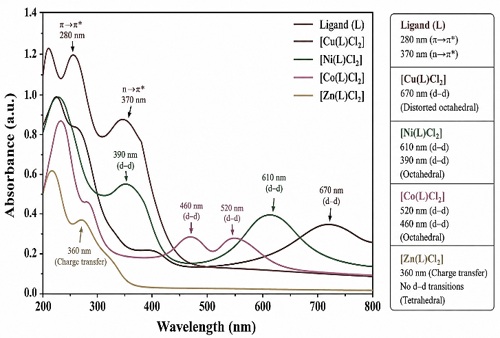
In this study, an indole-based azo Schiff base ligand was first synthesized via diazotization coupling and Schiff base condensation. The ligand was then coordinated with four transition metal ions, namely Cu (II), Ni (II), Co (II), and Zn (II), and stable-colored solid complexes were isolated. FT-IR results showed that the characteristic peaks of ν(C=N) and ν(N=N) of the free ligand were located at 1618 cm⁻¹ and 1452 cm⁻¹, respectively. After coordination, these peak positions shifted to lower wavenumbers by 10-25 cm⁻¹, and a new ν(M-N) vibration peak appeared in the 510-560 cm⁻¹ range, confirming that the nitrogen atoms of the azomethine and azo groups participated in coordination. The absorption signals of the Cu (II), Ni (II), and Co (II) complexes at 520-760 nm were consistent with an octahedral configuration, while the diamagnetic Zn (II) complex matched a tetrahedral coordination mode. Magnetic susceptibility tests returned magnetic moments of approximately 1.8 BM for Cu (II), 3.1 BM for Ni (II), and 4.7 BM for Co (II), which support the octahedral structure. This study clarified the coordination behavior of this indole-derived ligand, which can form stable chelates with distinct geometric configurations.
Downloads
Copyright (c) 2026 Zinah Areef Khalaf, Maha Raheem Abd Alzaher

This work is licensed under a Creative Commons Attribution-NonCommercial-NoDerivatives 4.0 International License.
Authors who publish with this journal agree to the following terms:
- Copyright on any article is retained by the author(s).
- The author grants the journal, the right of first publication with the work simultaneously licensed under a Creative Commons Attribution License that allows others to share the work with an acknowledgment of the work’s authorship and initial publication in this journal.
- Authors are able to enter into separate, additional contractual arrangements for the non-exclusive distribution of the journal’s published version of the work (e.g., post it to an institutional repository or publish it in a book), with an acknowledgment of its initial publication in this journal.
- Authors are permitted and encouraged to post their work online (e.g., in institutional repositories or on their website) prior to and during the submission process, as it can lead to productive exchanges, as well as earlier and greater citation of published work.
- The article and any associated published material is distributed under the Creative Commons Attribution-NonCommercial-NoDerivatives 4.0 International License.




_copy1.png)