Design, Molecular Docking, and ADMET Evaluation of Pyrazoline-Pyridine Derivatives as Dual-Target Ligands for Glucokinase (1V4S) and CDK5 (1UNL)
Abstract
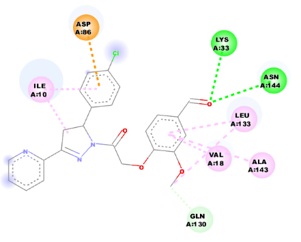
The development of dual-target ligands is an emerging strategy in medicinal chemistry to address complex diseases. This study aimed to evaluate six pyrazoline-pyridine derivatives (5A-5F) as potential dual-target ligands for Glucokinase (1V4S) and Cyclin-Dependent Kinase 5 (CDK5, 1UNL). Molecular docking was performed using AutoDock4 to assess binding affinity and interactions profiles, following validation of the docking protocol (RMSD < 2 Å). The results showed that compound 5F exhibited the strongest binding affinity toward Glucokinase (-10.96 kcal/mol) and high affinity toward CDK5 (-8.34 kcal/mol), forming key interactions with residues Thr65 and Arg63 (Glucokinase) as well as Asn144, and Lys33 (CDK5). ADMET prediction indicated that all compounds comply with Lipinski’s rule and exhibit high gastrointestinal absorption. However, most compounds were predicted to inhibit multiple CYP enzymes and show potential hepatotoxicity, highlighting the need for further optimization. Structure-activity relationship (SAR) analysis revealed that the pyrazoline scaffold contributes to molecular flexibility, while the pyridine ring enhances hydrogen bonding and hydrophobic interactions. Overall, compound 5F is identified as the most promising candidate for further investigation as a dual-target ligand.
Downloads
Copyright (c) 2026 Adi Berci Esti Rachmani Handrayani Liu, Matias Nataniel Kolobani, Baiq Ike Nursofia, Insani Fitrahulil Jannah

This work is licensed under a Creative Commons Attribution-NonCommercial-NoDerivatives 4.0 International License.
Authors who publish with this journal agree to the following terms:
- Copyright on any article is retained by the author(s).
- The author grants the journal, the right of first publication with the work simultaneously licensed under a Creative Commons Attribution License that allows others to share the work with an acknowledgment of the work’s authorship and initial publication in this journal.
- Authors are able to enter into separate, additional contractual arrangements for the non-exclusive distribution of the journal’s published version of the work (e.g., post it to an institutional repository or publish it in a book), with an acknowledgment of its initial publication in this journal.
- Authors are permitted and encouraged to post their work online (e.g., in institutional repositories or on their website) prior to and during the submission process, as it can lead to productive exchanges, as well as earlier and greater citation of published work.
- The article and any associated published material is distributed under the Creative Commons Attribution-NonCommercial-NoDerivatives 4.0 International License.




_copy1.png)