Seasonal Characterization of Water Quality in Lake dougba for the Purpose of Optimizing a Treatment System
Abstract
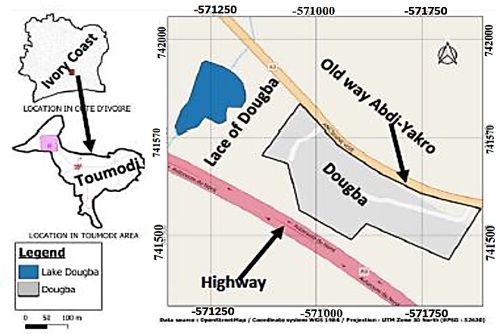
This study was initiated to better understand the varying physical and chemical parameters of the water in order to ensure its effective treatment. With rainfall ranging from 11.6 to 24.4 mm in 2018 and from 54 to 114 mm in 2023, the Yamoussoukro district receives ample rainfall. Average physical parameters such as temperature and pH are less affected by the dry and rainy seasons. In contrast to these two physical values, turbidity is very high during the dry season, with a maximum value of (7.83 ± 0.40) NTU, which accounts for the reddish color of the water. As for chemical parameters specifically COD and nitrate, the highest concentrations were observed during the rainiest months: 82.18 ± 0.19 mg/L and 103.23 ± 1.05 mg/L for COD and nitrate, respectively. Lake water with conductivity outside the (200–1,000) range specified by the WHO during the dry season has a higher bacterial load during the rainy season. Overall, the filter becomes saturated more quickly during the dry season than during the rainy season, resulting in a volume of 18 m³ and 22 m³ during the dry and rainy seasons, respectively.
Downloads
Copyright (c) 2026 Horo Sébastien Kone, Ahbeauriet Ahmed Ouattara, Irié Appolinaire Gouré Bi, Benjamin Kouassi Yao

This work is licensed under a Creative Commons Attribution-NonCommercial-NoDerivatives 4.0 International License.
Authors who publish with this journal agree to the following terms:
- Copyright on any article is retained by the author(s).
- The author grants the journal, the right of first publication with the work simultaneously licensed under a Creative Commons Attribution License that allows others to share the work with an acknowledgment of the work’s authorship and initial publication in this journal.
- Authors are able to enter into separate, additional contractual arrangements for the non-exclusive distribution of the journal’s published version of the work (e.g., post it to an institutional repository or publish it in a book), with an acknowledgment of its initial publication in this journal.
- Authors are permitted and encouraged to post their work online (e.g., in institutional repositories or on their website) prior to and during the submission process, as it can lead to productive exchanges, as well as earlier and greater citation of published work.
- The article and any associated published material is distributed under the Creative Commons Attribution-NonCommercial-NoDerivatives 4.0 International License.



_copy1.png)