Preparation and characterization of a lignocellulosic biosorbent from cocoa pod husks (Theobroma cacao L.): optimization by Response Surface Methodology
Abstract
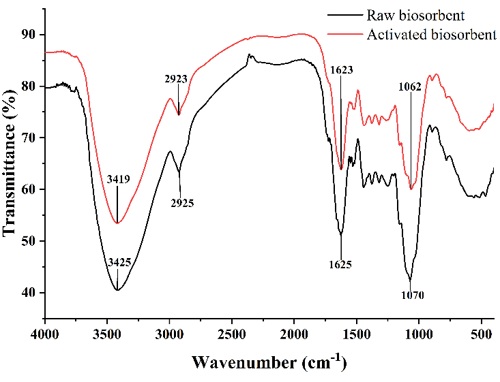
The valorization of lignocellulosic agro-industrial waste into low-cost adsorbents offers a promising route for treating colored textile effluents. The biosorbent was prepared from cocoa pod husks, an abundant residue in Côte d'Ivoire, through drying, grinding, sieving, and mild alkaline activation without carbonization. The preparation conditions were optimized using design of experiments, with methylene blue removal efficiency as the response—the Plackett-Burman screening of six factors identified particle size and activation temperature as the significant parameters. A central composite design applied to NaOH concentration and activation time yielded a significant quadratic model ( ; F = 26.73; p < 0.001), whose optimum (NaOH 0.96 mol L⁻1, 5 h) predicted a removal efficiency of 96.74%, experimentally confirmed at 92.71% on average, corresponding to an adsorption capacity of about 23.2 mg g⁻1. Physicochemical characterization (water retention, loss on ignition, FTIR, BET, SEM) confirmed the material's lignocellulosic nature, the persistence of oxygenated surface groups, and a fibrous, lamellar morphology after activation. These results show that alkali-activated cocoa pod husks constitute an effective, economical, and environmentally friendly biosorbent.
Downloads
Copyright (c) 2026 Gilles Sehontinhin Gouledehi, David Léonce Kouadio, Kacou Alain Paterne Dalogo, Yapo Hermann Aristide Yapi, Brou Dibi

This work is licensed under a Creative Commons Attribution-NonCommercial-NoDerivatives 4.0 International License.
Authors who publish with this journal agree to the following terms:
- Copyright on any article is retained by the author(s).
- The author grants the journal, the right of first publication with the work simultaneously licensed under a Creative Commons Attribution License that allows others to share the work with an acknowledgment of the work’s authorship and initial publication in this journal.
- Authors are able to enter into separate, additional contractual arrangements for the non-exclusive distribution of the journal’s published version of the work (e.g., post it to an institutional repository or publish it in a book), with an acknowledgment of its initial publication in this journal.
- Authors are permitted and encouraged to post their work online (e.g., in institutional repositories or on their website) prior to and during the submission process, as it can lead to productive exchanges, as well as earlier and greater citation of published work.
- The article and any associated published material is distributed under the Creative Commons Attribution-NonCommercial-NoDerivatives 4.0 International License.




_copy1.png)