Synthesis and Characterization of Citrate-Associated Calcium Materials from Blood Clam (Anadara granosa) Shells
Abstract
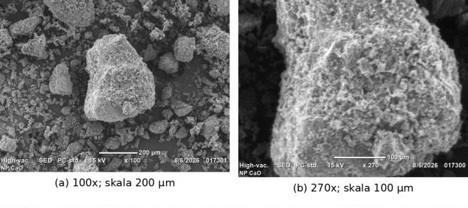
Blood clam shell waste is a source of biogenic calcium with the potential to be developed into calcium-based materials. This study synthesized nanocalcium using citrate as a coating agent from blood clam shells and evaluated its functional groups, morphology, and particle size distribution. The shells were cleaned, dried at 150 °C for 1 hour, ground, calcined at 1000 °C for 5 hours, hydrated, reacted with citric acid monohydrate at a 1:2 molar ratio via magnetic stirring and ultrasonication at 40 kHz for 30 minutes, aged for 24 hours, and then freeze-dried. FTIR analysis of calcium oxide (CaO) showed O–H bands at 3643.53–3383.14 cm⁻¹ and Ca–O vibrations at 553.57 and 397.34 cm⁻¹. After citrate treatment, C–H bands at 2918.30 and 2854.65 cm⁻¹ as well as carbonyl/carboxylate bands at 1743.65, 1707.00, 1587.42, 1431.18, and 1392.61 cm⁻¹ indicate the presence of citrate and its coordination with Ca2+. SEM revealed irregular micrometer-scale agglomerates and a rough surface. PSA yielded an average size of 56.08 nm, a peak at 53.25 nm, D10/D50/D90 values of 39.29/53.38/72.75 nm, and a polydispersity index of 0.059.
Downloads
Copyright (c) 2026 Azmalaeni Rifkah Ansyarif, Andriani Usman, Andi Nuraeni, Nur Zyalsabilah As Shahrah

This work is licensed under a Creative Commons Attribution-NonCommercial-NoDerivatives 4.0 International License.
Authors who publish with this journal agree to the following terms:
- Copyright on any article is retained by the author(s).
- The author grants the journal, the right of first publication with the work simultaneously licensed under a Creative Commons Attribution License that allows others to share the work with an acknowledgment of the work’s authorship and initial publication in this journal.
- Authors are able to enter into separate, additional contractual arrangements for the non-exclusive distribution of the journal’s published version of the work (e.g., post it to an institutional repository or publish it in a book), with an acknowledgment of its initial publication in this journal.
- Authors are permitted and encouraged to post their work online (e.g., in institutional repositories or on their website) prior to and during the submission process, as it can lead to productive exchanges, as well as earlier and greater citation of published work.
- The article and any associated published material is distributed under the Creative Commons Attribution-NonCommercial-NoDerivatives 4.0 International License.



_copy1.png)