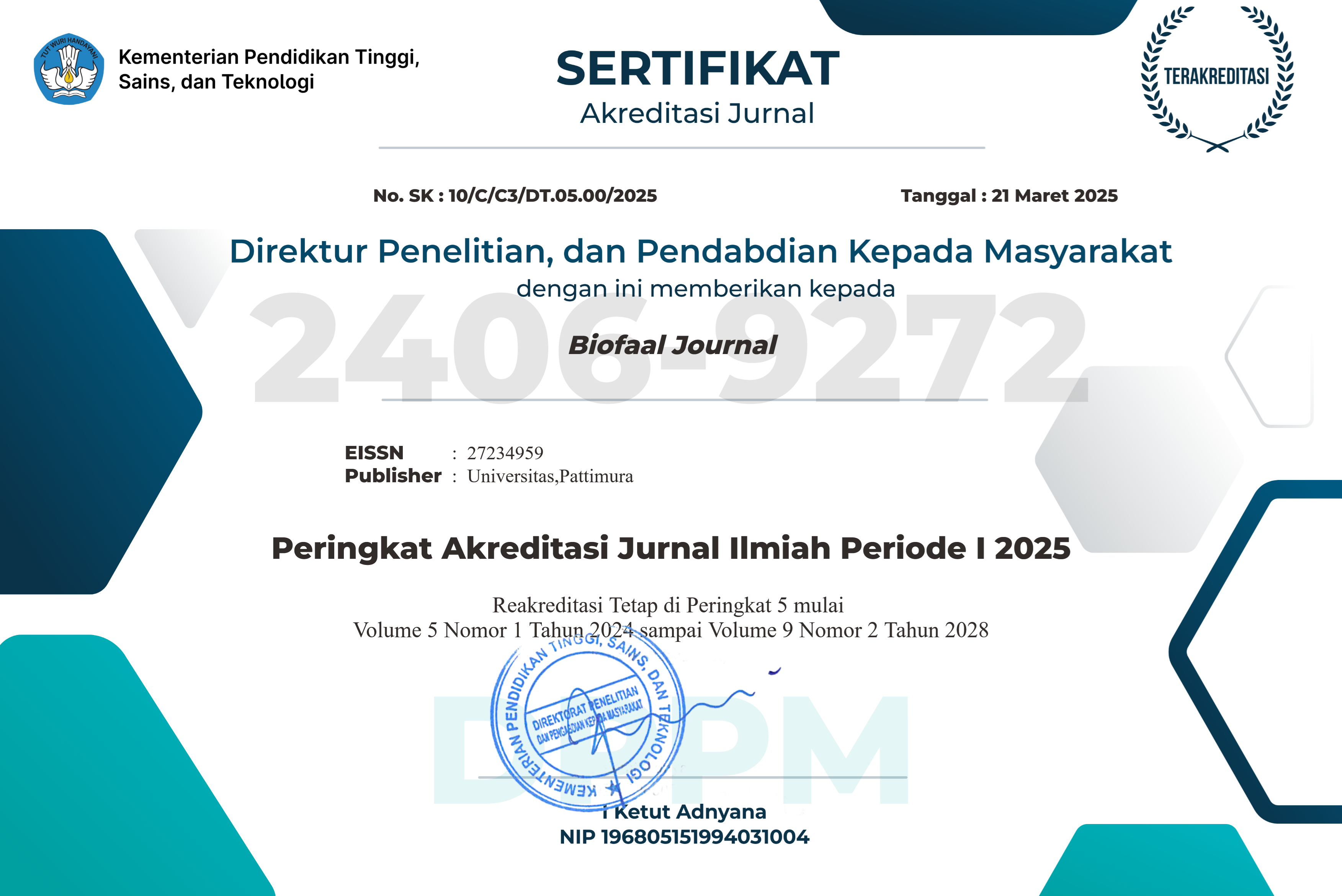
Effect of Effects of Local Ingredient Based Diets on Productivity and Feed Efficiency in Laying Hens
Abstract
Abstract
This study aimed to evaluate the efficiency of commercial feed compared with non-concentrate formulated feed on the productivity of laying hens. The experiment was conducted at PT Sitinrola Organik, Bone Regency, for 14 days using 64 laying hens divided into two treatments: P0 (control/commercial feed) and P1 (non-concentrate feed), with 32 replications each. The observed parameters included feed intake, body weight gain, and egg production percentage. The results showed that feed intake in the P1 treatment was significantly lower than in P0 (p < 0.05). However, body weight gain did not differ significantly between treatments (p > 0.05), although a slight increase was observed in P1. In contrast, the egg production percentage in P1 decreased significantly compared with P0 (p < 0.05). The reduction in feed intake and egg production in P1 was likely influenced by the low quality and palatability of the feed due to the absence of concentrate as well as feed storage factors. In conclusion, non-concentrate feed was not able to fully replace commercial feed in supporting the optimal productivity of laying hens in the short term
Downloads
Copyright (c) 2026 Mita Arifa Hakim, A. Muh Fuad Al-Kautsar, Ichlasul Amal, Muhammad Faried Fajri, Rini Anggereini, Muh Sidni Ilman, M. Zahran Putra Risyada

This work is licensed under a Creative Commons Attribution-NonCommercial-ShareAlike 4.0 International License.
1. Author retain copyright and grant the journal right of first publication with the work simultaneously licensed under a creative commons attribution license that allow others to share the work within an acknowledgement of the work’s authorship and initial publication of this journal.
2. Authors are able to enter into separate, additional contractual arrangementfor the non-exclusive distribution of the journal’s published version of the work (e.g. acknowledgement of its initial publication in this journal).
3. Authors are permitted and encouraged to post their work online(e.g. in institutional repositories or on their websites) prior to and during the submission process, as it can lead to productive exchanges, as well as earlier and greater citation of published works.