KELAYAKAN MEDIA POP-UP BOOK SUB MATERI STRUKTUR DAN FUNGSI JARINGAN TUMBUHAN KELAS VIII IPA MTSN 2 PONTIANAK
Abstract
Background: The learning process of sub-material of structure and function of plant tissue was conducted by discussion with the aid of two-dimensional media in small sizes. Laboratory work activities cannot be carried out in school while students are required to understand various tissues in plant organs. Thus, a media is needed that can attract students' attention, motivation and make it easier for students to distinguish plant tissue. This study aimed to develop pop-up book media equipped with pictures and learning materials.
Methods: Research and Development (R&D) was used to develop pop-up book media. The development steps were (1) potential and problems, (2) data collection, (3) product design, and (4) validation. The techniques used in media development were pull-tabs, transformation, and tunnel books. The instrument used was questionnaire with a Likert scale rating. Data analysis used the calculation of Content Validity Index (CVI) using the Lawshe’s method.
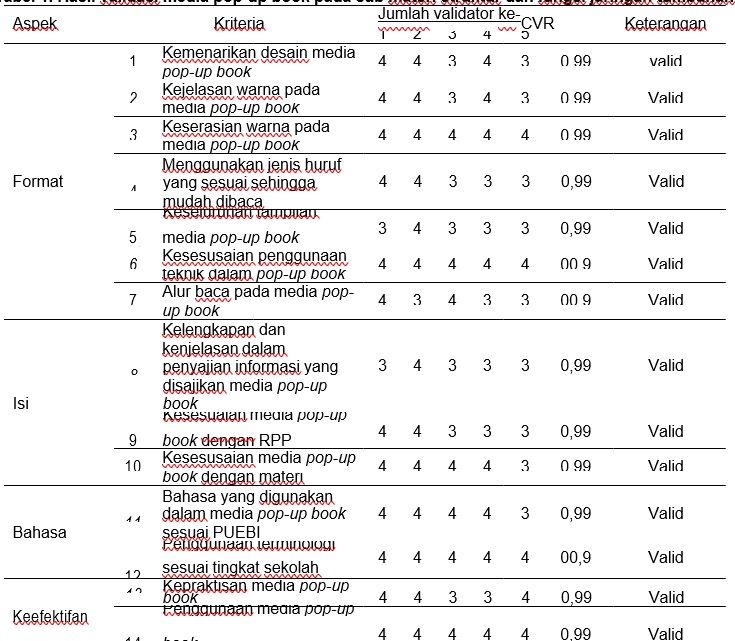
Results: Pop-up book media on the structure and function of plant tissue sub-materials were developed using pull-tabs, transformation, and tunnel books techniques based on four stages in R&D. The results of the CVI calculation obtained 0.99.
Conclusion: The pop-up book media which was developed using the techniques of pull-tabs, transformation, and tunnel books obtained a CVI of 0.99 with five validators. Based on this CVI, the media was feasible to use for learning process.
Downloads
Authors who publish with this Journal agree to the following terms:
- Author retain copyright and grant the journal right of first publication with the work simultaneously licensed under a creative commons attribution license that allow others to share the work within an acknowledgement of the work’s authorship and initial publication of this journal.
- Authors are able to enter into separate, additional contractual arrangement for the non-exclusive distribution of the journal’s published version of the work (e.g. acknowledgement of its initial publication in this journal).
- Authors are permitted and encouraged to post their work online (e.g. in institutional repositories or on their websites) prior to and during the submission process, as it can lead to productive exchanges, as well as earlier and greater citation of published works


 2
2