| Submit Your Article |
![]() |
| Download Article Template |
![]() |
| About the PAKEM |
| Focus and Scope |
| Peer Reviewers |
| Editorial Team |
| Author Guideline |
| Publication Ethics |
| Peer Review Process |
| Open Access Statement |
| Copyrigth Notice |
| License Term |
| AI Tools Usage Policy |
| Plagiarism Policy |
| Archiving |
| Indexed By |
![]() |
![]() |
![]() |
|
| Tools |
![]() |
![]() |
| Visit Statistics |
| Barcode |
|
|
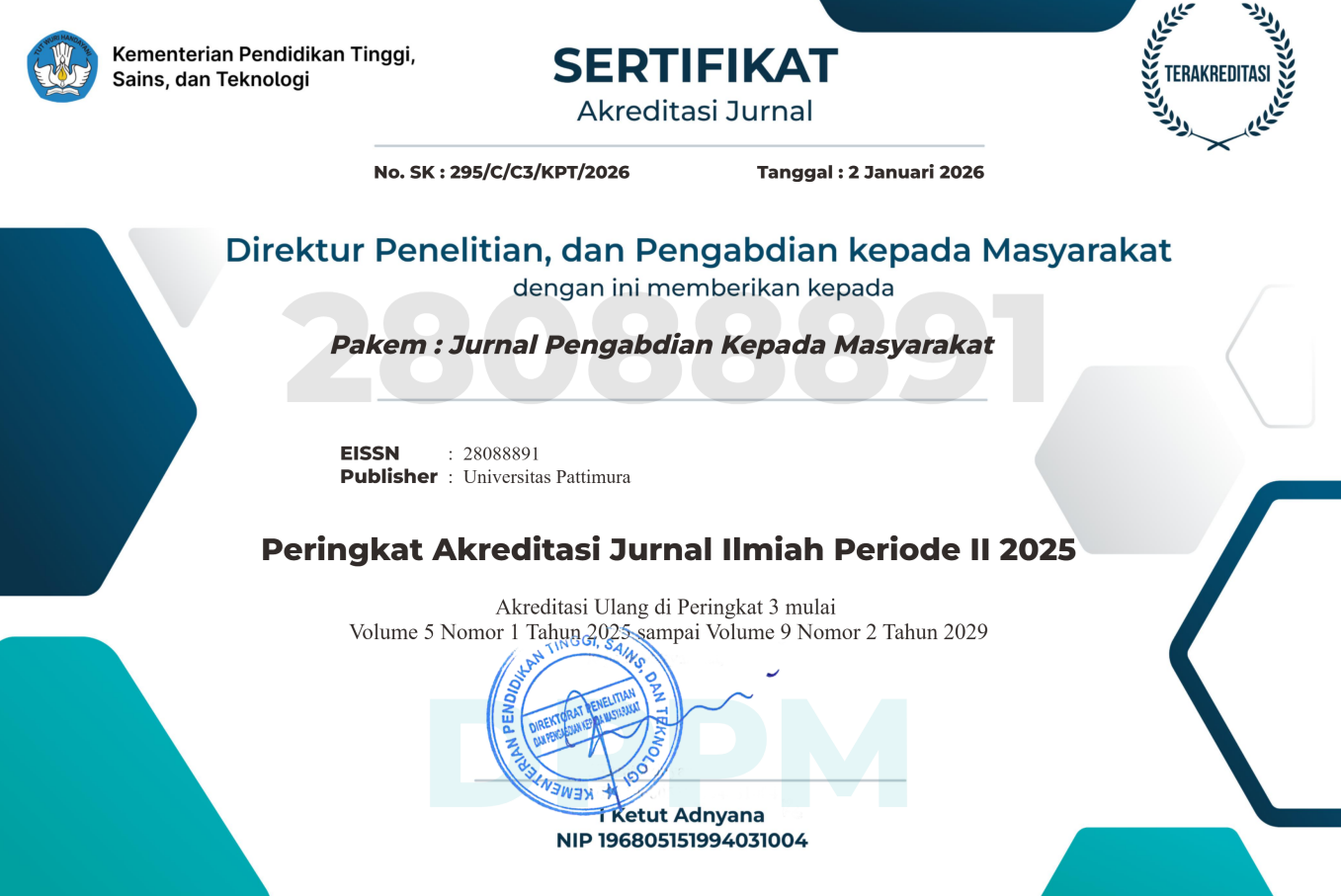
| Certificate SINTA |
![]() |
AI Tools Usage Policy
1. Introduction
PAKEM: Jurnal Pengabdian Kepada Masyarakat acknowledges the growing influence of Artificial Intelligence (AI) in academic research and publishing, including in the field of community engagement and service. In the context of community service, AI tools can offer benefits such as assisting in proposal development, improving language clarity, analyzing qualitative or quantitative data from activities, and designing dissemination and educational materials. However, their use must be governed by strict ethical principles to preserve academic integrity, originality, transparency, and authorial accountability.
This policy provides clear guidelines for the ethical and responsible use of AI tools in manuscript preparation for PAKEM. It is designed to prevent misuse, align with the standards of reputable indexing bodies, and adhere to the Core Practices and guidelines of the Committee on Publication Ethics (COPE).
2. Definition of AI Tools
For this policy, AI tools are defined as digital systems, platforms, or software that utilize artificial intelligence techniques—including machine learning (ML), natural language processing (NLP), and generative AI—to create, analyze, summarize, translate, or modify content within an academic writing context.
Examples relevant to community service include, but are not limited to:
-
Generative AI and Large Language Models (LLMs): ChatGPT, Gemini, Claude, etc.
-
Writing Assistance Tools: Grammarly, Quillbot, DeepL Write.
-
AI-Powered Data Analysis Tools: Tools that automate statistical analysis, generate code (e.g., for R, Python, SPSS), or identify patterns in qualitative data (e.g., analysis of interview themes).
-
AI for Visualization and Design: Software that generates graphs, program flowcharts, or infographic materials for dissemination.
-
AI-Based Literature Search and Citation Tools.
3. Acceptable Use of AI Tools
Authors may use AI tools for specific tasks, provided the following conditions are met:
a. Permissible Uses
-
Correcting grammar, spelling, and punctuation.
-
Improving the clarity, flow, and tone of academic writing.
-
Formatting references and citations.
-
Conducting initial literature searches and keyword identification.
-
Generating initial code snippets for statistical analysis or data visualization from community service activities, which must be thoroughly checked and validated by the authors.
-
Creating basic diagrams, graphs, or program data visualizations, provided they are original and do not infringe on copyright.
-
Assisting in structuring reports or formulating data-based recommendation points.
b. Restricted Uses
AI tools must NOT be used to:
-
Generate the entire manuscript or substantial portions of original scholarly content (such as conceptual frameworks, in-depth analysis of program impact, synthesis of participant evaluation, or discussion of implications) without critical human intellectual input and oversight.
-
Fabricate or synthetically generate research/community service data (such as survey data, interview/focus group discussion transcripts, or activity outcome reports).
-
Automatically paraphrase or summarize existing literature in a way that constitutes plagiarism.
-
Translate texts without subsequent human verification for accuracy, especially for technical or local-context terms.
-
Create content that infringes upon copyright or intellectual property rights.
4. Responsibilities of Authors
Authors retain full and sole responsibility for the entire content of their submitted manuscript, including any part developed or modified using AI tools. Authors must:
-
Verify the accuracy, originality, and validity of all AI-assisted content, including data analysis, interpretations, and conclusions related to community service activities.
-
Ensure the absence of plagiarism, factual errors, conceptual misunderstandings, or AI "hallucinations" (confidently stated but incorrect information).
-
Critically review, edit, and validate all outputs from AI tools to ensure they meet the scholarly and ethical standards of community service reporting.
-
Accept full accountability for any ethical breaches or errors resulting from the use of AI tools.
5. Authorship and AI
AI tools and language models cannot be listed as authors or co-authors. Authorship is strictly reserved for individuals who have made substantial intellectual contributions to the research conception, design, execution, data interpretation, and manuscript drafting. Crediting an AI tool in the authorship section, author notes, or contribution statement is prohibited and will result in immediate desk rejection.
6. Disclosure Requirements
Authors must provide a transparent declaration if AI tools were used in the preparation of their manuscript beyond basic grammar and spelling checks (e.g., for data analysis, code generation, or content assistance). The disclosure must include:
-
The name, version, and provider of the AI tool used.
-
A clear description of the specific purpose and extent of its use.
-
A statement confirming that the authors have critically reviewed and validated all AI-generated outputs.
7. Location of Disclosure in Manuscripts
The disclosure must be placed in the manuscript as follows:
-
Methods Section: If the AI tool was used for data analysis, coding, or generating research instruments.
-
Acknowledgments Section: If the tool was used primarily for language polishing, translation, or reference formatting.
-
Dedicated Statement Section: Authors are strongly encouraged to include a separate section titled "Statement on AI Tool Usage" using wording similar to:
"During the preparation of this work, the author(s) used [Tool Name, Version, Provider] in order to [Purpose, e.g., 'analyze qualitative feedback data', 'improve language and readability']. After using this tool/service, the author(s) reviewed and edited the content as necessary and take(s) full responsibility for the content of the publication."
8. Editorial and Peer Review Oversight
Editors and peer reviewers will assess the AI disclosure as part of the manuscript's ethical and methodological evaluation. If undisclosed or inappropriate AI use is suspected, the editorial office may:
-
Request clarification or a revised disclosure from the authors.
-
Reject the manuscript.
-
Initiate a formal investigation, potentially involving the authors' institution, in cases of suspected misconduct.
PAKEM will not rely exclusively on AI-detection software; all assessments will involve human expert judgment.
9. Consequences of Non-Compliance
Failure to adhere to this policy may lead to:
-
Immediate rejection of the manuscript.
-
Retraction of a published article.
-
Notification of the authors' institution or funding bodies.
-
A ban on future submissions from the author(s) for severe or repeated violations.
10. Appeals and Dispute Resolution
Authors who disagree with an editorial decision related to AI usage may submit a formal, written appeal to the Editor-in-Chief. The appeal must clearly state the grounds for the dispute, provide supporting evidence, and reference this policy. Appeals will be reviewed by the journal's ethics committee.
11. Use of AI by the Editorial Team
PAKEM's editorial team does not use fully autonomous AI tools to make editorial decisions on manuscripts. Any use of AI for administrative tasks, such as initial plagiarism checks or identifying potential reviewers, will be disclosed transparently and will always be subject to final human oversight and decision-making by the editors.
12. Policy Updates and Author Guidance
This policy will be reviewed regularly to keep pace with technological advancements and evolving ethical standards in academic publishing. Authors are responsible for consulting the latest version of this policy before submission and should contact the editorial office with any questions regarding compliant AI use.
PAKEM supports the responsible use of technology to advance the reporting and impact of community service while upholding the highest standards of academic integrity.
13. Ethical Framework and References
This policy is informed by the ethical guidelines of:
-
Committee on Publication Ethics (COPE): Core Practices, Discussion Document on AI in Decision Making, and Guidelines on Authorship and Contributorship.
-
Scopus Content Policy guidelines on publication ethics.
Adherence to these standards is a mandatory condition for submission to PAKEM: Jurnal Pengabdian Kepada Masyarakat.
1.png)