ANALISIS KETERLIBATAN PENULIS BERDASARKAN JENIS KELAMIN DALAM PUBLIKASI JURNAL BAREKENG
KAJIAN DATA SEBAGAI BENTUK PENGABDIAN PROFESI DI BIDANG PENGELOLAAN JURNAL ILMIAH
Abstract
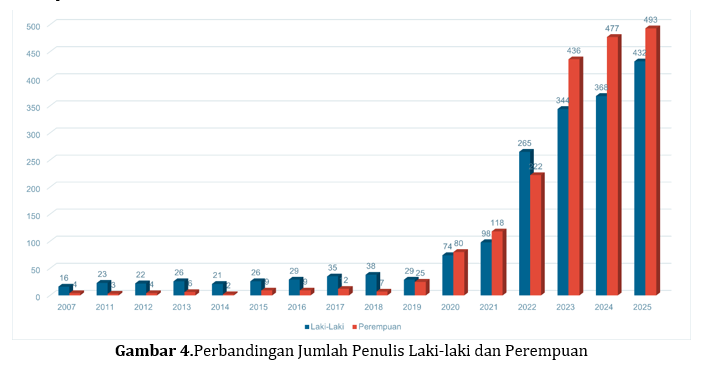
Professional scientific journal management requires transparent, inclusive, and data-driven governance practices, including in terms of author involvement based on gender. This article aims to analyze the involvement of male and female authors in Berekeng journal publications as part of the reflection and contribution of the scientific journal management profession. The method used is quantitative descriptive analysis that analyzes the dynamics of gender participation in scientific publications during the 2007–2025 period. The results of the study show that the 2007–2018 period was significantly dominated by male authors (peaking at 84.44% in 2018). However, there was a rapid transition towards balance in 2019–2021, where female participation began to prevail (54.63% in 2021). This pattern continued in the 2023–2025 period, showing a new significant dominance by female authors (peaking at 56.45% in 2024). Overall, the total number of female authors (50.81%) slightly exceeded that of male authors (49.19%). This dramatic shift implies a fundamental change in the academic community. Specifically in the context of Mathematics, this trend is predicted to encourage diversification of research topics into Applied Mathematics and Data Science, strengthen interdisciplinary collaboration, and create a more inclusive research environment. This study concludes that gender equality efforts have fundamentally changing the landscape of publishing. These activities are expected to strengthen the capacity of journal managers in implementing data-driven management while promoting fair and sustainable scientific publishing practices as a tangible manifestation of professional dedication in the field of scientific journal management.
Downloads
References
Arifin, Z., Setiawan, A., & Prasetyo, B. (2019). Penguatan tata kelola jurnal ilmiah sebagai bagian dari pengabdian kepada masyarakat di perguruan tinggi. Jurnal Pengabdian Kepada Masyarakat, 4(2), 85–94.
Ceci, S. J., Williams, W. M., & Barnett, S. M. (2009). Women’s underrepresentation in science: Sociocultural and biological considerations. Psychological Bulletin, 135(2), 218–261. https://doi.org/10.1037/a0014412
Eccles, J. S. (2007). Where are all the women? Gender differences in participation in physical science and engineering. Dalam Where are the women in science? (Vol. 51, hlm. 47–56).
Elsevier. (2020). The researcher journey through a gender lens. Elsevier.
Gasparyan, A. Y., Nurmashev, B., Yessirkepov, M., Endovitskiy, D. A., Voronov, A. A., & Kitas, G. D. (2015). Researcher and author profiles: Opportunities, advantages, and limitations. Journal of Korean Medical Science, 30(11), 1513–1520. https://doi.org/10.3346/jkms.2015.30.11.1513
Hewlett, S. A., Sherbin, L., & Alsop, R. (2019). How diversity can drive innovation. Harvard Business Review, 87(12), 30–31.
Hidayat, D., Nugroho, Y., & Sari, M. P. (2020). Penguatan kapasitas pengelolaan jurnal ilmiah nasional berbasis Open Journal Systems. Jurnal Abdimas, 24(1), 1–8.
Holman, L., Stuart-Fox, D., & Hauser, C. E. (2018). The gender gap in science: How long until women are equally represented? PLOS Biology, 16(4). https://doi.org/10.1371/journal.pbio.2004956
Kemendikbud, L. (2020). Panduan pelaksanaan Kuliah Kerja Nyata (KKN) Tematik dan Profesi. Kementerian Pendidikan dan Kebudayaan.
Larivière, V., Ni, C., Gingras, Y., Cronin, B., & Sugimoto, C. R. (2013). Bibliometrics: Global gender disparities in science. Nature, 504(7479), 211–213. https://doi.org/10.1038/504211a
Shen, H., Webster, J., Shoda, Y., & Fine, I. (2018). Persistent underrepresentation of women in computer science. Communications of the ACM, 61(10), 56–63. https://doi.org/10.1145/3234460
Subekti, R., Hidayat, T., & Lestari, S. (2021). KKN profesi sebagai model pengabdian berbasis kompetensi mahasiswa. Jurnal Pengabdian Masyarakat, 6(2), 101–110.
Sugimoto, C. R., & Science, T. S. C. for G. E. in. (2022). The global gender gap in science: Findings of the Gender Gap in Science Project. Routledge.
Suryanto, T., & Nugroho, A. (2019). Etika dan profesionalisme dalam pengelolaan jurnal ilmiah nasional. Jurnal Ilmu Informasi dan Perpustakaan, 3(1), 45–54.
UNESCO. (2017). Cracking the code: Girls’ and women’s education in science, technology, engineering and mathematics (STEM). UNESCO Publishing.
Van Emmerik, I. J. H., & Euwema, M. C. (2006). Gender differences in networking and career success: A systematic review and meta-analysis. Journal of Management, 32(6), 795–818. https://doi.org/10.1177/0149206306295211
Ware, M., & Mabe, M. (2015). The STM report: An overview of scientific and scholarly journal publishing (4 ed.). International Association of Scientific, Technical and Medical Publishers.
Weller, A. C. (2001). Editorial peer review: Its strengths and weaknesses. Information Today.
West, J. D., Jacquet, J., King, M. M., Correll, S. J., & Bergstrom, C. T. (2013). The role of peer review in the unequal representation of women in science. eLife, 2, e00799. https://doi.org/10.7554/eLife.00799
Xie, Y., & Shauman, K. A. (2003). Women in science: Career processes and outcomes. Harvard University Press.
Copyright (c) 2026 PAKEM : Jurnal Pengabdian Kepada Masyarakat

This work is licensed under a Creative Commons Attribution-NonCommercial-ShareAlike 4.0 International License.
Authors who publish with PAKEM: Jurnal Pengabdian Kepada Masyarakat agree to the following terms:
- Authors grant copyright to the journal and right of first publication with the work simultaneously licensed under a Creative Commons Attribution License (CC BY-NC-SA 4.0)
- Authors are able to enter into separate, additional contractual arrangements for the non-exclusive distribution of the journal's published version of the work (e.g., post it to an institutional repository or publish it in a book), with an acknowledgment of its initial publication in this journal.
- Authors are permitted and encouraged to post their work online (e.g., in institutional repositories or on their website) prior to and during the submission process, as it can lead to productive exchanges, as well as earlier and greater citation of published work.
1.png)