IMPLEMENTASI RUMPON RAMAH LINGKUNGAN (BIODEGRADABLE FAD) SEBAGAI SOLUSI EKOLOGIS PADA PERIKANAN TUNA
Abstract
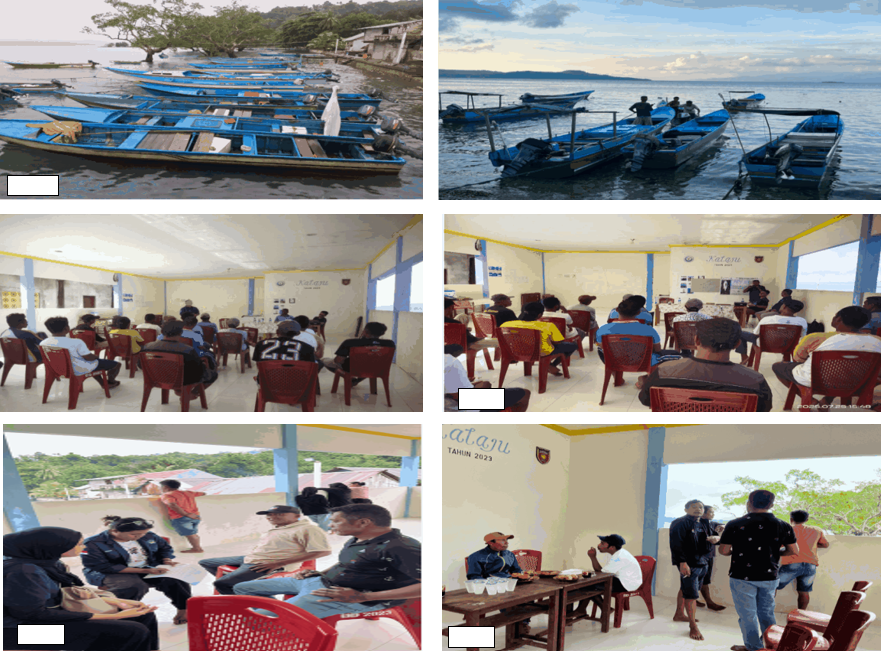
Tanjung Air Panas Hamlet, Tulehu Village, is one of the traditional tuna fisheries centers using hand line fishing gear located on the eastern coast of Ambon Island. In fishing practices, local fishers utilize conventional fish aggregating devices (FADs), which are mostly made of synthetic materials such as plastic and nylon nets. The use of these materials has the potential to contribute to marine pollution and is less supportive of sustainable marine ecosystem management. This community service activity aimed to introduce and implement environmentally friendly fish aggregating devices (biodegradable FADs) made from locally available natural materials such as bamboo, coconut leaves, and rattan. The implementation methods included socialization, training on FAD construction, technical assistance, and evaluation using a Likert-scale questionnaire to assess fishers’ level of understanding, technical skills, and attitudes toward the introduced technology. The activity involved two groups of tuna hand line fishers with a total of 25 participants who took part in the entire program. The evaluation results showed that the average scores of the indicators ranged from 4.1 to 4.8 (good to very good category). Fishers’ understanding of the concept of environmentally friendly FADs obtained an average score of 4.6, technical skills in assembling and installing FADs ranged from 4.2 to 4.3, and fishers’ willingness to shift from synthetic-material FADs to natural-material FADs obtained a score of 4.7. These results indicate a positive response from fishers toward the implementation of environmentally friendly FADs, particularly in terms of knowledge, technical skills, and ecological commitment. The application of biodegradable FADs has the potential to serve as an environmentally friendly fishing technology alternative and support sustainable tuna fisheries management in Tulehu waters.
Downloads
References
Chambers, R. (1994). Participatory rural appraisal (PRA): Analysis of experience. World Development, 22(9), 1253–1268. https://doi.org/10.1016/0305-750X(94)90003-5
Dagorn, L., Holland, K. N., Restrepo, V., & Moreno, G. (2013). Is it good or bad to fish with FADs? What are the real impacts of the use of drifting FADs on pelagic marine ecosystems? Fish and Fisheries, 14(3), 391–415. https://doi.org/10.1111/j.1467-2979.2012.00478.x
FAO. (2018). The state of world fisheries and aquaculture 2018: Meeting the sustainable development goals. Food and Agriculture Organization of the United Nations. http://www.fao.org/3/i9540en/I9540EN.pdf
Haruna., Agustinus Tupamahu., Ruslan H.S. Tawari., S.R. Siahainenia., Ari Trisnadhi., Muhammad Ikhsan Wamnebo. (2022). Eksplorasi Penangkapan Ikan dengan Pancing Ulur Tuna Madidihang Skala Kecil Exploration of Small-Scale Yellowfin Tuna Handline Fishing. Jurnal Airaha, 11(02).
Hilborn, R., Amoroso, R. O., Anderson, C. M., Baum, J. K., Branch, T. A., Costello, C., de Moor, C. L., Faraj, A., Hively, D., Jensen, O. P., Kurota, H., Little, L. R., Mace, P. M., McClanahan, T., Melnychuk, M. C., Minto, C., Osio, G. C., Parma, A. M., Pons, M., & Ye, Y. (2020). Effective fisheries management instrumental in improving fish stock status. Proceedings of the National Academy of Sciences, 117(4), 2218–2224. https://doi.org/10.1073/pnas.1909726116
International Seafood Sustainability Foundation (ISSF). (2019). ISSF guide for non-entangling and biodegradable FADs. International Seafood Sustainability Foundation. https://www.iss-foundation.org
International Seafood Sustainability Foundation (ISSF). (2019). ISSF guide for non-entangling and biodegradable FADs. ISSF. https://www.iss-foundation.org
James Abrahamsz., Yoisye Lopulalan., Simon Tubalawony., Dionisius Bawole., Haruna., Frederik W. Ayal., Marvin M. Makailipessy. (2024). Kajian Penempatan dan Alokasi Rumpon di WPPNRI-714 dan WPPNRI-715 Provinsi Maluku. Tim Kajian Fakultas Perikanan dan Ilmu Kelautan Universitas Pattimura.
Kementerian Kelautan dan Perikanan. (2014). Peraturan Menteri KP No. 26 Tahun 2014 tentang Rumpon.
Moreno, G., Murua, J., Kebe, P., Scott, J., & Restrepo, V. (2018). Design workshop on the use of biodegradable fish aggregating devices in Ghanaian purse seine and pole and line tuna fleets. ISSF Technical Report 2018-07.
Murua, H., Zudaire, I., Tolotti, M., Murua, J., Capello, M., Basurko, O. C., ... & Santiago, J. (2023). Lessons learnt from the first large-scale biodegradable FAD research experiment to mitigate drifting FADs impacts on the ecosystem. Marine Policy, 148, 105394.
Phillips, J. S., Escalle, L., Murua, H., Lopez, J., & Moreno, G. (2025). A short-lived FAD in the Pacific: Implications and adaptations in the move to biodegradable fish aggregating devices. Marine Pollution Bulletin, 218, 118130.
Pomeroy, R. S., & Andrew, N. L. (2011). Small-scale fisheries management: Frameworks and approaches for the developing world. CABI. https://doi.org/10.1079/9781845936075.0000
Tahapary, J., Pi, S., Mishbach, I., Kel, S., Amir, M. I., Pi, S., ... & Noor, S. M. (2025). Eksplorasi Dan Teknik Penangkapan Ikan: Teori dan Praktik di Laut Indonesia. LSO Creative.
Yasim, A., Sidartawan, R., Widityo, P. G., & Kusnadi, R. F. (2021). Penggunaan Fish Finder sebagai Upaya Peningkatan Hasil Tangkapan Nelayan Tradisional di Desa Puger Wetan Kabupaten Jember. Wave: Jurnal Ilmiah Teknologi Maritim, 15(2), 53-60.
Copyright (c) 2026 PAKEM: Jurnal Pengabdian Kepada Masyarakat

This work is licensed under a Creative Commons Attribution-NonCommercial-ShareAlike 4.0 International License.
Authors who publish with PAKEM: Jurnal Pengabdian Kepada Masyarakat agree to the following terms:
- Authors grant copyright to the journal and right of first publication with the work simultaneously licensed under a Creative Commons Attribution License (CC BY-NC-SA 4.0)
- Authors are able to enter into separate, additional contractual arrangements for the non-exclusive distribution of the journal's published version of the work (e.g., post it to an institutional repository or publish it in a book), with an acknowledgment of its initial publication in this journal.
- Authors are permitted and encouraged to post their work online (e.g., in institutional repositories or on their website) prior to and during the submission process, as it can lead to productive exchanges, as well as earlier and greater citation of published work.
1.png)