RAWAT DAN JAGA TUBUH PRIBADI
EVALUASI EDUKASI KESEHATAN REPRODUKSI REMAJA PEREMPUAN
Abstract
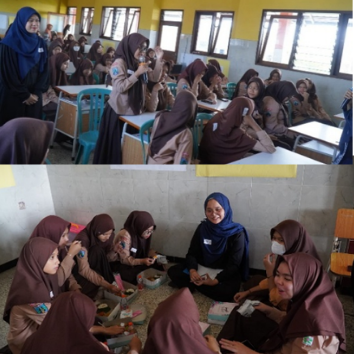
Reproductive health is an important part of adolescent development, particularly for girls who experience biological, emotional, and social changes simultaneously. This activity aimed to evaluate changes in reproductive health knowledge following case-based education and to explore participants’ experiences and responses to puberty and reproductive health topics. The activity was conducted at SMP Putri Al Irsyad Al Islamiyah, Malang City, involving 64 female students from grades VII–IX aged 12–16 years (Mage = 14.17 years; SDage = 0.98). A mixed-methods approach was used, combining quantitative evaluation through a one-group pretest–posttest design with qualitative exploration through focus group discussions (FGD), reflection, and debriefing. Because the data were not normally distributed (Shapiro–Wilk, W = 0.844; p < 0.001), differences in scores were analyzed using the Wilcoxon Signed-Rank test. The analysis showed a significant increase from pretest (M = 83.75; SD = 17.77) to posttest (M = 92.50; SD = 12.08), z = −3.586, p < 0.001, with a rank-biserial correlation of −0.738, indicating a large effect. Thematic analysis identified three main themes: (1) understanding primary reproductive characteristics, (2) awareness of secondary characteristics and emotional changes, and (3) reproductive hygiene practices. The findings indicate that case-based education was associated with increased reproductive health knowledge. Qualitative findings further indicated increased understanding of bodily changes, reproductive hygiene practices, and openness in discussing puberty-related experiences. The implication of these findings is that reproductive health education can serve as an input for integration into the school curriculum and the existing Guidance and Counseling services.
Downloads
References
Ajzen, I. (1991). The theory of planned behavior. Organizational Behavior and Human Decision Processes, 50(2), 179–211. https://doi.org/10.1016/0749-5978(91)90020-T
Ausubel, D. P. (1963). The Psychology of Meaningful Verbal Learning. Grune & Stratton.
BPS, BKKBN, & Kemenkes RI. (2018). Survei Demografi dan Kesehatan Indonesia 2017. Jakarta: BPS.
Byrne, D. (2022). A worked example of Braun and Clarke’s approach to reflexive thematic analysis. Quality and Quantity, 56(3), 1391–1412. https://doi.org/10.1007/s11135-021-01182-y
Corey, G. (2016). Theory & Practice of Counseling & Psychotherapy (10 edition). Cengage Learning.
Edmonson, A. C. (2018). The Fearless Organization: Creating Psychological Safety in the Workplace for Learning, Innovation, and Growth (1st ed.). Wiley.
Erikson, E. H. (1968). Identity Youth and Crisis. Norton & Company.
Ghimire, S., et al. (2024). Effects of health education intervention on menstrual hygiene knowledge and practices among the adolescent girls of Pokhara Metropolitan, Nepal. PLOS ONE, 19(10), 1-12. https://doi.org/10.1371/journal.pone.0291884
Grogan, S. (2021). Body Image Understanding Body Dissatisfaction in Men, Women and Children. Routledge.
Hanifah, F. A., Tampubolon, M. M., & Jumaini. (2024). Effectiveness of menstrual hygiene management education on knowledge of young women. JETISH: Journal of Education Technology Information Social Sciences and Health, 3(1), 355-364. https://doi.org/10.57235/jetish.v3i1.1741
Kim, E. J., Park, B., Kim, S. K., Park, M. J., Lee, J. Y., Jo, A. R., Kim, M. J., & Shin, H. N. (2023). A meta-analysis of the effects of comprehensive sexuality education programs on children and adolescents. Healthcare, 11(18), 1-17. https://doi.org/10.3390/healthcare11182511
Kolb, A. Y., & Kolb, D. A. (2017). Experiential learning theory as a guide for experiential educators in higher education. Experiential Learning & Teaching in Higher Education, 7(1), 7-44. https://nsuworks.nova.edu/elthe/vol1/iss1/7
Mayer, R. E. (2021). Multimedia Learning (3rd ed.). Cambridge University Press.
Muhlisa, Amiruddin, R., Moedjiono, A. I., Suriah, Damanik, R., Salmah, U., Nasir, S., Areni, I. S., & Mallongi, A. (2024). Application-based reproductive health education on reproductive health risk behavior among adolescents in ternate city. Pharmacognosy Journal, 16(4), 942–948. https://doi.org/10.5530/pj.2024.16.152
Piaget, J., & Inhalder, B. (1972). The Psychology of The Child. Basic Books.
Rodríguez-García, A., Botello-Hermosa, A., Borralo-Riego, A., & Guerra-Martin, M. D. (2025). Effectiveness of comprehensive sexuality education to reduce risk sexual behaviours among adolescents: A systematic review. Sexes, 6(1), 1-15. https://doi.org/10.3390/sexes6010006
Santrock, J. W. (2015). Adolescence. McGraw-Hill Education.
Steinberg, L. (2015). Age Of Opportunity: Lessons from the New Science of Adolescence. Harper Paperbacks.
Syamsuddin, S. D. (2023). Pengaruh edukasi kesehatan reproduksi terhadap pengetahuan pada remaja pubertas di SMPN 1 Pitu Tahun 2022. Jurnal Midwifery, 5(1), 27-33. https://doi.org/10.24252/jmw.v5i1.35187
Todesco, M., van Reeuwijk, M., Monaghan, E., Tolman, D. L., Fikawati, S., Kusumawardani, N., & Michielsen, K. (2023). Effect evaluation of a comprehensive sexuality education curriculum based on social emotional learning in Jakarta, Indonesia. Frontiers in Public Health, 11, 1-11. https://doi.org/10.3389/fpubh.2023.1254717
UNESCO. (2018). International technical guidance on sexuality education: An evidence-informed approach (revised edition). Paris: UNESCO. https://doi.org/10.54675/UQRM6395
UNFPA. (2014). UNFPA Operational Guidance for Comprehensive Sexuality Education: A Focus on Human Rights and Gender. New York: United Nations Population Fund
UNFPA. (2019). Sexual and Reproductive Health and Rights: An Essential Element of Universal Health Coverage. Nairobi: United Nations Population Fund
Utomo, I. D., & McDonald, P. (2009). Adolescent reproductive health in Indonesia: Contested values and policy inaction. Studies in Family Planning, 40(2), 133–146. https://doi.org/10.1111/j.1728-4465.2009.00196.x
Vaishali, R. N., Mahantshetti, G. J., Baliga, S. S., & Patil, A. J. (2024). Effect of health education on knowledge and attitudes toward reproductive health among pre-university girls in an urban area. Cureus, 16(12), 1-13. https://doi.org/10.7759/cureus.76354
Yusuf, N. N., Yanti, E. M., & Nafi, J. D. (2016). Effectiveness of digital reproductive health education interventions for adolescent girls: A literature review. Jurnal Kesehatan Tropis Indonesia, 4(1), 58-67. https://doi.org/10.63265/jkti.v4i1.186
Vygotsky, L. S., Cole, M., John-Steiner, V., Scribner, S., & Souberman, E. (1978). Mind in Society Development of Higher Psychological Processes. Harvard University Press.
Wilopo, S. A., Pinandari, A. W., Setyawan, A., Hadati, R. S., & Choiriyyah, I., Reeuwijk, M., Moreau, C., Li, M., Mmari, K., & Kagesten, A. (2023). SETARA Impact Evaluation Report: Global Early Adolescents Study Indonesia Wave 2-3. Yogyakarta: Pusat Kesehatan Reproduksi, Fakultas Kedokteran, Kesehatan Masayakat, Dan Keperawatan, Universitas Gadjah Mada.
Yuniarti, S., Yustanta, B. F., Kowaas, I. N., Nurrachmawati, A., & Rahmawati, S. (2024). The effect of health education programs on adolescents’ knowledge and attitudes regarding reproductive health. Journal of World Future Medicine, Health and Nursing, 2(2), 325–338. https://doi.org/10.70177/health.v2i2.820
Copyright (c) 2026 PAKEM: Jurnal Pengabdian Kepada Masyarakat

This work is licensed under a Creative Commons Attribution-NonCommercial-ShareAlike 4.0 International License.
Authors who publish with PAKEM: Jurnal Pengabdian Kepada Masyarakat agree to the following terms:
- Authors grant copyright to the journal and right of first publication with the work simultaneously licensed under a Creative Commons Attribution License (CC BY-NC-SA 4.0)
- Authors are able to enter into separate, additional contractual arrangements for the non-exclusive distribution of the journal's published version of the work (e.g., post it to an institutional repository or publish it in a book), with an acknowledgment of its initial publication in this journal.
- Authors are permitted and encouraged to post their work online (e.g., in institutional repositories or on their website) prior to and during the submission process, as it can lead to productive exchanges, as well as earlier and greater citation of published work.
1.png)