PEMBUATAN ECO-ENZIM UNTUK PUPUK PERTANIAN BERKELANJUTAN DI DESA PELABUHAN DALAM, OGAN ILIR
Abstract
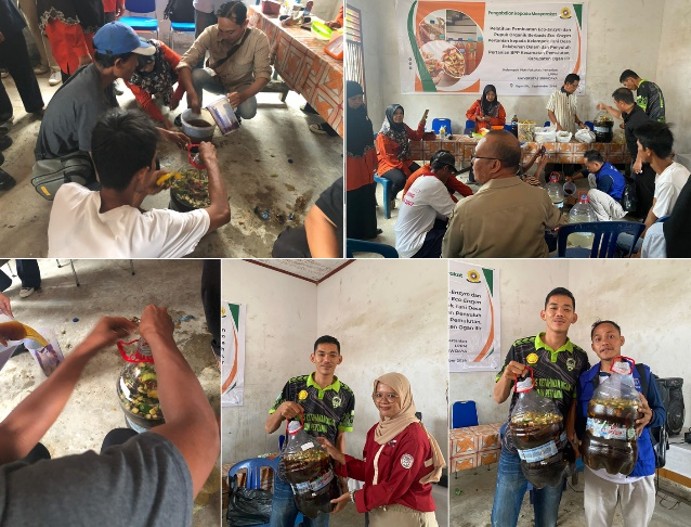
The price of chemical fertilizers is currently increasing and increasingly unaffordable for farmers, and their availability is increasingly scarce. Farmers really need fertilizer so that their plants can produce optimally, as an alternative substitution is organic fertilizer using eco-enzyme. Eco-enzyme liquid is the result of fermentation of a mixture of sugar (molasses), organic materials (fruit and vegetable waste), and water with a ratio of 1:3:10 for three months, in an airtight container. The target of this community service is farmers in Pelabuhan Dalam village, and Agricultural Extension Workers (AEW) in Pemulutan District, Ogan Ilir Regency. The purpose of this activity is to provide farmers and AEW with the ability to make eco-enzymes, improve farmers' ability to provide and obtain alternative fertilizers to substitute chemical fertilizers, and provide farmers with skills in applying eco-enzymes as fertilizers. The methods used are socialization with socialization, counseling, eco-enzyme making practices, eco-enzyme applications and mentoring. The results of the community service program have provided farmers and agricultural extension workers (PPL) with the knowledge and skills regarding eco-enzymes and their applications in agriculture. Following this program, 100% of the target audience is capable of making their own eco-enzymes and applying them directly as fertilizer. Furthermore, approximately 40% of the participants have independently produced eco-enzymes, while 60% prefer purchasing the finished product over making it themselves.
Downloads
References
Aboagye-Darko D, Mkhize P (2025). Unearthing the determinants of digital innovation adoption in the agricultural sector: The role of food security awareness and agricultural experience. Heliyon, 11 (1), e41695.
Benny, N., Shams, R., Dash, K. K., Pandey, V. K., & Bashir, O. (2023). Recent trends in utilization of citrus fruits in production of eco-enzyme. Journal of Agriculture and Food Research, 13, 100657.
Cahyantini, A., D. Setyawati. (2023). Pelatihan Pengolahan Sampah Organik Menjadi Eco-Enzym Bagi Ibu-Ibu PKK Kelurahan Karangbesuki Kecamatan Sukun Kota Malang. Jurnal Jompa Abdi, 2(2),78-84.
Fadlilla, T., M. T. S. Budiastuti, & R. Rosariastuti. (2023). Potensi Limbah Organik Sayuran Sebagai Pupuk Eco-Enzime Mendukung Pertumbuhan Dan Produksi Pakcoy (Brassica rapa L). Prosiding Seminar Nasional Sinergi Riset dan Inovasi, 1(1), 1-12.
Halim, Arma, M. J., Rembon, F., S & Basruddin (2025). Chemical Characteristics of Eco-enzymes as Liquid Organic Fertilizer from Vegetable Waste and Its Impact to Improve the Growth of Red Onion (Allium ascalonicum L.) on. International Journal of Agriculture and Biosciences, 14(4), 582-588.
Hariani, N., R. Kusuma, Samsurianto, F. Patang, L. Oktavianingsih & D. S. Rukmi. (2022). Pemberdayaan Masyarakat Suwandi, Samarinda Ulu: Sampah Organik Dapur Untuk Bumi Dengan Eco Enzym. Jurnal Pengabdian Masyarakat Global Abdimas, 2(1), 36-44.
Hermawan, W. & F. S. Madyasti. (2023). Pemanfaatan Limbah Buah dan Sayur Sebagai Ecoenzyme Alternatif Pestisida Sintetik di Desa Sukapura, Kecamatan Kertasari, Kabupaten Bandung. Dharmakarya: Jurnal Aplikasi Ipteks untuk Masyarakat, 12(1), 71-76.
Irawan, E. A. (2025). Skripsi. Strategi Menjadikan Pupuk Eco-Enzyme sebagai Subtitusi Pupuk Kimia untuk Budidaya Tanaman Padi Rawa Lebak di Kecamatan Pemulutan. Program Studi Teknik Pertanian Jurusan Teknologi Pertanian, Universitas Sriwijaya, Sumatera Selatan.
Junaidi, M. R., M. Zaini, Ramadhan, M. Hasan, B. Y. Z. B. Ranti, M. W. Firmansyah, S. Umayasari, A. Sulistyo, R. D. Aprilia, & F. Hardiansyah. (2021). Pembuatan Eco-Enzymesebagai Solusi Pengolahan Limbah Rumah Tangga. Jurnal Pembelajaran Pemberdayaan Masyarakat, 2(2), 118-123.
Kunda, R. M., Kakisina, P., Salamor, R., Manuhutu, F., & Lakoan, M. R. (2025). Penerapan Teknologi Pembuatan Pupuk Cair Ramah Lingkungan Dari Limbah Kulit Pisang Dan Nanas Menggunakan Aktivator EM4. PAKEM: Jurnal Pengabdian Kepada Masyarakat, 5(2), 47-54.
Nguyen-Sy, T., Do, H. H., Tran, Y. A. T., Kieu, H. T., Diem, U. H. T., & Tran, N. S. (2023). Effect of rice straw and garbage enzyme addition on soil properties and plant growth of rice. SAINS TANAH-Journal of Soil Science and Agroclimatology, 20(1), 94-99.
Pakki, T., R. Adawiyah, A. Yuswana, N. Namriah, M. A. Dirgantoro & A. Slamet. (2021). Pemanfaatan Eco-Enzime Berbahan Dasar Sisa Bahan Organik Rumah Tangga Dalam Budidaya Tanaman Sayuran Di Pekarangan. Prosiding Pepadu, 3, 126-134.
Pasalari, H., Moosavi, A., Kermani, M., Sharifi, R., & Farzadkia, M. (2024). A systematic review on garbage enzymes and their applications in environmental processes. Ecotoxicology and Environmental Safety, 277, 116369.
Ramli, I. & Y. P. Jap. (2021). Eco-Enzyme Pemberdayaan Kelompok Petani Desa Ciranjang Cianjur Tahun 2021. Jurnal Bakti Masyarakat Indonesia, 4(2), 389-397.
Saifuddin1, R. Syahyadi, Nahar, S. Bahri. (2021). Peningkatan Kualitas Utilization Of Domestic Waste For Bar Soap And Enzym Cleanner (Ecoenzym) Sebagai Bahan Baku Pembuatan Sabun. Jurnal Vokasi, 5(1), 45-56.
Sari, A. S., Nurlita, F., Bharata, W., Arsyad, A. W., & Hijrah, L. (2024). Pengolahan Limbah Organik Untuk Pembuatan Pupuk Kompos di Desa Kersik Kecamatan Marangkayu. Jurnal Pengabdian Masyarakat Polmanbabel, 4(01), 87-95.
Soverda, N., E. I. Swari & Meliyati. (2023). Pengaruh Komposisi Media Tanam Yang Diberi Eco Enzim Terhadap Pertumbuhan dan Hasil Tanaman Bawang Merah (Allium ascalonicum L.). Jurnal Media Pertanian, 8(1), 86-91
Wahyuni, I., Muliatiningsih, M., Suhairin, S., Karyanik, K., Muanah, M., & Huda, A. A. (2023). Sosialisasi pengolahan sampah organik limbah rumah tangga menjadi eco-enzym. JMM (Jurnal Masyarakat Mandiri), 7(1), 906-914.
Yusuf, M. (2023). Pemetaan Potensi Ekonomi Desa Di Desa Pelabuhan Dalam Kecamatan Pemulutan Kabupaten Ogan Ilir. Jurnal Pengabdian Community, 5(1), 1-13.
Copyright (c) 2026 PAKEM: Jurnal Pengabdian Kepada Masyarakat

This work is licensed under a Creative Commons Attribution-NonCommercial-ShareAlike 4.0 International License.
Authors who publish with PAKEM: Jurnal Pengabdian Kepada Masyarakat agree to the following terms:
- Authors grant copyright to the journal and right of first publication with the work simultaneously licensed under a Creative Commons Attribution License (CC BY-NC-SA 4.0)
- Authors are able to enter into separate, additional contractual arrangements for the non-exclusive distribution of the journal's published version of the work (e.g., post it to an institutional repository or publish it in a book), with an acknowledgment of its initial publication in this journal.
- Authors are permitted and encouraged to post their work online (e.g., in institutional repositories or on their website) prior to and during the submission process, as it can lead to productive exchanges, as well as earlier and greater citation of published work.
1.png)