IMPLEMENTASI TEKNOLOGI KONSERVASI TANAH DAN AGROFORESTRI UNTUK PEMULIHAN FUNGSI HIDROLOGIS DAS POSO
Abstract
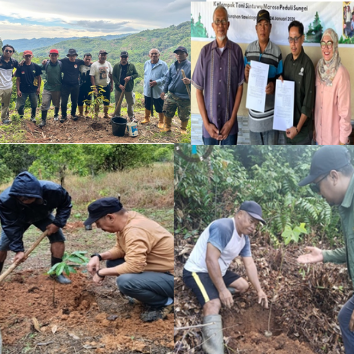
The Poso Watershed faces threats of land degradation and erosion due to steep slopes ranging from 37.24% to 39.41% and the compaction of Red-Yellow Podzolic soils, which reduces infiltration rates and increases erosion risk on steep terrain. This condition is further aggravated by the limited technical capacity of farmers in implementing land conservation practices. This community service activity aimed to restore the hydrological functions of the Poso Watershed through the participatory transfer of soil conservation and agroforestry technologies. Using an Action Research approach, the program involved 40 farmers from the Sintuwu Maroso Farmer Group and the Sintuwu Wawolembo Farmer Group. The results demonstrated measurable improvements in farmers’ capacity: 70% of participants consistently applied conservation techniques, the use of chemical fertilizers was reduced by up to 80% through the adoption of independently produced compost, pest incidence decreased by 70% through the application of botanical pesticides, and weed competition around crop bases was reduced by up to 60% through ring weeding. These quantitative improvements demonstrate that a learning-by-doing mentoring approach successfully transformed farmers from passive participants into independent actors in maintaining the ecohydrological functions of the Poso Watershed. Furthermore, the program effectively integrated soil conservation technologies with farmers’ economic self-reliance while fostering a strong sense of ownership toward the preservation of the watershed’s hydrological functions and the long-term sustainability of its ecosystem.
Downloads
References
Asdak, C. (2023). Hidrologi dan Pengelolaan Daerah Aliran Sungai. Yogyakarta: Gadjah Mada University Press.
Astar, I., Rahayu, S., & Suyanto, A. (2025). Rehabilitasi Tanah Aluvial Terdegradasi dengan Pupuk Kandang Kambing dan POC Tahu untuk Meningkatkan Produktivitas Okra. Rawa Sains: Jurnal Sains STIPER Amuntai, 10-19.
Babaremu, K., Taiwo, O., & Ajayi, D. (2024). Impacts of land use and land cover changes on hydrological response. TWIST, 19(1), 256-267.
Cui, W., Li, X., Duan, W., Xie, M., & Dong, X. (2023). Heavy metal stabilization remediation in polluted soils with stabilizing materials: a review. Environmental geochemistry and health, 45(7), 4127-4163.
Ewunetu, T., Selassie, Y. G., Molla, E., Admase, H., & Gezahegn, A. (2025). Soil properties under different land uses and slope gradients: Implications for sustainable land management in the Tach Karnuary watershed, Northwestern Ethiopia. Frontiers in Environmental Science, 13, 1518068.
Granata, F., & Di Nunno, F. (2026). Pathways for hydrological resilience: strategies for adaptation in a changing climate. Earth Systems and Environment, 10(1), 203-231.
Ha, L. T., Bastiaanssen, W. G., Simons, G. W., & Poortinga, A. (2023). A new framework of 17 hydrological ecosystem services (HESS17) for supporting river basin planning and environmental monitoring. Sustainability, 15(7), 6182.
Irwan, M., Rosdiana, R., Hasibuan, J., & Syahputa, D. D. (2023). Model pemberdayaan masyarakat berbasis kemandirian pangan untuk pengentasan kemiskinan di Kampung Matfa. Jurnal Pemberdayaan Masyarakat, 11(2), 118-129.
Khalis, I. M., Swahip, S., Hidayat, A. R., & Fibriyanti, B. V. (2025). Kajian Daya Dukung Tata Air sebagai Upaya Perencanaan Pengelolaan Daerah Aliran Sungai (DAS) yang Berkelanjutan (Studi Kasus pada DAS Dodokan, NTB, Indonesia). Agregat, 10(1), 1302-1312.
Kunda, R. M., Kakisina, P., Salamor, R., Manuhutu, F., & Lakoan, M. R. (2025). Penerapan Teknologi Pembuatan Pupuk Cair Ramah Lingkungan Dari Limbah Kulit Pisang Dan Nanas Menggunakan Aktivator EM4. PAKEM: Jurnal Pengabdian Kepada Masyarakat, 5(2), 47-54.
Liu, Y., Zhu, L., & Chen, C. (2025). The mechanisms and optimization strategies of tillage practices affecting soil pore structure. Geographical Research Bulletin, 4, 507-529.
Mangela, D., Muis, H., Rahman, A., Naharuddin, N., Massiri, S. D., Maiwa, A., ... & Istiqamah, N. (2024). Analisis Spasial Tingkat Kekritisan Lahan di Sub Das Wimbi, Kelurahan Sawidago Kecamatan Pamona Utara, Kabupaten Poso. Savana Cendana, 9(1), 1-5.
Maryuni, S., Pardi, P., Jumadi, J., Apriyani, E., Putri, N. D., & Resti, F. (2026). Pendampingan Berbasis Participatory Action Research dalam Penguatan Implementasi Program Adiwiyata di Sekolah Dasar dan Menengah Kabupaten Kubu Raya, Kalimantan Barat. Jurnal Abdi Masyarakat Indonesia, 6(1), 357-364.
Moazeni, S., Salajegheh, A., Khalighi-Sigaroodi, S., Golkarian, A., & Cerda, A. (2025). Impacts of Watershed Restoration on Runoff, Evapotranspiration, and Ecosystem Service Valuation in a Semi-Arid Region. Ecosystems, 28(6), 1-22.
Mudin, M. I., Ouannes, M. H., & Saputri, N. (2025). Paradigma Dominasi Vis As Vis Harmoni Atas Alam: Studi Kritis Perspektif Teo-Ekologi Islam. Academic Journal of Islamic Principles and Philosophy, 6(1), 91-124.
Muhammetoglu, A., Akdegirmen, O., Dugan, S. T., & Orhan, P. (2025). A modeling framework for control of nonpoint source pollution and evaluation of best management practices for identification of critical source areas. Environmental Earth Sciences, 84(10), 257.
Naharuddin, N. (2018). Komposisi dan struktur vegetasi dalam potensinya sebagai parameter hidrologi dan erosi. Jurnal Hutan Tropis, 5(2), 134-142.
Naharuddin, N., Malik, A., & Ahyauddin, A. (2021). Soil loss estimation for conservation planning in the Dolago Watershed Central Sulawesi, Indonesia. Journal of Ecological Engineering, 22(7), 242-251.
Naharuddin, N., Rahmawati, R., Wahid, A., Massiri, S. D., & Toknok, B. (2024). Pemberdayaan Masyarakat dalam Usaha Konservasi Lahan Terdegradasi di Wilayah Penyangga Kawasan Konservasi. Jurnal Masyarakat Madani Indonesia, 3(1), 36-42.
Nurfitria, N., Sriwulan, S., & Nuruddin, A. W. (2025). Pendampingan Pengolahan Limbah Peternakan Sebagai Upaya Mewujudkan Pertanian Berkelanjutan di Desa Margosuko. PAKEM: Jurnal Pengabdian Kepada Masyarakat, 5(2), 164-171.
Pan, R., Martinez, A., Brito, T., & Seidel, E. (2018). Processes of soil infiltration and water retention and strategies to increase their capacity. Journal of Experimental Agriculture International, 20(2), 1-14.
Ramadhan, M. F. (2020). Pengaturan ideal tentang pengelolaan daerah aliran sungai di Indonesia (Studi di Sungai Serang Kabupaten Kulon Progo). Jurnal Hukum Ius Quia Iustum.
Soumena, W., & Susilowati, L. E. (2025). Efektivitas Rehabilitasi Daerah Aliran Sungai terhadap Pemulihan Hutan dan Daya Dukung Lahan di Kabupaten Lombok Barat. Jurnal Ilmiah Mahasiswa Agrokomplek, 4(3), 959-970.
Sudomo, A., Leksono, B., Tata, H. L., Rahayu, A. A. D., Umroni, A., & Rianawati, H. (2023). Asmaliyah; Krisnawati; Setyayudi, A.; Utomo, MMB; et al. Can Agroforestry Contribute to Food and Livelihood Security for Indonesia’s Smallholders in the Climate Change Era? Agriculture 2023, 13, 1896.
Tang, Y., Lian, J., Li, C., Cheng, X., Jia, Z., Liu, X., ... & Zhang, J. (2025). Vertically oriented roots affect soil water infiltration by decomposition and altering soil structure: An examination based on CT technology and innovation in soil infiltration research methods. Plant and Soil, 1-17.
Usharani, K. V., Roopashree, K. M., & Naik, D. (2019). Role of soil physical, chemical and biological properties for soil health improvement and sustainable agriculture. Journal of Pharmacognosy and Phytochemistry, 8(5), 1256-1267.
Copyright (c) 2026 PAKEM: Jurnal Pengabdian Kepada Masyarakat

This work is licensed under a Creative Commons Attribution-NonCommercial-ShareAlike 4.0 International License.
Authors who publish with PAKEM: Jurnal Pengabdian Kepada Masyarakat agree to the following terms:
- Authors grant copyright to the journal and right of first publication with the work simultaneously licensed under a Creative Commons Attribution License (CC BY-NC-SA 4.0)
- Authors are able to enter into separate, additional contractual arrangements for the non-exclusive distribution of the journal's published version of the work (e.g., post it to an institutional repository or publish it in a book), with an acknowledgment of its initial publication in this journal.
- Authors are permitted and encouraged to post their work online (e.g., in institutional repositories or on their website) prior to and during the submission process, as it can lead to productive exchanges, as well as earlier and greater citation of published work.
1.png)