PEMANFAATAN TEKNOLOGI CHROMEBOOK UNTUK MENINGKATKAN LITERASI DIGITAL DI SDI KHAZANAH KEBAJIKAN
Abstract
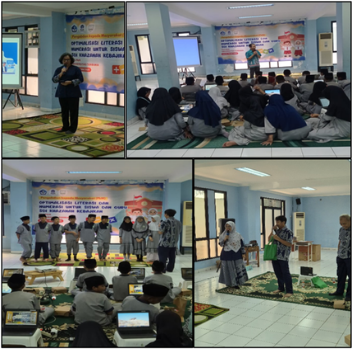
Digital literacy is a skill that encompasses the ability to use technology wisely, intelligently, and effectively, and is a crucial component of any learning environment. Digital literacy encompasses not only technological mastery but also the skills to find, evaluate, use, and create information wisely. In the context of education, digital literacy helps improve the quality of interaction and communication in the ever-expanding digital world. On the other hand, there are challenges in disseminating digital information, as well as the prevalence of negative content circulating in society. Therefore, deeper digital literacy skills are needed so that the public, especially students, can access technology safely and productively. As part of efforts to improve digital literacy, the Directorate of Junior High Schools, Kemendikbudristek, provides assistance with Information and Communication Technology devices to support school digitalization. However, several schools, including SDI Khazanah Kebajikan, have not yet received this assistance. Given the importance of technology use in the learning process and the implementation of the Computer-Based National Assessment (ANBK), the school often has to borrow devices from other schools. The Community Service (PkM) program, conducted by lecturers at Universitas Terbuka, aimed to provide Chromebook devices, along with training and guidance on their use, both during the learning process and during national assessments. The PkM program went well. Participants were enthusiastic and eager to gain knowledge and experience with Chromebook technology, a technology not widely known in schools. The PkM program also improved digital literacy skills and positively impacted the quality of education.
Downloads
References
Alifa, Z.A., Sufyadi, S., & Utama, A.H. (2024). Pemanfaatan Chromebook Sebagai Penunjang Pembelajaran Bagi Siswa Di SMPN 1 Banjarmasin. Edutech: Jurnal Teknologi Pendidikan, 23(2), 116–127. https://doi.org/10.17509/e.v23i2.69560
Dahiana, W. O., Anastasyia, N., & Mataheru, E. E. (2025). Upaya Meningkatkan Kompetensi Digital Guru Melalui Pelatihan Penggunaan Learning Management System Berbasis Edukati. PAKEM: Jurnal Pengabdian Kepada Masyarakat, 5(2), 182-191. https://doi.org/10.30598/pakem.5.2.182-191
Febrinita, F. (2022). Efektivitas Penggunaan Modul terhadap Hasil Belajar Matematika Komputasi pada Mahasiswa Teknik Informatika. De Fermat: Jurnal Pendidikan Matematika, 5(1), 1-9.
Kharis, S.A.A., Septiarini, T.W., Zili, A.H.A., Arisanty, M., dan Permatasari, S.M. (2025). Identifying The Drivers Of Digital Literacy In Indonesia’s Distance Learning Era. Pedagoria: Jurnal Kajian, Penelitian dan Pengembangan Kependidikan, 16(4), 466–473.
Kresnadi, H., Halidjah, S., Pranata, R., & Syahrudin, H. (2023). Pemanfaatan Chromebook Dalam Pembelajaran IPAS di Sekolah Dasar Negeri 18 Sungai Kakap. Jurnal Pendidikan Dasar Perkhasa: Jurnal Penelitian Pendidikan Dasar, 9(1), 1-15. https://doi.org/10.31932/jpdp.v9i1.2028
Nesya, J., Kresnadi, H., & Pranata, R. (2024). Pemanfaatan Fitur Chromebook Untuk Meningkatkan Keterampilan Membaca Pemahaman Siswa Kelas V Sekolah Dasar Negeri 18 Sungai Kakap. Innovative: Journal Of Social Science Research, 4(4), 10893–10901. https://doi.org/10.31004/innovative.v4i4.12342
Nurani, N., Dirgantoto, E.W., & Rakhman, A. (2025). Pemanfaatan Chromebook Sebagai Penunjang Pembelajaran Aktivitas Kebugaran Untuk Kesehatan. Jurnal Pedagogik Olahraga, 11(1), 59–66. https://doi.org/10.24114/jpor.v11i1.66032
Sari, G. I., Winasis, S., Pratiwi, I., & Nuryanto, U. W. (2024). Strengthening digital literacy in Indonesia: Collaboration, innovation, and sustainability education. Social Sciences & Humanities Open, 10, 101100.
Copyright (c) 2026 PAKEM: Jurnal Pengabdian Kepada Masyarakat

This work is licensed under a Creative Commons Attribution-NonCommercial-ShareAlike 4.0 International License.
Authors who publish with PAKEM: Jurnal Pengabdian Kepada Masyarakat agree to the following terms:
- Authors grant copyright to the journal and right of first publication with the work simultaneously licensed under a Creative Commons Attribution License (CC BY-NC-SA 4.0)
- Authors are able to enter into separate, additional contractual arrangements for the non-exclusive distribution of the journal's published version of the work (e.g., post it to an institutional repository or publish it in a book), with an acknowledgment of its initial publication in this journal.
- Authors are permitted and encouraged to post their work online (e.g., in institutional repositories or on their website) prior to and during the submission process, as it can lead to productive exchanges, as well as earlier and greater citation of published work.
1.png)