LEADING BY SERVING: SERVANT LEADERSHIP TRAINING FOR INTERGENERATIONAL YOUTH MINISTRY ACTIVISTS IN GKI GEJAYAN
Abstract
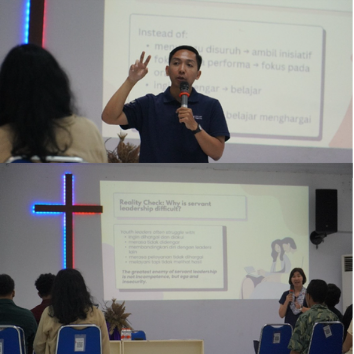
Leadership development in intergenerational youth ministry requires not only conceptual understanding but also opportunities to reflect on leadership motivation, communication, and conflict-management practices. This community service program aimed to strengthen participants' conceptual knowledge of servant leadership and support the application of servant-oriented leadership practices among members of the GKI Gejayan Youth Commission. Forty participants completed a four-phase program comprising program socialization and qualitative needs assessment, on-site training, online mentored practice, and evaluation. The training included two core sessions: Servant Leadership Training and an Assertive Communication and Conflict Resolution Workshop. The Leading by Serving module served as the primary instructional framework and emphasized five servant-leadership themes selected for their relevance to the identified ministry needs: empathy, humility, stewardship, commitment to others' growth, and moral and social responsibility. Evaluation was organized using Kirkpatrick's Four-Level Model. Pre- and post-training results showed a statistically significant increase in participants' conceptual knowledge of servant leadership from pre-test (M = 60.00, SD = 11.80) to post-test (M = 80.00, SD = 10.90), t(39) = 9.37, p < .001, with a large effect size (Cohen's dz = 1.48). Participant satisfaction was also high for both training content (M = 4.60/5) and facilitators (M = 4.70/5). Exploratory qualitative findings from participant reflections, facilitator observations, mentoring records, and partner feedback suggested greater awareness of leadership motivations, attempts to apply servant-oriented leadership practices, and more intentional use of assertive communication and constructive conflict-management strategies. Partner feedback additionally suggested favorable changes in selected aspects of team communication and intergenerational collaboration. Because behavioral and team-level outcomes were not assessed using standardized pre-post measures, these findings were interpreted descriptively. Overall, the program demonstrated significant gains in conceptual knowledge and preliminary evidence of behavioral application, supporting the feasibility of experiential servant-leadership training in an intergenerational church-ministry context.
Downloads
References
Arnett, J. J. (2015). Emerging adulthood: The winding road from the late teens through the twenties (2nd ed.). Oxford University Press.
Carter, N., Bryant-Lukosius, D., DiCenso, A., Blythe, J., & Neville, A. J. (2014). The use of triangulation in qualitative research. Oncology Nursing Forum, 41(5), 545–547. https://doi.org/10.1188/14.ONF.545-547
Dean, K. C., Clark, C., & Rahn, D. (2010). Starting right: Thinking theologically about youth ministry. Zondervan.
Elo, S., & Kyngäs, H. (2008). The qualitative content analysis process. Journal of Advanced Nursing, 62(1), 107–115. https://doi.org/10.1111/j.1365-2648.2007.04569.x
Eva, N., Robin, M., Sendjaya, S., van Dierendonck, D., & Liden, R. C. (2019). Servant leadership: A systematic review and call for future research. The Leadership Quarterly, 30(1), 111-132. https://doi.org/10.1016/j.leaqua.2018.07.004
Gollwitzer, P. M., & Sheeran, P. (2006). Implementation intentions and goal achievement: A meta-analysis of effects and processes. Advances in Experimental Social Psychology, 38, 69–119. https://doi.org/10.1016/S0065-2601(06)38002-1
Greenleaf, R. K. (1977). Servant leadership: A journey into the nature of legitimate power and greatness. Paulist Press.
Kimotho, S. (2019). Is servant leadership a 'Christian theory'? A critical examination of Greenleaf's servant leadership concept. International Journal of Research in Humanities and Social Studies, 6(3), 71-78.
Kirkpatrick, J. D., & Kirkpatrick, W. K. (2016). Kirkpatrick's four levels of training evaluation. Association for Talent Development.
Knowles, M. S. (1984). Andragogy in action: Applying modern principles of adult learning. Jossey-Bass.
Kolb, A. Y., & Kolb, D. A. (2006). Learning styles and learning spaces: A review of the multidisciplinary application of experiential learning theory in higher education. In Learning Styles and Learning (pp. 45-91).
Laub, J. A. (1999). Assessing the servant organization: Development of the servant organizational leadership assessment (SOLA) instrument. Florida Atlantic University.
Laudert, E. (2018). Generation Z: Utilizing adaptive and authentic leadership to promote intergenerational collaboration at work. UC San Diego.
Lewier, M., Supriyono, A. Y., & Triyana, E. (2025). OPTIMALISASI PERAN MAHASISWA PBSI DALAM PKM MELALUI SOSIALISASI DAN COACHING. PAKEM: Jurnal Pengabdian Kepada Masyarakat, 5(2), 97-108. https://doi.org/10.30598/pakem.5.2.97-108
Northouse, P. G. (2022). Leadership: Theory and practice (9th ed.). Sage Publications.
OECD. (2018). Education at a Glance 2018: OECD Indicators. OECD Publishing.
Owens, B. P., & Hekman, D. R. (2012). Modeling how to grow: An inductive examination of humble leader behaviors. Academy of Management Journal, 55(4), 787-818. https://doi.org/10.5465/amj.2010.0441
Schlesman, S. G. (2020). The passing zone: Building an intergenerational leadership team. Assemblies of God Theological Seminary.
Seemiller, C., & Grace, M. (2016). Generation Z goes to college. John Wiley & Sons.
Sendjaya, S., & Sarros, J. C. (2002). Servant leadership: Its origin, development, and application in organizations. Journal of Leadership & Organizational Studies, 9(2), 57–64. https://doi.org/10.1177/107179190200900205
Spears, L. C. (2010). Character and servant leadership: Ten characteristics of effective, caring leaders. The Journal of Virtues & Leadership, 1(1), 25-30.
Twenge, J. M. (2017). iGen: Why today's super-connected kids are growing up less rebellious, more tolerant, less happy. Atria Books.
Van Dierendonck, D. (2011). Servant leadership: A review and synthesis. Journal of Management, 37(4), 1228-1261. https://doi.org/10.1177/0149206310380462
Copyright (c) 2026 PAKEM: Jurnal Pengabdian Kepada Masyarakat

This work is licensed under a Creative Commons Attribution-NonCommercial-ShareAlike 4.0 International License.
Authors who publish with PAKEM: Jurnal Pengabdian Kepada Masyarakat agree to the following terms:
- Authors grant copyright to the journal and right of first publication with the work simultaneously licensed under a Creative Commons Attribution License (CC BY-NC-SA 4.0)
- Authors are able to enter into separate, additional contractual arrangements for the non-exclusive distribution of the journal's published version of the work (e.g., post it to an institutional repository or publish it in a book), with an acknowledgment of its initial publication in this journal.
- Authors are permitted and encouraged to post their work online (e.g., in institutional repositories or on their website) prior to and during the submission process, as it can lead to productive exchanges, as well as earlier and greater citation of published work.
1.png)