DIGITAL SAVVY KIDS: PENGUATAN KARAKTER DAN LITERASI DIGITAL SISWA MELALUI KOMIK DIGITAL
Abstract
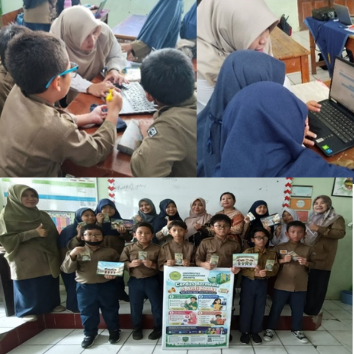
Digital transformation has increased technology use among elementary school students, yet it has not been accompanied by adequate digital literacy and character development. This condition highlights the need for innovative learning programs that integrate Artificial Intelligence (AI), digital literacy, and character education. This community service program aimed to implement the Digital Savvy Kids program to strengthen students' digital literacy and character through AI based digital comics integrated with Al Islam and Kemuhammadiyahan (AIK) values. The program was conducted at SD Muhammadiyah 47 Bekasi and involved 17 fourth grade students. The implementation consisted of needs analysis, digital comic development using Gemini AI, Edugems, NotebookLM, and Canva, learning implementation, and evaluation through pretests, posttests, product assessment, observations, interviews, and questionnaires. The results showed that all participants successfully produced digital comics with good to excellent quality. The average product assessment scores were 88.2 for content relevance, 86.5 for story creativity, 84.7 for AI application, and 89.1 for the integration of AIK values. In addition, students demonstrated improvements in digital literacy, creativity, participation, collaboration, responsibility, and digital ethics. The Digital Savvy Kids program has the potential to serve as an innovative learning model for strengthening digital literacy and character through the creative and responsible use of AI in elementary schools.
Downloads
References
Asosiasi Penyelenggara Jasa Internet Indonesia. (2026). Laporan survei profil internet Indonesia 2026. APJII. https://apjii.or.id/survei
Asosiasi Penyelenggara Jasa Internet Indonesia. (2025). Laporan survei profil internet Indonesia 2026. APJII. https://apjii.or.id/survei
Asosiasi Penyelenggara Jasa Internet Indonesia. (2024). Laporan survei penetrasi internet Indonesia 2024. https://apjii.or.id/survei
Aziz, A. M., Wardani, P. A., & Usman, H. (2024). Pengembangan media pembelajaran komik digital berbasis artificial intelligence di sekolah dasar. Pendas: Jurnal Ilmiah Pendidikan Dasar, 9(2), 4874–4888. https://doi.org/10.23969/jp.v9i2.14364
Dewi, N. M. H. M., Astawan, I. G., & Trisna, G. A. P. S. (2024). Komik digital berbasis tri hita karana untuk meningkatkan literasi sosial budaya siswa sekolah dasar. Edukatif: Jurnal Ilmu Pendidikan, 6(4), 3188-3198. https://doi.org/10.31004/edukatif.v6i4.7062
Fibiyanti, H., & Nuroh, E. Z. (2024). Pengaruh media komik digital terhadap kemampuan menulis cerita di sekolah dasar. JIIP - Jurnal Ilmiah Ilmu Pendidikan, 7(5), 4544-4550. https://doi.org/10.54371/jiip.v7i5.4350
Gilster, P. (1997). Digital literacy. Wiley Computer Publishing.
Hariyati, H., & Badariah, S. (2025). Penerapan kurikulum berbasis karakter melalui pemanfaatan teknologi digital: Tantangan dan strategi di era Society 5.0. Jurnal Pendidikan Dasar, 13(1), 1–13. https://doi.org/10.46368/jpd.v13i1.3483
Kristina, A. D., & Asih, S. S. (2023). Pengembangan komik digital berbasis pendidikan karakter sebagai media pembelajaran muatan IPS. Jurnal Kreatif: Jurnal Kependidikan Dasar, 14(2), 47–57.
Kurniawan, A., & Wulandari, T. (2024). Penguatan literasi digital dan berpikir kritis siswa SD melalui pembelajaran berbasis proyek interaktif. Jurnal Inovasi Pendidikan Dasar, 12(1), 55–69. https://doi.org/10.31227/osf.io/ijk567
Miranda, D., & Dafit, F. (2024). Pengembangan media komik digital untuk membaca pemahaman siswa kelas V SD. Jurnal Basicedu, 8(5), 3649–3657. https://doi.org/10.31004/basicedu.v8i5.8572
Mudopar, M., Rahayu, I., & Marwati, T. (2022). Desain komik digital berbasis nilai karakter sebagai media pembelajaran teks eksplanasi siswa sekolah dasar. Caruban: Jurnal Ilmiah Ilmu Pendidikan Dasar, 5(1). https://doi.org/10.33603/caruban.v5i1.6478
Nggolaon, D., & Supu, E. (2025). Pendidikan karakter melalui media digital: Tantangan dan peluang di era Generasi Alpha. Damhil Education Journal, 5(1), 55–63. https://doi.org/10.37905/dej.v5i1.2864
Nurjanah, N., Subrata, H., & Sukartiningsih, W. (2023). Komik digital berbasis keberagaman budaya Indonesia sebagai media literasi siswa sekolah dasar. Deiksis: Jurnal Pendidikan Bahasa dan Sastra Indonesia, 5(2), 115-125. https://doi.org/10.33603/deiksis.v9i2.8230
Sari, R. P., Fitria, L., Nabilla, U., Fairus, F., Rangkuti, W., & Fazira, A. (2026). Empowering teachers with ai: Optimalisasi kecerdasan buatan untuk guru SMP Negeri 1 Aceh Tamiang. PAKEM: Jurnal Pengabdian Kepada Masyarakat, 6(1), 1-7. https://doi.org/10.30598/pakem.6.1.1-7
UNICEF. (2021). Children in a digital world: The state of the world's children 2021. https://www.unicef.org/reports/state-of-worlds-children-2021
Copyright (c) 2026 PAKEM: Jurnal Pengabdian Kepada Masyarakat

This work is licensed under a Creative Commons Attribution-NonCommercial-ShareAlike 4.0 International License.
Authors who publish with PAKEM: Jurnal Pengabdian Kepada Masyarakat agree to the following terms:
- Authors grant copyright to the journal and right of first publication with the work simultaneously licensed under a Creative Commons Attribution License (CC BY-NC-SA 4.0)
- Authors are able to enter into separate, additional contractual arrangements for the non-exclusive distribution of the journal's published version of the work (e.g., post it to an institutional repository or publish it in a book), with an acknowledgment of its initial publication in this journal.
- Authors are permitted and encouraged to post their work online (e.g., in institutional repositories or on their website) prior to and during the submission process, as it can lead to productive exchanges, as well as earlier and greater citation of published work.
1.png)