CREATIVE INNOVATIONS TO IMPROVE SKILLS AND EMPOWERING DISABLED COMMUNITIES
Abstract
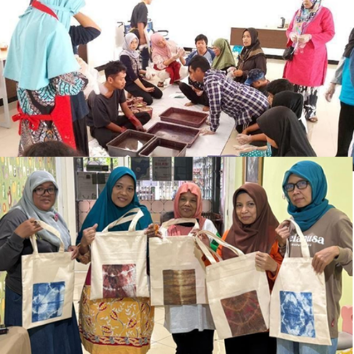
Individuals with disabilities, particularly those with mental limitations, face persistent barriers to employment and economic independence. Community-based training has emerged as a strategic approach to address these challenges. This program aimed to evaluate the effectiveness of an innovative, continuous community-based training program in improving skills, knowledge, psychosocial outcomes, and economic independence among individuals with disabilities. A community-based participatory approach was applied involving 30 participants from parents and children with disabilities from the ABeKa Mom’s Craft, Disabled Community in Malang, East Java, Indonesia. Participants received practical training in batik ciprat, shibori techniques, tote bag production, production of natural liquid soap and solid soap, basic entrepreneurship and marketing techniques. A three-month mentoring phase was conducted to ensure skill retention and production continuity. Program outcomes were assessed using both qualitative measures and quantitative analysis through a pre-test and post-test design. Differences in knowledge scores were analysed using a paired t-test. Participants demonstrated substantial improvement in technical and entrepreneurial skills, evidenced by the production of approximately 500 marketable tote bags. Psychosocial outcomes included increased self-confidence, motivation, and social participation by children with disabilities and their parents. Early economic impacts were observed through the establishment of a small-scale production group, participation in exhibitions, and collaboration with local creative industry stakeholders. The mean knowledge score increased significantly from 52.5 ± 18.9 (pre-test) to 97.5 ± 6.9 (post-test) (p < 0.001), with a very large effect size (Cohen’s d = 2.57).
Downloads
References
An, Z., Zhang, Q., Liu, Y., & Lv, J. (2026). Resource Bricolage for Inclusive Employment: A Case Study of Social Entrepreneurship to Support Parents of Individuals with Intellectual Disabilities. Behavioral Sciences, 16(2). https://doi.org/10.3390/bs16020274
Endawansa, A., & Setyonaluri, D. (2025). Workforce Inclusion through Training: Evidence from Indonesia’s Disabled Labor Force. Jurnal Minds: Manajemen Ide Dan Inspirasi, 12(1), 383–394. https://doi.org/10.24252/minds.v12i1.53556
Enticott, A., & Dew, A. (2025). A systematic review of the characteristics of programs and services resulting in competitive employment outcomes for young people with an intellectual disability. In Journal of Intellectual and Developmental Disability. Routledge. https://doi.org/10.3109/13668250.2025.2499674
Greenwood, M., Bechange, S., Emong, P., Lawrence, E., Kyosaba, W., Nsajja, D., Atugonza, I., Sunday, R., Pamella, D., Baguma, J., Abigaba, E., Ngendanabo, H., Kalibeela, S., Kyagondeze, M., Nyamahunge, E., Musika, A., Asiimwe, B., Kirungi, I., Kabanyoro, M., … Baker, E. (2023). Using a community-based participatory research (CBPR) approach to explore economic empowerment for youth with disabilities in rural Uganda. Social Sciences and Humanities Open, 8(1). https://doi.org/10.1016/j.ssaho.2023.100647
Heaton, L., Halliday, E., Wheeler, P., Ring, A., Kaloudis, H., & Popay, J. (2024). Strengthening community empowerment initiatives as a route to greater equity: an English case study. Community Development Journal. https://doi.org/10.1093/cdj/bsae046
Lindsay, S., Cagliostro, E., Leck, J., Shen, W., & Stinson, J. (2019). Disability disclosure and workplace accommodations among youth with disabilities. Disability and Rehabilitation, 41(16), 1914–1924. https://doi.org/10.1080/09638288.2018.1451926
Mudde, L., Reid, R. C., & Hole, R. (2026). The Importance of Building Soft Skills in Vocational Training for Youth with Intellectual and Developmental Disabilities: Evidence from the Impact Project. Journal of Vocational Rehabilitation, 64(1), 14–25. https://doi.org/10.1177/10522263251394318
Reed, G. M. (2024). What’s in a name? Mental disorders, mental health conditions and psychosocial disability. In World Psychiatry (Vol. 23, Number 2, pp. 209–210). John Wiley and Sons Inc. https://doi.org/10.1002/wps.21190
Reims, N., & Tisch, A. (2022). Employment effects for people with disabilities after participation in vocational training programmes: A cohort analysis using propensity score matching. Work, 72(2), 611–625. https://doi.org/10.3233/WOR-205046
Renko, M., Parker Harris, S., & Caldwell, K. (2016). Entrepreneurial entry by people with disabilities. International Small Business Journal: Researching Entrepreneurship, 34(5), 555–578. https://doi.org/10.1177/0266242615579112
Shakespeare, T., Bright, T., & Kuper, H. (2018).Access to health for people with disabilities. The Lancet.
Suarez-Balcazar, Y., Balcazar, F., Labbe, D., McDonald, K. E., Keys, C., Taylor-Ritzler, T., Anderson, S. M., & Agner, J. (2023). Disability rights and empowerment: Reflections on AJCP research and a call to action. In American Journal of Community Psychology (Vol. 72, Numbers 3–4, pp. 317–327). John Wiley and Sons Inc. https://doi.org/10.1002/ajcp.12710
Takasaki, Y (2024). Impacts of vocational training for persons with disabilities: Experimental evidence from Cambodia. Journal of Development Economics.Volume 169. ISSN 0304-3878. https://doi.org/10.1016/j.jdeveco.2024.103277
World Health Organization. (2024, March 8). Clinical descriptions and diagnostic requirements for ICD-11 mental, behavioural and neurodevelopmental disorders (CDDR). World Health Organization. https://www.who.int/publications/i/item/9789240077263?utm
World Health Organization. (2025, September 30). Mental disorders. World Health Organization. https://www.who.int/news-room/fact-sheets/detail/mental-disorders?utm
Copyright (c) 2026 PAKEM: Jurnal Pengabdian Kepada Masyarakat

This work is licensed under a Creative Commons Attribution-NonCommercial-ShareAlike 4.0 International License.
Authors who publish with PAKEM: Jurnal Pengabdian Kepada Masyarakat agree to the following terms:
- Authors grant copyright to the journal and right of first publication with the work simultaneously licensed under a Creative Commons Attribution License (CC BY-NC-SA 4.0)
- Authors are able to enter into separate, additional contractual arrangements for the non-exclusive distribution of the journal's published version of the work (e.g., post it to an institutional repository or publish it in a book), with an acknowledgment of its initial publication in this journal.
- Authors are permitted and encouraged to post their work online (e.g., in institutional repositories or on their website) prior to and during the submission process, as it can lead to productive exchanges, as well as earlier and greater citation of published work.
1.png)