HILIRISASI TEBU BERBASIS TEKNOLOGI TEPAT GUNA: MODEL PENCIPTAAN NILAI TAMBAH DAN PENGUATAN EKONOMI MASYARAKAT DESA DI SELOK ANYAR, LUMAJANG
Abstract
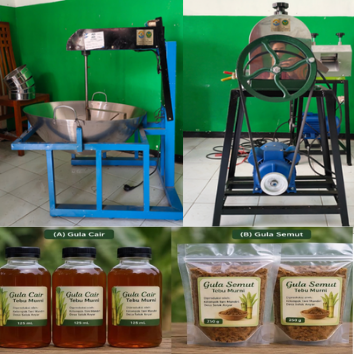
Sugarcane downstreaming has become an important strategy for increasing product value addition and strengthening rural economies. Selok Anyar Village, Lumajang Regency, possesses considerable sugarcane production potential; however, most of its harvest is still marketed as raw material, limiting the economic benefits received by local communities. This community service program aimed to strengthen the local economy through the implementation of Appropriate Technology (AT) integrated with community capacity building. The program adopted a participatory approach by providing three units of appropriate technology, consisting of a sugarcane crusher, a sugarcane juice evaporator, and a drying oven, complemented by training on palm sugar and liquid sugar production, marketing strategies, product branding and packaging, as well as technical assistance for equipment operation and maintenance involving the Mandiri Farmer Group and the Family Welfare Empowerment (PKK) organization of Selok Anyar Village. The implementation of appropriate technology improved the efficiency of sugarcane processing, enhanced participants' knowledge and technical skills in producing value-added products, and strengthened the community's capacity for business management and product marketing. Furthermore, the integration of technological innovation, capacity building, and institutional strengthening contributed to the development of a more sustainable sugarcane downstreaming system. These findings suggest that integrating appropriate technology with continuous mentoring provides an effective approach to strengthening community-based economic development founded on local resources.
Downloads
References
Badan Pusat Statistik. (2025). Statistik Tanaman Perkebunan Semusim Indonesia 2024: Tebu dan Tembakau. Jakarta: BPS.
Chambers, R. (1994). Participatory rural appraisal (PRA): Analysis of experience. World Development, 22(9), 1253–1268.
Faiz Muntazori, A., & Listya, A. (2021). Branding UMKM produk Kopi Bang Sahal melalui desain logo. SENADA: Semangat Nasional dalam Mengabdi, 1(3), 342–351.
Hake, R. R. (1998). Interactive-engagement versus traditional methods: A six-thousand-student survey of mechanics test data for introductory physics courses. American Journal of Physics, 66(1), 64–74.
Hindratmo, A., Riyanto, O. A. W., & Tajuddin, U. (2020). Penerapan teknologi tepat guna dan perbaikan manajemen produksi UMKM Krupuk Puli Sidoarjo. Prosiding Konferensi Nasional Pengabdian kepada Masyarakat dan Corporate Social Responsibility (PKM-CSR), 3, 129–135.
Imran, S., Indriani, R., & Bakari, Y. (2023). Perbandingan nilai tambah dan peluang pasar gula aren dan gula semut. Jurnal Agercolere, 5(1), 1–9.
Kurniawan, B. D., Nugroho, D. A., & Munifatussaidah, A. (2023). Peningkatan daya saing UMKM gula semut Dusun Tangkisan II melalui digital marketing. Jurnal Pengabdian Masyarakat Bumi Raflesia, 6(2), 213–220.
Kurniawan, H., Khalil, F. I., Septiyana, K. R., Adnand, M., Adriansyah, I., & Nurkayanti, H. (2021). Peningkatan kualitas gula semut melalui introduksi alat pengering bagi kelompok pengrajin gula aren di Desa Kekait Kabupaten Lombok Barat. Journal of Community Development & Empowerment, 1(2), 88–95.
Mustanir, A., Hamid, H., & Syarifuddin, R. N. (2019). Pemberdayaan kelompok masyarakat desa dalam perencanaan metode partisipatif. Jurnal Pemberdayaan Masyarakat, 5(1), 1–10.
Nimasari, E. P., Pasa, F. D. A., Wijaya, A., Muzaky, M. A. R., Devara, G. A., Nurfaisandi, M. R., Pratama, B. S. P., Pinastiko, C., Mahendra, D. F. A., Pratiwi, I. R., Anggraeni, K. N., Mursyidin, D. A., Septian, G. C., Purnomo, D., Anggraini, M., Noviati, M. A., & Apriliyani, D. (2025). Teknologi tepat guna dalam kegiatan sosial dan ekonomi di Desa Pudak Wetan: Sebuah program Kuliah Kerja Nyata Tematik. Jurnal SOLMA, 14(3), 4737–4747.
Pardi, I. W., Yudiana, I. K., & Miskawi, M. (2019). Pelatihan dan pendampingan pembuatan gula semut di Desa Patoman Kabupaten Banyuwangi. AKSIOLOGIYA: Jurnal Pengabdian kepada Masyarakat, 3(1), 84–92.
Prasetyono, D. W., Astuti, S. J. W., Supriyanto, S., & Syahrial, R. (2017). Pemberdayaan petani berbasis modal sosial dan kelembagaan. Asian Journal of Innovation and Entrepreneurship, 2(3), 231–238.
Pratama, A., Wibowo, O., & Ainurrofiq, A. (2018). Penambahan alat produksi mesin perajang guna meningkatkan produktivitas usaha mikro gula semut. Dinamisia: Jurnal Pengabdian kepada Masyarakat, 2(2).
Tawali, A. B., Arifin, A. S., Mahendradatta, M., Suloi, A. N. F., Nabilah, A., & Bohari. (2026). Pemberdayaan desa binaan: Peningkatan nilai tambah gula aren melalui transfer teknologi pasca panen nira dan diversifikasi produk di Desa Bonto Manurung, Kabupaten Maros, Sulawesi Selatan. Jurnal Dinamika Pengabdian, 11(3).
Wusko, A. U., Aminullah, A., Yuwita, N., Huda, W. S., Lestari, W. I., Maulidiya, M., Sya'bani, M. I., & Rohman, M. F. (2025). Synergy in implementing Desa Tangguh Semeru innovation: Food technology transformation and disaster mitigation in Lumajang Regency. Asian Journal of Community Services, 4(11), 985–992. https://doi.org/10.55927/ajcs.v4i11.471
Zulha, I. Z. N. A. (2018). Penerapan teknologi tepat guna untuk peningkatan pemberdayaan masyarakat dan lingkungan. JMM (Jurnal Masyarakat Mandiri), 2(2), 118–124.
Copyright (c) 2026 PAKEM: Jurnal Pengabdian Kepada Masyarakat

This work is licensed under a Creative Commons Attribution-NonCommercial-ShareAlike 4.0 International License.
Authors who publish with PAKEM: Jurnal Pengabdian Kepada Masyarakat agree to the following terms:
- Authors grant copyright to the journal and right of first publication with the work simultaneously licensed under a Creative Commons Attribution License (CC BY-NC-SA 4.0)
- Authors are able to enter into separate, additional contractual arrangements for the non-exclusive distribution of the journal's published version of the work (e.g., post it to an institutional repository or publish it in a book), with an acknowledgment of its initial publication in this journal.
- Authors are permitted and encouraged to post their work online (e.g., in institutional repositories or on their website) prior to and during the submission process, as it can lead to productive exchanges, as well as earlier and greater citation of published work.
1.png)