- Journal Visitors
Research misconduct involves fabrication, falsification, citation manipulation, or plagiarism in conducting, reviewing, or reporting research and writing articles. When authors are found guilty of such misconduct or other serious irregularities in published articles, Editors must maintain the scientific record's accuracy and integrity.
In suspected misconduct cases, Editors and the Editorial Board will follow COPE's best practices to resolve the complaint and address the issue fairly. This includes an investigation by the Editors. Manuscripts found to contain misconduct will be rejected. If a published paper is found to have misconduct, a retraction will be issued and linked to the original article.
The first step is to validate the allegation and assess if it aligns with the definition of research misconduct. This initial step also includes determining if the complainants have any conflicts of interest.
If there is a possibility of scientific misconduct or significant research irregularities, the allegations are shared with the corresponding author, who is asked to provide a detailed response on behalf of all coauthors. After evaluating the response, further review and expert involvement (e.g., statistical reviewers) may be necessary. If it appears unlikely that misconduct occurred, clarifications, additional analyses, or corrections published as letters to the editor, along with a correction notice, may suffice.
Institutions are expected to conduct thorough investigations of scientific misconduct allegations. Authors, journals, and institutions must ensure the scientific record's accuracy. By appropriately addressing concerns about scientific misconduct and taking necessary actions, such as corrections, retractions with replacement, and retractions, ARIKA Journal will uphold the scientific record's validity and integrity.
e-ISSN
p-ISSN



Accredited
Arika is accredited SINTA 5, based on the Directorate General of Higher Education, Research and Technology, Ministry of Education, Culture, Research and Technology of the Republic of Indonesia
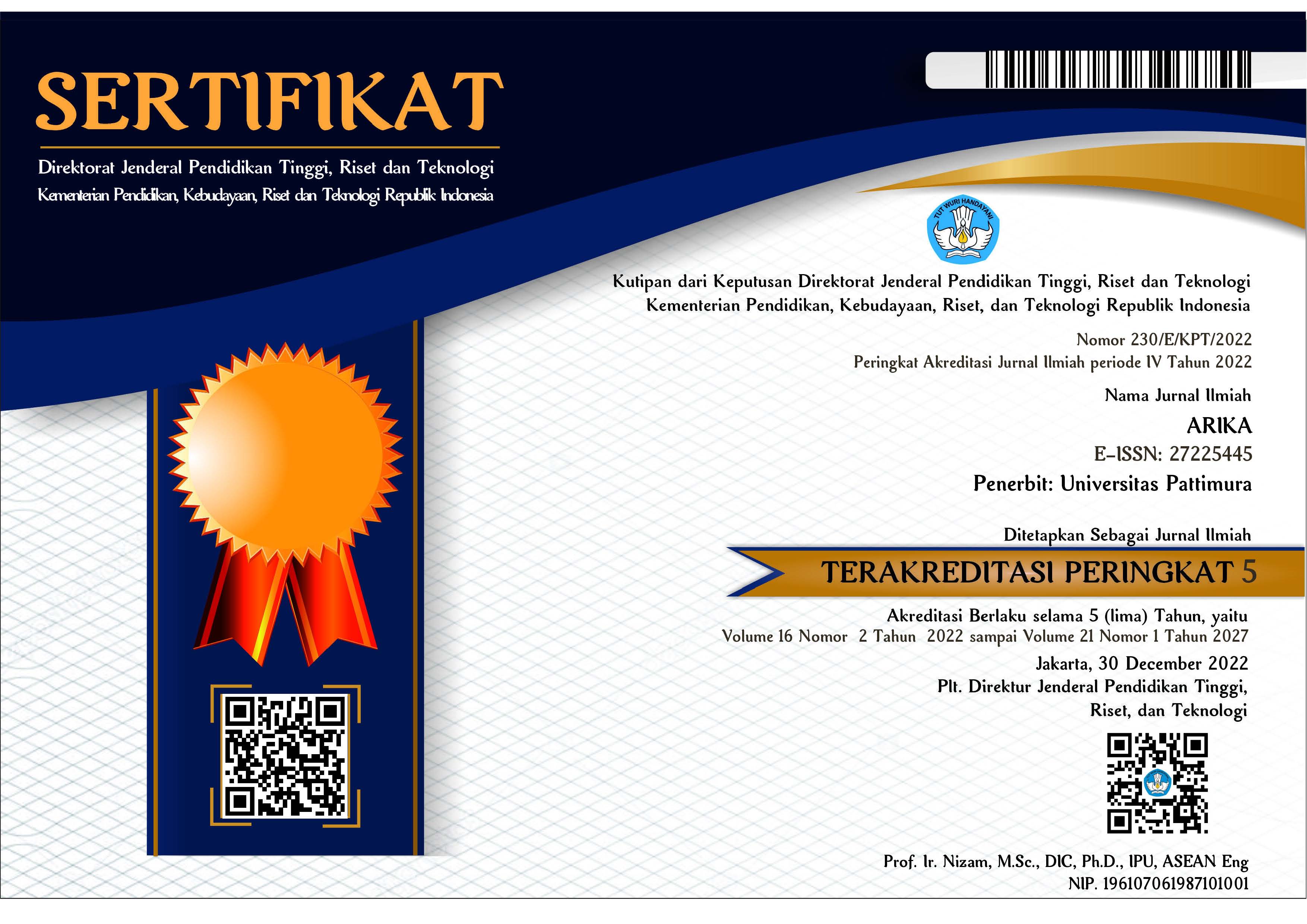
Volume 16, Issue 2, August 2022 to Volume 21, Issue 1, February 2027
ARIKA Journal
Room of Industrial Engineering Study Program
First Floor, Faculty of Engineering Pattimura University
Jl. Ir. M. Putuhena, Kampus Poka - Ambon, 97233

This work is licensed under a Creative Commons Attribution-ShareAlike 4.0 International License.