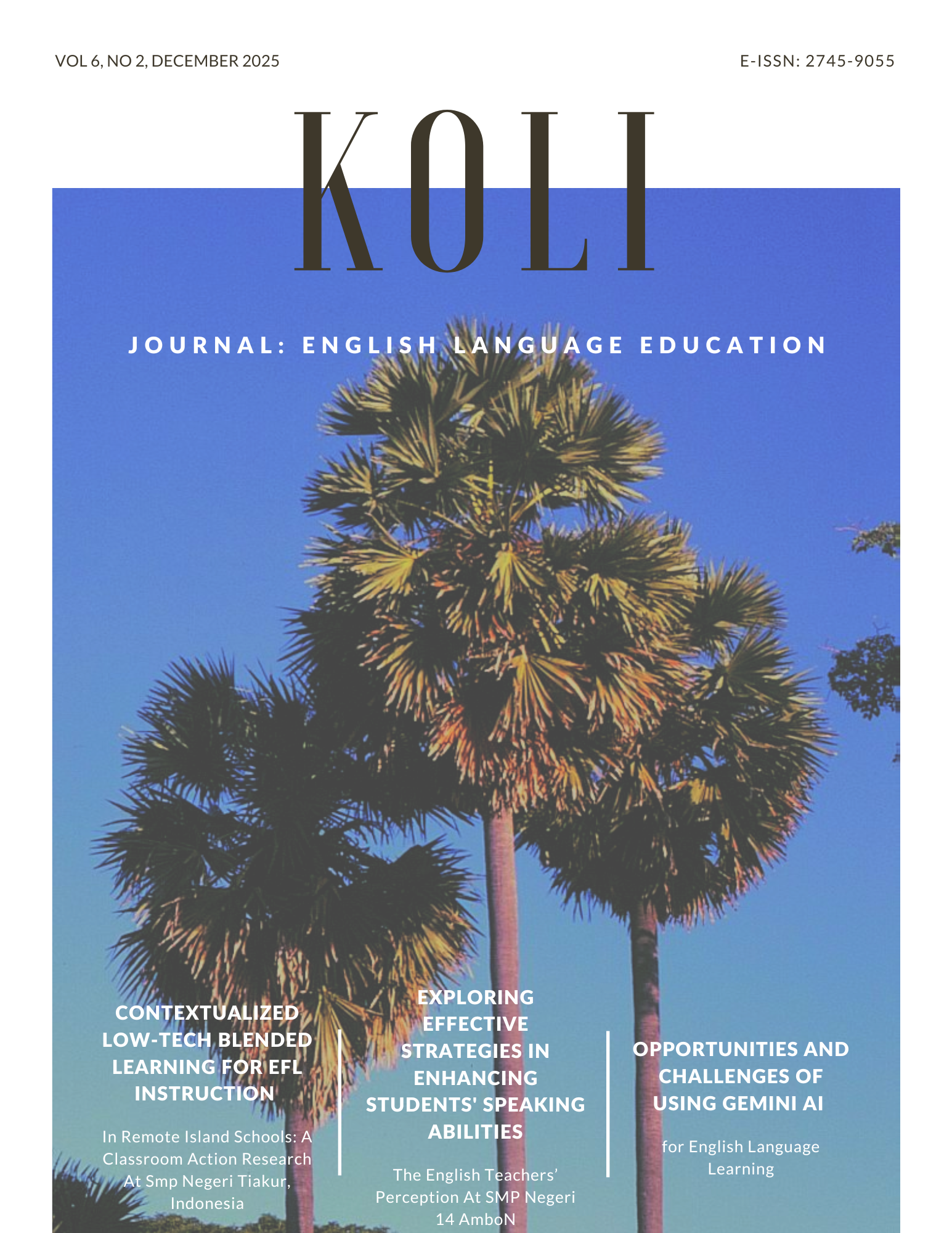
Exploring Effective Strategies in Enhancing Students Speaking Abilities: The English Teachers’ Perception at SMP Negeri 14 Ambon
Abstract
This study aims to explore the strategies that English teachers at SMP Negeri 14 Ambon consider most effective in enhancing students’ speaking abilities. The research focuses on four aspects of speaking assessed at the school, namely fluency, intonation, accuracy, and pronunciation. This study employed an explanatory sequential mixed-method design, combining quantitative data from a checklist-style questionnaire distributed to 10 English teachers with qualitative data from in-depth interviews with selected teachers. The findings reveal that Conversation, Discussion, and Language Games are the most frequently used strategies, with Conversation consistently ranked as the most effective across all speaking aspects. Additionally, the use of various strategies not only improves students’ pronunciation but also boosts their confidence and motivation to speak English. This study highlights the importance of applying interactive and communicative strategies to create a supportive environment for students to actively practice speaking in real contexts. It is expected that the results of this study can serve as a valuable reference for English teachers to select and implement appropriate strategies to improve students’ speaking skills.
Downloads
Copyright (c) 2025 The Author(s)

This work is licensed under a Creative Commons Attribution-NonCommercial-ShareAlike 4.0 International License.