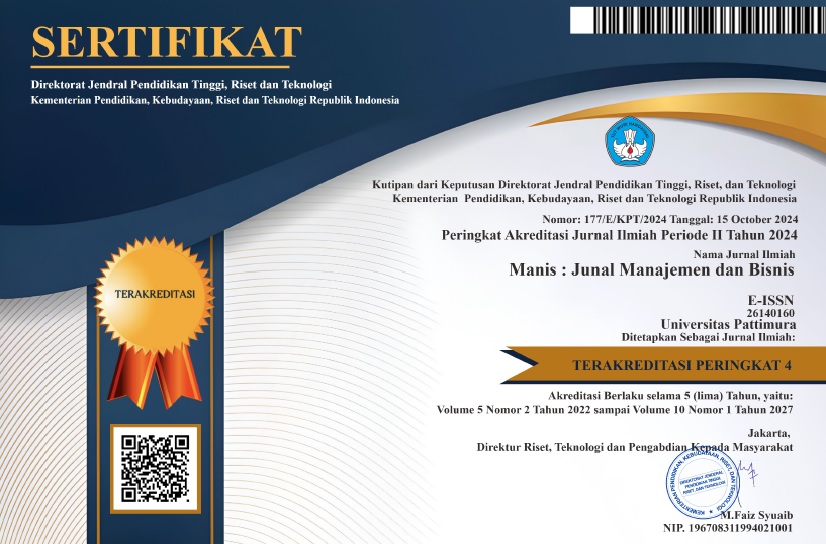
Certificate SINTA
Submit Your Article

Article Template

Journal Menu
Supporting Tools


Visitors

Manis: Jurnal Manajemen dan Bisnis
Published by S1 Management Study Program, Faculty of Economics and Business, Universitas Pattimura, Indonesia
⚡ Quick Summary: Manis: Jurnal Manajemen dan Bisnis applies a double-blind peer review process. Each submitted manuscript is reviewed by at least two independent reviewers. The review process considers novelty, objectivity, methodology, scientific contribution, conclusion, and references.
Manis: Jurnal Manajemen dan Bisnis is a double-blind peer-reviewed journal published periodically two times a year. The journal publishes scholarly works in the field of management and business that provide significant contributions to the development of science, thought, profession, and management practices in Indonesia and internationally.
The publication of articles in a double-blind peer-reviewed journal is an important part of scientific development. A published article reflects the quality of the research conducted by the authors and their institutions. Therefore, the journal requires all parties involved in the publication process, including editors, reviewers, and authors, to uphold ethical standards and academic integrity.
Every submitted manuscript will be reviewed by at least two peer reviewers. The journal applies a double-blind review system, in which reviewers do not know the identity of the authors, and authors do not know the identity of the reviewers.
The editorial team checks the manuscript’s suitability with the journal’s focus and scope, template format, originality, and basic submission requirements.
Manuscripts that pass the initial screening are assigned to at least two reviewers with relevant expertise in management and business.
Reviewers evaluate the manuscript based on novelty, objectivity, methodology, scientific impact, clarity of discussion, conclusion, and references.
The editor makes a decision based on reviewers’ recommendations, including acceptance, revision, resubmission, or rejection.
The review process considers the following aspects:
Based on the reviewers’ comments and recommendations, the editor may make one of the following decisions:
The manuscript is accepted for publication without major changes.
The manuscript requires minor improvements before acceptance.
The manuscript requires substantial revision and may be reviewed again.
The manuscript is not suitable for publication in the journal.
All manuscripts submitted to Manis: Jurnal Manajemen dan Bisnis must be free from plagiarism. Authors are encouraged to use plagiarism detection software before submitting their manuscripts to ensure originality and academic integrity.
The editors check manuscript similarity using Turnitin or other plagiarism detection software. Manuscripts with a similarity index of less than 20% will be processed further, provided that the similarity does not indicate plagiarism or improper citation.
Important Note: Manuscripts with indications of plagiarism, duplicate publication, data fabrication, data falsification, or unethical authorship may be rejected at any stage of the editorial process.
Editors, reviewers, and authors are expected to uphold ethical standards in publication. Editors are responsible for ensuring a fair and objective editorial process. Reviewers are responsible for providing constructive and confidential evaluations. Authors are responsible for submitting original manuscripts, presenting accurate data, acknowledging sources properly, and responding to reviewers’ comments in a professional manner.
Certificate SINTA