PENGARUH PEMBERIAN ETHREL TERHADAP PEMBENTUKAN BUNGA DAN BUAH TANAMAN TOMAT (Lycopersicum pyriforme )
Abstract
Background: Tomato is a vegetable plant that is popular with the public considering the various benefits of the tomato itself, so the demand for tomatoes is increasing. To obtain good results, especially in the process of growth and production of tomato plants, it is necessary to provide growth stimulants that are able to work in stimulating growth. tomato plants and stimulates the formation of flowers and fruit on tomato plants, one of which is ZPT Ethrel.
Methods: This study used a completely randomized design (CRD) with 3 repetitions and 4 treatments; R0 = without ethrel ; R1 = 2 cc/liter ethrel; R2 = 4 cc/liter ethrel; R3 = 6 cc/liter ethrel, so the total test unit is 12 units. This research will be analyzed using the F test if the calculation F_(count)>f_table at a confidence level of 5% or 1% will be followed by the Least Significant Difference (LSD) test.
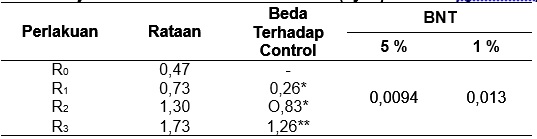
Results: The results showed that the administration of ethrel affected the productivity of flower and fruit formation of tomato plants. The best flower and fruit formation was given 6 cc/liter ethrel, then 4 cc/liter ethrel, 2 cc/liter ethrel, and the lowest was without ethrel.
Conclusion: Giving ethrel affects the formation of flowers and fruit of tomato plants (Lycopersicum pyriforme). The best flower and fruit formation was given R3 (6 cc/liter ethrel), then R2 (4 cc/liter ethrel), R1 (2 cc/liter ethrel), and the lowest was on R0 (without ethrel administration).
Downloads
Authors who publish with this Journal agree to the following terms:
- Author retain copyright and grant the journal right of first publication with the work simultaneously licensed under a creative commons attribution license that allow others to share the work within an acknowledgement of the work’s authorship and initial publication of this journal.
- Authors are able to enter into separate, additional contractual arrangement for the non-exclusive distribution of the journal’s published version of the work (e.g. acknowledgement of its initial publication in this journal).
- Authors are permitted and encouraged to post their work online (e.g. in institutional repositories or on their websites) prior to and during the submission process, as it can lead to productive exchanges, as well as earlier and greater citation of published works



 2
2