Written Mathematical Communication Profiles: Symbolic, Visual, and Metacognitive Features in Inclusion–Exclusion Problem Solving
Abstract
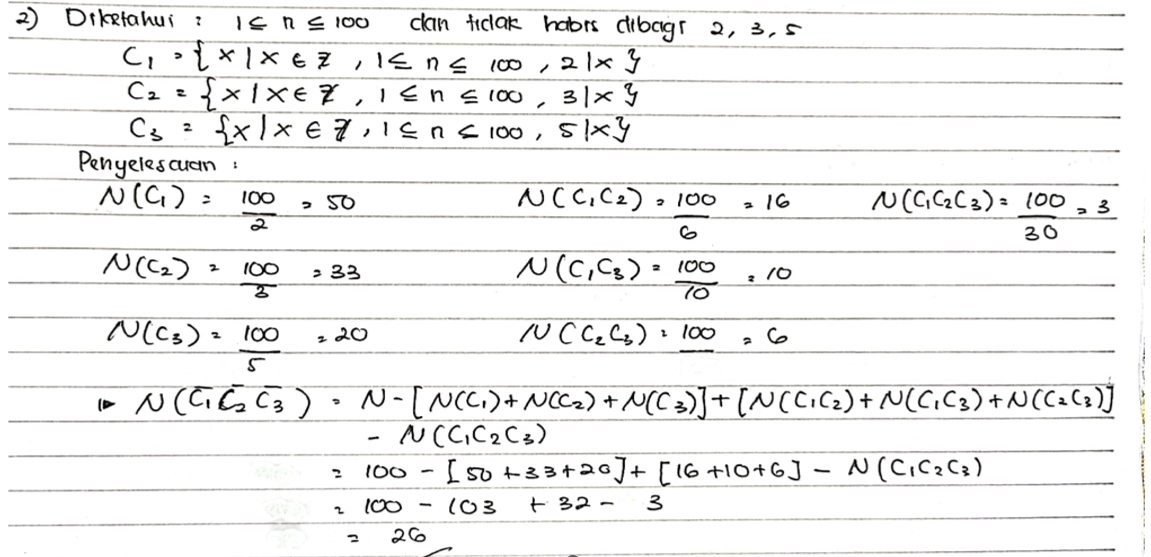
This study explores profiles of written mathematical communication in solving an inclusion–exclusion problem, with a focus on four interrelated components: writing, mathematical expression, drawing, and metacognitive verification. Employing a qualitative case study design, data were collected from undergraduate mathematics education students through written problem-solving tasks and task-based semi-structured interviews. Two participants were purposively chosen in order to illustrate the variation in communication profiles. These profiles were analyzed through iterative coding and cros-case comparison to understand the way the participants store, present, and substantiate ideas in the field of mathematics. The results suggest that the profiles observed were the results of participants’ engagement with multiple representational systems. Symbolic-visual communication, the first of the two profiles, includes the use and combination of formal, sequentially bound systems and multiple representational systems while the second, systematic symbolic communication, involves the use of organized, rational thought structured through sequentially bound systems (i.e., without the use of multiple representational systems). Although each communication profile leads to the same correct answer, they diverge in the degree of engagement with representational systems and the verification process. Most importantly, the results suggest that, to an extent, communication problems were the results of the participants’ insufficient integration and verification of multiple representational systems, rather than procedural problems. The results suggest that communication in mathematics involves not only sequence and order, but participants’ engagement with multiple, representational systems. Finally, the results suggest that participants’ integration of multiple representational systems and reflective processes might be the facilitators to communication in mathematics.
Downloads
References
Ainsworth, S. (2006). DeFT: A conceptual framework for considering learning with multiple representations. Learning and Instruction, 16(3), 183–198. https://doi.org/10.1016/j.learninstruc.2006.03.001
Annisavitri, R., Sa’Dijah, C., Qohar, Abd., Sa’Diyah, M., & Anwar, L. (2020). Analysis of mathematical literacy test as a problem-solving ability assessment of junior high school students. AIP Conference Proceedings, 2215, 060002. https://doi.org/10.1063/5.0000648
Azizah, N., Usodo, B., & Saputro, D. (2020). The written mathematical communication ability of junior high school students in solving set problems. Journal of Physics: Conference Series, 1538, 12103. https://doi.org/10.1088/1742-6596/1538/1/012103
Bahrun, R. K. W., & Dasari, D. (2023). A Literature Review of Indonesian Students’ Mathematical Communication Ability in Geometry Materials. EduLine: Journal of Education and Learning Innovation, 3(3), 354–358. https://doi.org/10.35877/454RI.eduline1880
Bellon, E., Fias, W., & De Smedt, B. (2020). Metacognition across domains: Is the association between arithmetic and metacognitive monitoring domain-specific? PLOS ONE, 15(3), 1–19. https://doi.org/10.1371/JOURNAL.PONE.0229932
Cheng, P. C.-H. (2003). Diagrammatic re-codification of probability theory: A representational epistemological study. https://api.semanticscholar.org/CorpusID:37394128
Creswell, J. W. (2012). Educational Research. In AORN Journal (Fourth, Vol. 62, Number 1). Pearson.
Crowe, S., Cresswell, K., Robertson, A., Huby, G., Avery, A., & Sheikh, A. (2011). The case study approach. BMC Medical Research Methodology, 11(1), 100. https://doi.org/10.1186/1471-2288-11-100
Duval, R. (2006). A cognitive analysis of problems of comprehension in a learning of mathematics. Educational Studies in Mathematics, 61, 103–131. https://doi.org/10.1007/s10649-006-0400-z
Freeman, B., Higgins, K. N., & Horney, M. (2016). How Students Communicate Mathematical Ideas: An Examination of Multimodal Writing Using Digital Technologies. Contemporary Educational Technology, 7(4). https://doi.org/10.30935/cedtech/6178
Goldsby, D. S., & Cozza, B. (2002). Writing Samples to Understand Mathematical Thinking. Mathematics Teaching in the Middle School, 7(9), 517–520. https://doi.org/10.5951/MTMS.7.9.0517
Goswami, M., Chen, L., & Dubrawski, A. (2020). Discriminating Cognitive Disequilibrium and Flow in Problem Solving: A Semi-Supervised Approach Using Involuntary Dynamic Behavioral Signals. 34(01), 420–427. https://doi.org/10.1609/AAAI.V34I01.5378
Johnston-Wilder, S., & Lee, C. (2008). Does Articulation Matter when Learning Mathematics. https://api.semanticscholar.org/CorpusID:116912789
Kaya, D., & Aydın, H. (2016). Elementary Mathematics Teachers’ Perceptions and Lived Experiences on Mathematical Communication. Eurasia Journal of Mathematics, Science and Technology Education, 12(6). https://doi.org/10.12973/eurasia.2014.1203a
Khadka, J. B. (2024). Role of Mathematical Communication for Learning Mathematics. Journal of Educational Research and Innovation, 4(1), 68–76. https://doi.org/10.3126/jeri.v4i1.75791
Khairunnisa, G. F., Maulyda, M. A., Annizar, A. M., Hijriani, L., & Khair, M. S. (2020). Mathematics Communication: Translation of Elementary Students’ Idea. Numerical: Jurnal Matematika Dan Pendidikan Matematika, 77–86. https://doi.org/10.25217/numerical.v4i2.781
Koedinger, K. R., & Nathan, M. J. (2004). The Real Story Behind Story Problems: Effects of Representations on Quantitative Reasoning. Journal of the Learning Sciences, 13(2), 129–164. https://doi.org/10.1207/s15327809jls1302_1
Korstjens, I., & Moser, A. (2018). Series: Practical guidance to qualitative research. Part 4: Trustworthiness and publishing. European Journal of General Practice, 24(1), 120–124. https://doi.org/10.1080/13814788.2017.1375092
Kulpa, Z. (2003). Self-consistency, imprecision, and impossible cases in diagrammatic representations. Machine Graphics & Vision International Journal Archive, 12, 147–160. https://api.semanticscholar.org/CorpusID:116759012
Lim, L., & Pugalee, D. K. (2004). Using Journal Writing to Explore “They Communicate to Learn Mathematics and They Learn to Communicate Mathematically”. https://api.semanticscholar.org/CorpusID:63219664
Lowrie, T., & Kay, R. (2001). Relationship between visual and nonvisual solution methods and difficulty in elementary mathematics. The Journal of Educational Research, 94(4), 248–255. https://doi.org/10.1080/00220670109598758
Mata, A. (2023). Overconfidence in the Cognitive Reflection Test: Comparing Confidence Resolution for Reasoning vs. General Knowledge. Journal of Intelligence, 11(5), 81. https://doi.org/10.3390/jintelligence11050081
Masfingatin, T., Maharani, S., Rufiana, I. S., & Sanwidi, A. (2020). Mathematics Communication of Middle School Students in Solving Geometry Problems Based on Spatial Intelligence. 151–160. https://doi.org/10.2991/ASSEHR.K.200827.135
Meaney, T., Trinick, T., & Fairhall, U. (2009). Learning How to Represent Mathematics on Paper. Australian Primary Mathematics Classroom, 14, 21–27. https://api.semanticscholar.org/CorpusID:126099557
Menezes, L., & Costa, A. M. (2020). Writing to learn mathematics. 841–848. https://doi.org/10.21125/iceri.2020.0246
Mezmir, E. A. (2020). Qualitative Data Analysis: An Overview of Data Reduction, Data Display and Interpretation. Research on Humanities and Social Sciences. https://doi.org/10.7176/RHSS/10-21-02
NCTM. (2000). Principles and Standards for School Mathematics.
Pugalee, D. K. (2001). Writing, Mathematics, and Metacognition: Looking for Connections Through Students’ Work in Mathematical Problem Solving. School Science and Mathematics, 101(5), 236–245. https://doi.org/10.1111/j.1949-8594.2001.tb18026.x
Rohid, N., Suryaman, S., & Rusmawati, R. D. (2019). Students’ Mathematical Communication Skills (MCS) in Solving Mathematics Problems: A Case in Indonesian Context. Anatolian Journal of Education, 4(2), 19–30. https://doi.org/10.29333/aje.2019.423a
Sfard, A. (2002). There is More to Discourse than Meets the Ears: Looking at Thinking as Communicating to Learn More About Mathematical Learning. In Learning Discourse (pp. 13–57). Kluwer Academic Publishers. https://doi.org/10.1007/0-306-48085-9_1
Sfard, A., & Kieran, C. (2001). Cognition as Communication: Rethinking Learning-by-Talking Through Multi-Faceted Analysis of Students’ Mathematical Interactions. Mind, Culture, and Activity, 8(1), 42–76. https://doi.org/10.1207/S15327884MCA0801_04
Shahriari, S. (2021). An Invitation to Combinatorics. Cambridge University Press. https://doi.org/10.1017/9781108568708
Stein, C. A. (2007). Let’s Talk: Promoting Mathematical Discourse in the Classroom. The Mathematics Teacher, 101(4), 285–289. https://doi.org/10.5951/MT.101.4.0285
Sweller, J. (1988). Cognitive load during problem solving: Effects on learning. Cognitive Science, 12(2), 257–285. https://doi.org/10.1207/s15516709cog1202_4
Thompson, D. R., & Chappell, M. F. (2007). Communication and Representation as Elements in Mathematical Literacy. Reading & Writing Quarterly, 23(2), 179–196. https://doi.org/10.1080/10573560601158495
Toh, T. L. (2012). Reasoning, Communication and Connections in A-Level Mathematics. In Reasoning, Communication and Connections in Mathematics (pp. 127–147). World Scientific. https://doi.org/10.1142/9789814405430_0007
Wandari, W., & Anggara, B. (2021). Analysis of students difficulties in completing mathematical communication problems. Journal of Physics: Conference Series, 1918(4), 042090. https://doi.org/10.1088/1742-6596/1918/4/042090
Yin, R. K. (2018). Case Study Research and Applications Sixth Edition (6th ed.). Sage publications.
Copyright (c) 2026 Nurma Wahyu Utami, Lathiful Anwar, Makbul Muksar

This work is licensed under a Creative Commons Attribution-NonCommercial-ShareAlike 4.0 International License.
License and Copyright Agreement
By submitting a manuscript to Jurnal Pendidikan Matematika (JUPITEK), the author(s) certify and agree to the following terms:
- Originality and Authority: The submitting author is authorized by all co-authors to enter into this agreement. The manuscript describes original work that has not been published previously in a peer-reviewed journal, nor is it under consideration for publication elsewhere.
- Approval: Its publication has been approved by all author(s) and by the responsible authorities of the institutions where the work was carried out.
- Rights: The authors secure the right to reproduce any material that has already been published or copyrighted elsewhere.
- Licensing and Copyright: Authors retain the copyright to their work.
- License Grant: The authors grant Jurnal Pendidikan Matematika (JUPITEK) the right of first publication, with the work simultaneously licensed under the Creative Commons Attribution-NonCommercial-ShareAlike 4.0 International (CC BY-NC-SA 4.0).
- Self-Archiving: Authors are permitted and encouraged to deposit the published version of their article in institutional repositories, on their personal websites, and other academic platforms, with proper acknowledgment of its initial publication in Jurnal Pendidikan Matematika (JUPITEK).



.png)