Commognitive Analysis of 11th-Grade Students in Solving Inverse Matrix Problems: A Gender-Based Study
Abstract
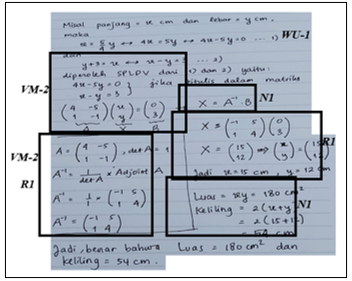
Research has shown that male students have good abilities in applying mathematical formulas appropriately and correctly, but they are less complete in explaining in detail the steps taken in solving problems, meanwhile, female students are systematically and completely structured and comprehensive manner. Commognitive analysis was important to understand how it influences student learning achievement so that educators can develop better learning strategies. This qualitative research with purposive sampling aims to analyze high school students' commognitive skills in solving contextual mathematics problems in terms of gender. All participants, 23 students of 11th-Grade grouped based on gender, male and female, and one student was chosen from each as the research subjects. Research data was taken from students' written tests and semi-structured interviews based on test results. The data analysis techniques included data reduction, data presentation, and drawing conclusions. The written test is used to determine students' commognitive skills using commognitive components, that are words use, visual mediators, narratives, and routines. The results show that female students demonstrate more detailed and structured completion steps than male. Further research can be carried out to further reveal the potential for commognitive conflict in other materials so that can help teachers how to choose teaching strategies.
Downloads
References
Ambrose, R., & Fennema, E. (2001). Gender and School Learning: Mathematics and Science (pp. 5972–5976). https://doi.org/10.1016/B0-08-043076-7/02424-4
Barbieri, C. A., Rodrigues, J., Dyson, N., & Jordan, N. C. (2019). Improving fraction understanding in sixth graders with mathematics difficulties: Effects of a number line approach combined with cognitive learning strategies. Journal of Educational Psychology, 3(June). https://doi.org/10.1037/edu0000384
Cresswel, J. (2013). Qualitative, quantitative, and mixed methods approaches. In Research design. https://doi.org/10.2307/3152153
Emre-Akdoğan, E., Güçler, B., & Argün, Z. (2018). The development of two high school students’ discourses on geometric translation in relation to the teacher’s discourse in the classroom. Eurasia Journal of Mathematics, Science and Technology Education. https://doi.org/10.29333/EJMSTE/84885
Gamboa-Araya, R. (2012). Gender Equality in Mathematics Education. 16(1), 63–78. http://www.revistas.una.ac.cr/index.php/EDUCARE/article/view/3733/3582
Hadinugrahaningsih, T., Rahmawati, Y., & Ridwan, A. (2017). Developing 21st century skills in chemistry classrooms: Opportunities and challenges of STEAM integration. AIP Conference Proceedings. https://doi.org/10.1063/1.4995107
Heyd-Metzuyanim, E., & Graven, M. (2016). Between people-pleasing and mathematizing: South African learners’ struggle for numeracy. Educational Studies in Mathematics, 91(3), 349–373. https://doi.org/10.1007/s10649-015-9637-8
Ioannou, M. (2018). Commognitive analysis of undergraduate mathematics students’ first encounter with the subgroup test. Mathematics Education Research Journal. https://doi.org/10.1007/s13394-017-0222-6
Kelly, A. E. (2014). Handbook of Design Research Methods in Education. In Handbook of Design Research Methods in Education. https://doi.org/10.4324/9781315759593
Lu, J., Tao, Y., Xu, J., & Stephens, M. (2020). Commognitive responsibility shift and its visualizing in computer-supported one-to-one tutoring. Interactive Learning Environments. https://doi.org/10.1080/10494820.2020.1777167
Lu, J., Zhang, X., & Stephens, M. (2019). Visualizing the commognitive processes in computer-supported one-to-one tutoring. Interactive Learning Environments. https://doi.org/10.1080/10494820.2019.1610452
Misu, L., & Rahim, U. (2019). Analysis of mathematical ability based on gender. 1188(1), 012054. https://doi.org/10.1088/1742-6596/1188/1/012054
Morgan, C., & Sfard, A. (2016). Investigating changes in high-stakes mathematics examinations: a discursive approach. Research in Mathematics Education, 18(2), 92–119. https://doi.org/10.1080/14794802.2016.1176596
Mudaly, V., & Mpofu, S. (2019). Learners’ views on asymptotes of a hyperbola and exponential function: A commognitive approach. Problems of Education in the 21st Century. https://doi.org/10.33225/pec/19.77.734
Nimely, D. R., & Nyamu, O. F. K. (2023). Strategies for Inculcating Gender Equity in Mathematics Classrooms for Enhancement of Learners’ Problem-Solving Skills. International Journal of Research and Innovation in Social Science, VII(VII), 1446–1454. https://doi.org/10.47772/ijriss.2023.70814
Park, J. Y. (2017). A Commognitive Perspective on Pre-service Secondary Teachers’ Content Knowledge in Mathematical Modelling. https://doi.org/10.1007/978-3-319-62968-1_25
Presmeg, N. (2016). Commognition as a lens for research. Educational Studies in Mathematics. https://doi.org/10.1007/s10649-015-9676-1
Putut, E., Emanuel, L., Nusantara, T., & Rahardi, R. (2024). Does Domain of Absolute Value Function Always Positive ? Commognitive-Conflict Analysis of Students of First Semester. Qalamuna: Jurnal Pendidikan, Agama, Dan Sosial, 16(2), 795–806. https://doi.org/10.37680/qalamuna.v16i2.5169
Putut, E., Emanuel, L., Nusantara, T., Rahman, A., & Rahardi, R. (2023). Why am I confused ? Commognitive Conflict in Non-ordinary Question About Number Division. Journal for ReAttach Therapy and Developmental Diversities, 6(5s), 891–901. Retrieved from https://jrtdd.com/index.php/journal/article/view/644
Radford, L., & Barwell, R. (2016). Language in Mathematics education research. The Second Handbook of Research on the Psychology of Mathematics Education: The Journey Continues, 275–313. https://doi.org/10.1007/978-94-6300-561-6_8
Scott, D., Hargreaves, E., & Sfard, A. (2015). Learning, Commognition and Mathematics. In The SAGE Handbook of Learning. https://doi.org/10.4135/9781473915213.n12
Sfard, A. (2008). Thinking as Communicating. In Thinking as Communicating. https://doi.org/10.1017/cbo9780511499944
Sfard, A. (2020). Commognition. In Encyclopedia of Mathematics Education. https://doi.org/10.1007/978-3-030-15789-0_100031
Sitorus, J., & Masrayati. (2016). Students’ creative thinking process stages: Implementation of realistic mathematics education. Thinking Skills and Creativity. https://doi.org/10.1016/j.tsc.2016.09.007
Sternberg, R. J. (2014). Environmental Effects on Cognitive Abilities. In Environmental Effects on Cognitive Abilities. https://doi.org/10.4324/9781410612311
Sternberg, R. J., & Zhang, L. F. (2014). Perspectives on thinking, learning, and cognitive styles. In Perspectives on Thinking, Learning, and Cognitive Styles. https://doi.org/10.4324/9781410605986
Sudarsana, I. K., Nakayanti, A. R., Sapta, A., Haimah, Satria, E., Saddhono, K., … Mursalin, M. (2019). Technology Application in Education and Learning Process. Journal of Physics: Conference Series, 1363(1). https://doi.org/10.1088/1742-6596/1363/1/012061
Swidan, O., & Daher, W. M. (2019). Low achieving students’ realization of the notion of mathematical equality with an interactive technological artifacts. Eurasia Journal of Mathematics, Science and Technology Education. https://doi.org/10.29333/ejmste/103073
Tabach, M., & Nachlieli, T. (2016). Communicational perspectives on learning and teaching mathematics: prologue. Educational Studies in Mathematics. https://doi.org/10.1007/s10649-015-9638-7
Thoma, A., & Nardi, E. (2018). Transition from School to University Mathematics: Manifestations of Unresolved Commognitive Conflict in First Year Students’ Examination Scripts. International Journal of Research in Undergraduate Mathematics Education. https://doi.org/10.1007/s40753-017-0064-3
Toscano, R., Gavilán-Izquierdo, J. M., & Sánchez, V. (2019). A study of pre-service primary teachers’ discourse when solving didactic-mathematical tasks. Eurasia Journal of Mathematics, Science and Technology Education, 15(11). https://doi.org/10.29333/ejmste/108631
Umah, U. (2020). Comparison of Students' Covariational Reasoning Based on Differences in Field-Dependent and Field-Independent Cognitive Style. NUMERICAL: Jurnal Matematika Dan Pendidikan Matematika, 41-54. https://doi.org/10.25217/numerical.v4i1.638.
Umah, U., & Vitantri, C. A. (2019). Representasi visual matematis mahasiswa dalam memodelkan kejadian dinamis ditinjau dari perbedaan gaya kognitif dan jenis kelamin. FIBONACCI: Jurnal Pendidikan Matematika Dan Matematika, 5(1), 87-96. https://doi.org/10.24853/fbc.5.1.87-96.
Viirman, O. (2015). Explanation, motivation and question posing routines in university mathematics teachers’ pedagogical discourse: a commognitive analysis. International Journal of Mathematical Education in Science and Technology. https://doi.org/10.1080/0020739X.2015.1034206
Viirman, O., & Nardi, E. (2019). Negotiating different disciplinary discourses: biology students’ ritualized and exploratory participation in mathematical modeling activities. Educational Studies in Mathematics. https://doi.org/10.1007/s10649-018-9861-0
Yazar Soyadı, B. B. (2015). Creative and Critical Thinking Skills in Problem-based Learning Environments. Journal of Gifted Education and Creativity. https://doi.org/10.18200/jgedc.2015214253
Copyright (c) 2026 Endrayana Putut Laksminto Emanuel, Yohana Stasia Ghele, Suharnanik Suharnanik, Ulumul Umah

This work is licensed under a Creative Commons Attribution-NonCommercial-ShareAlike 4.0 International License.
License and Copyright Agreement
By submitting a manuscript to Jurnal Pendidikan Matematika (JUPITEK), the author(s) certify and agree to the following terms:
- Originality and Authority: The submitting author is authorized by all co-authors to enter into this agreement. The manuscript describes original work that has not been published previously in a peer-reviewed journal, nor is it under consideration for publication elsewhere.
- Approval: Its publication has been approved by all author(s) and by the responsible authorities of the institutions where the work was carried out.
- Rights: The authors secure the right to reproduce any material that has already been published or copyrighted elsewhere.
- Licensing and Copyright: Authors retain the copyright to their work.
- License Grant: The authors grant Jurnal Pendidikan Matematika (JUPITEK) the right of first publication, with the work simultaneously licensed under the Creative Commons Attribution-NonCommercial-ShareAlike 4.0 International (CC BY-NC-SA 4.0).
- Self-Archiving: Authors are permitted and encouraged to deposit the published version of their article in institutional repositories, on their personal websites, and other academic platforms, with proper acknowledgment of its initial publication in Jurnal Pendidikan Matematika (JUPITEK).