A Comparative Study of RME and PBL Models on Students’ Problem-Solving Skills Based on Mathematical Communication
Abstract
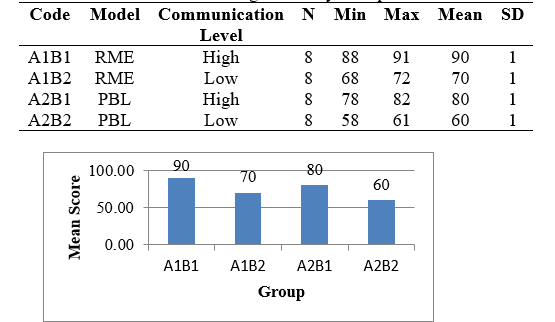
This study aims to compare the effects of the Realistic Mathematics Education (RME) and Problem-Based Learning (PBL) models on junior high school students’ problem-solving skills, viewed through the lens of mathematical communication. A quasi-experimental method employing a 2×2 factorial design (treatment by level) was implemented. The sample consisted of 32 seventh-grade students from a public junior high school in East Lombok, West Nusa Tenggara, divided into four groups based on instructional model and mathematical communication level (high vs. low). The research instrument was an essay-based test administered both before and after the intervention. Two-way ANOVA results revealed a statistically significant effect of the learning model on problem-solving skills (F = 106.68; p < 0.001), a significant effect of mathematical communication level (F = 85.34; p < 0.001), and a significant interaction between the two factors (F = 13.00; p = 0.0012). Dunnett’s post hoc analysis indicated that students with both high and low levels of mathematical communication performed significantly better under the RME model than under PBL (t = 3.56 and t = 3.74, respectively; t₀.₀₅ = 2.49). These findings suggest that RME is more effective than PBL in enhancing students’ problem-solving abilities, regardless of their level of mathematical communication, and is well-suited for implementation in diverse classroom settings.
Downloads
References
Akosah, E. F., Arthur, Y. D., & Adu Obeng, B. (2026). Effectiveness of realistic mathematics education: A meta-analysis. American Journal of STEM Education, 24, 361–380. https://doi.org/10.32674/dkrfgy81
Barrows, H. S., & Tamblyn, R. M. (1980). Problem-based learning: An approach to medical education. Springer Publishing Company.
Dinglasan, J. K. L., Caraan, D. R. C., & Ching, D. A. (2023). Effectiveness of realistic mathematics education approach on problem-solving skills of students. International Journal of Educational Management and Development Studies, 4(2), 64–87. https://doi.org/10.53378/352980
Freudenthal, H. (1973). Mathematics as an educational task. D. Reidel Publishing Company.
Freudenthal, H. (1991). Revisiting mathematics education: China lectures. Kluwer Academic Publishers.
Genç, M., Akıncı, M., Karataş, İ., Çolakoğlu, Ö. M., & Yılmaz Tığlı, N. (2025). From thinking to creativity: The interplay of mathematical thinking perceptions, mathematical communication dispositions, and creative thinking dispositions. Behavioral Sciences, 15(10), 1346. https://doi.org/10.3390/bs15101346
Gravemeijer, K. (1994). Developing realistic mathematics education. CD-β Press / Freudenthal Institute, Utrecht University.
Gunawan, W., & Hadi, S. (2024). The effect of a Realistic Mathematics Education (RME) approach and reasoning ability on students' conceptual and procedural understanding. Contemporary Educational Researches Journal, 14(2), 90–102. https://doi.org/10.18844/cerj.v14i2.9318
Guo, Q., Jamil, H., Ismail, L., Luo, S., & Sun, Z. (2024). Effects of problem-based learning on EFL learning: A systematic review. PLOS ONE, 19(12), e0307819. https://doi.org/10.1371/journal.pone.0307819
International Association for the Evaluation of Educational Achievement. (2024). TIMSS 2023 international results in mathematics and science. IEA.
Kementerian Pendidikan, Kebudayaan, Riset, dan Teknologi. (2023). Rapor Pendidikan Indonesia 2023. Badan Standar, Kurikulum, dan Asesmen Pendidikan. Rapor Pendidikan Indonesia - Semua Wilayah - 2023.
Malacapay, M. C. (2024). The influence of learning styles and attitudes on academic performance of college students in a flipped learning environment. International Journal of Instruction, 17(4), 623–644. https://doi.org/10.29333/iji.2024.17435a
Mangarin, R. A., & Caballes, D. O. (2024). Difficulties in learning mathematics: A systematic review. International Journal of Research and Scientific Innovation, 11(9), 401–405. https://doi.org/10.51244/IJRSI.2024.1109037
Marpaung, M., Minarni, A., & Panjaitan, T. (2020). The effect of mathematics realistic education aided by mathematics software towards the process of solving mathematical communication problems of junior high school students. BirLE-Journal (Budapest International Research and Critics in Linguistics and Education), 3(3), 1445–1455. https://doi.org/10.33258/birle.v3i3.1213
Mutmainah, R., & Karlimah, K. (2024). Model pembelajaran realistic mathematics education (RME) dalam pembelajaran matematika di sekolah dasar. Jurnal Penelitian Pendidikan, 24(1), 64–75. https://doi.org/10.17509/jpp.v24i1.69278
National Council of Teachers of Mathematics. (2000). Principles and standards for school mathematics. NCTM.
Ndia, L., Salam, M., Iru, L., & Atma, N. (2025). Differentiated instruction in problem-based and direct instruction: The moderating role of mathematical disposition on students' mathematical communication skills. Education Sciences, 15(12), 1636. https://doi.org/10.3390/educsci15121636
Nguyen, H. T. M., Nguyen, G. T. C., Nguyen, B. N., Truong, D. T., & Thai, L. T. H. (2025). Mathematical communication skills for high school students: A comprehensive review of present practices, challenges, and prospective advancements. TEM Journal, 14(3), 2349–2360. https://doi.org/10.18421/TEM143-40
Nicholus, G., Muwonge, C. M., & Joseph, N. (2023). The role of problem-based learning approach in teaching and learning physics: A systematic literature review. F1000Research, 12, 951. https://doi.org/10.12688/f1000research.136339.2
Nicholus, G., Muwonge, C. M., & Joseph, N. (2023). The role of problem-based learning approach in teaching and learning physics: A systematic literature review. F1000Research, 12, 951. https://doi.org/10.12688/f1000research.136339.2
Organisation for Economic Co-operation and Development. (2023). PISA 2022 results (Volume I): The state of learning and equity in education. OECD Publishing. https://doi.org/10.1787/53f23881-en
Palinussa, A. L., Dias, T. C., & Ngilawajan, D. A. (2021). The effect of realistic mathematics education and problem based learning model on mathematics problem solving ability in terms of precondition mathematics abilities. Proceedings of the 1st International Conference on Mathematics and Mathematics Education (ICMMEd 2020), 550, 488–491. https://doi.org/10.2991/assehr.k.210508.109
Putri, N. S., Juandi, D., & Jupri, A. (2022). The implementation effect of realistic mathematics education and contextual teaching and learning approaches on the students' mathematical communication ability: A meta-analysis. Al-Jabar: Jurnal Pendidikan Matematika, 13(2), 383–400. https://doi.org/10.24042/ajpm.v13i2.13562
Saragih, S., & Napitupulu, E. (2015). Developing student-centered learning model to improve high order mathematical thinking ability. International Education Studies, 8(6), 104–112. https://doi.org/10.5539/ies.v8n6p104
Sidik, G. T., & Herman, T. (2023). The impact application of realistic mathematics education on problem-solving ability and mathematical communication of elementary school students. The 7th International Conference on Elementary Education, 7(1). https://proceedings.upi.edu/index.php/icee/article/view/3116
Susanti, G., & Rustam, A. (2018). The effectiveness of learning models realistic mathematics education and problem based learning toward mathematical reasoning skills at students of junior high school. Journal of Mathematics Education, 3(1), 33–39. https://doi.org/10.31327/jomedu.v3i1.534
UNESCO. (2023). Global education monitoring report 2023: Technology in education: A tool on whose terms? UNESCO.
Copyright (c) 2025 Marindra Kariadi, Edy Waluyo, Shahibul Ahyan

This work is licensed under a Creative Commons Attribution-NonCommercial-ShareAlike 4.0 International License.
License and Copyright Agreement
By submitting a manuscript to Jurnal Pendidikan Matematika (JUPITEK), the author(s) certify and agree to the following terms:
- Originality and Authority: The submitting author is authorized by all co-authors to enter into this agreement. The manuscript describes original work that has not been published previously in a peer-reviewed journal, nor is it under consideration for publication elsewhere.
- Approval: Its publication has been approved by all author(s) and by the responsible authorities of the institutions where the work was carried out.
- Rights: The authors secure the right to reproduce any material that has already been published or copyrighted elsewhere.
- Licensing and Copyright: Authors retain the copyright to their work.
- License Grant: The authors grant Jurnal Pendidikan Matematika (JUPITEK) the right of first publication, with the work simultaneously licensed under the Creative Commons Attribution-NonCommercial-ShareAlike 4.0 International (CC BY-NC-SA 4.0).
- Self-Archiving: Authors are permitted and encouraged to deposit the published version of their article in institutional repositories, on their personal websites, and other academic platforms, with proper acknowledgment of its initial publication in Jurnal Pendidikan Matematika (JUPITEK).


.png)