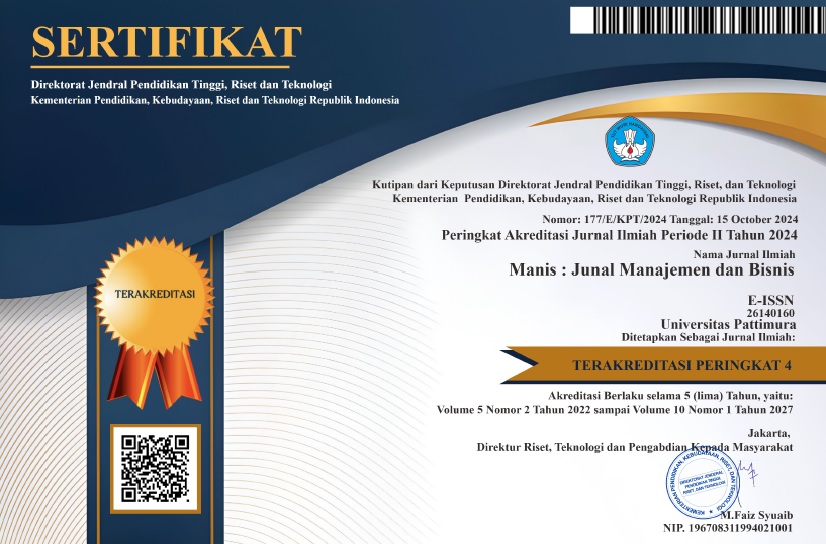
Certificate SINTA
Submit Your Article
Article Template

Journal Menu
Supporting Tools


Visitors
Manis: Jurnal Manajemen dan Bisnis
Published by S1 Management Study Program, Faculty of Economics and Business, Universitas Pattimura, Indonesia
⚡ Quick Summary: Manis: Jurnal Manajemen dan Bisnis may retract a published article when the findings, data, conclusions, authorship, peer-review process, or publication record are no longer reliable due to major error, plagiarism, duplicate publication, research misconduct, unethical practice, or other serious publication problems.
Manis: Jurnal Manajemen dan Bisnis is committed to maintaining the integrity, accuracy, and reliability of the scholarly record. Retraction is used as a mechanism to correct the literature and alert readers when a published article contains serious problems that make its findings, data, conclusions, or publication record unreliable.
The purpose of retraction is not to punish authors, but to protect the integrity of scientific communication and ensure that readers are properly informed about articles that should no longer be relied upon.
Core Principle: Retraction decisions are made based on evidence, editorial investigation, publication ethics, and the reliability of the published article.
A published article may be considered for retraction when one or more of the following conditions are identified:
The retraction process is conducted carefully, fairly, and transparently. The editorial team will examine all allegations or evidence before making a decision.
A concern may be raised by editors, reviewers, authors, readers, institutions, or other parties regarding the reliability or ethics of a published article.
The editor examines the allegation, similarity report, data issue, ethical concern, or other evidence related to the published article.
The corresponding author may be contacted and asked to provide clarification, supporting evidence, original data, or an explanation.
Based on the evidence and clarification, the editor decides whether to issue a correction, expression of concern, retraction, or no further action.
If an article is retracted, the journal will publish a retraction notice. The notice will be clearly identified as a retraction and linked to the original article. The original article may remain available online to preserve the scholarly record, but it will be clearly marked as retracted.
A retraction notice should include sufficient information to identify the retracted article and explain the reason for the retraction in a transparent and responsible manner.
The notice identifies the article title, author names, journal name, volume, issue, year, pages, DOI, and URL.
The notice states the reason for retraction, such as unreliable data, plagiarism, ethical violation, or publication misconduct.
The notice is published openly and remains freely accessible to readers.
Not every error requires retraction. The editorial team will determine the most appropriate action based on the seriousness of the problem and its impact on the reliability of the article.
Issued when an article contains honest errors that do not invalidate the main findings or conclusions.
Issued when serious concerns exist but the investigation is still ongoing or the evidence is not yet conclusive.
Issued when the article is seriously unreliable, unethical, duplicated, fraudulent, or affected by major publication misconduct.
Authors may request retraction of their published article if they discover serious errors, ethical problems, or other issues that significantly affect the reliability of the article.
The request must be submitted in writing to the editorial office and must include a clear explanation of the reason for retraction. The editor will evaluate the request before issuing a decision.
After retraction, the article will remain part of the journal’s publication record but will be clearly marked as retracted. The article metadata and retraction notice will remain accessible to maintain transparency and the integrity of the scholarly record.
The journal may notify indexing databases, repositories, and relevant parties about the retraction so that the article status can be updated accordingly.
Concerns regarding published articles, potential retraction, correction, ethical violation, or publication misconduct should be submitted to the editorial office of Manis: Jurnal Manajemen dan Bisnis through the journal contact page or official editorial email.
Certificate SINTA