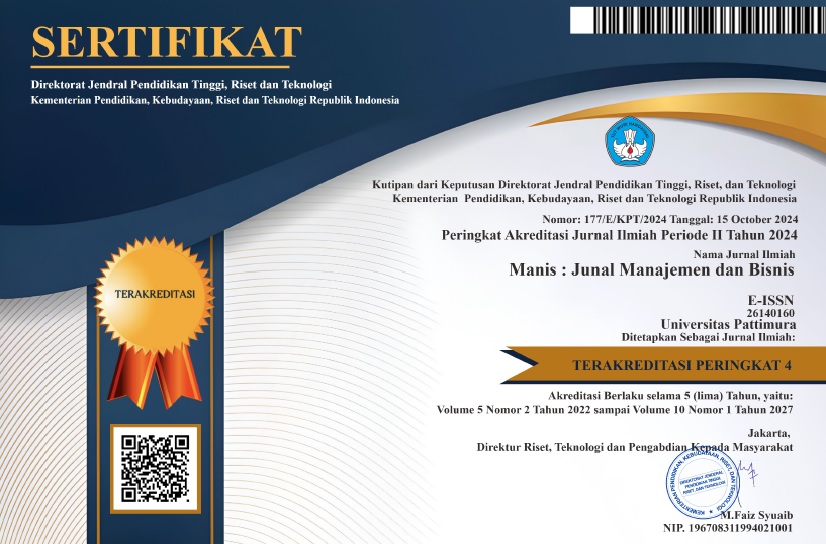
Certificate SINTA
Submit Your Article

Article Template

Journal Menu
Supporting Tools


Visitors

Manis: Jurnal Manajemen dan Bisnis
Published by S1 Management Study Program, Faculty of Economics and Business, Universitas Pattimura, Indonesia
⚡ Quick Summary: Manis: Jurnal Manajemen dan Bisnis is committed to ensuring the long-term preservation, accessibility, and availability of all published articles. The journal maintains digital archiving through the journal website, metadata preservation, indexing services, DOI registration, OAI-PMH, and regular backup mechanisms.
Manis: Jurnal Manajemen dan Bisnis is committed to preserving published scholarly content and ensuring that articles remain accessible to readers, authors, researchers, institutions, and the wider academic community over time.
The journal applies a digital archiving policy to protect article files, metadata, publication records, and supporting information from loss, damage, or long-term inaccessibility. Archiving is carried out to maintain the continuity, reliability, and sustainability of the journal’s scholarly record.
Core Principle: Published articles must remain permanently accessible, citable, and traceable as part of the journal’s academic record.
The journal preserves digital content through several mechanisms to ensure long-term access and sustainability.
All published articles are archived and made accessible through the official journal website.
Article metadata, including title, authors, abstract, keywords, DOI, volume, issue, and publication date, are maintained for long-term discoverability.
Published article files, including PDF and related publication files, are stored and maintained as part of the journal archive.
Articles and metadata may be preserved and disseminated through indexing and abstracting databases.
Manis: Jurnal Manajemen dan Bisnis supports metadata harvesting through OAI-PMH. This allows article metadata to be harvested by indexing services, academic databases, institutional repositories, and other scholarly platforms.
The journal uses DOI and article metadata to support permanent identification, citation, and discoverability of published articles. DOI registration and indexing help ensure that articles remain traceable even when article metadata are harvested by external databases.
DOI supports persistent identification and citation of published articles.
Article metadata may be indexed in academic databases to improve long-term visibility.
DOI and metadata support citation tracking and scholarly record preservation.
The journal maintains backup and website management practices to reduce the risk of data loss and to support continued access to published content.
Authors are allowed to archive and share their published articles in institutional repositories, personal websites, academic networks, and other scholarly platforms, provided that the original publication in Manis: Jurnal Manajemen dan Bisnis is properly acknowledged.
When self-archiving, authors should include complete citation information, DOI if available, and a link to the article page on the journal website.
Author Right: Authors retain copyright and may share their published articles according to the journal’s copyright notice and license terms.
Manis: Jurnal Manajemen dan Bisnis is committed to providing long-term access to published articles. The journal maintains its online archive to ensure that published content remains accessible, discoverable, citable, and preserved as part of the scholarly record.
Certificate SINTA