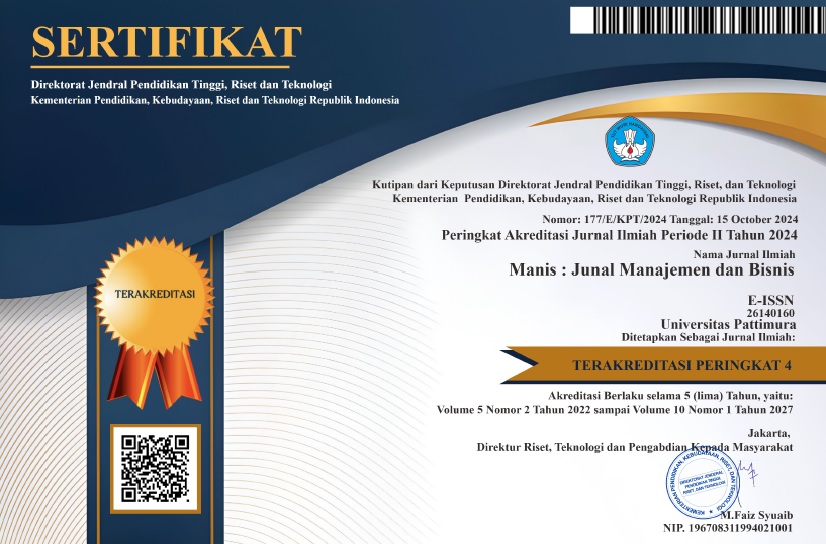
Certificate SINTA
Submit Your Article

Article Template

Journal Menu
Supporting Tools


Visitors
Manis: Jurnal Manajemen dan Bisnis
Published by S1 Management Study Program, Faculty of Economics and Business, Universitas Pattimura, Indonesia
⚡ Quick Summary: Manis: Jurnal Manajemen dan Bisnis applies a similarity check policy to ensure the originality and integrity of submitted manuscripts. All manuscripts must be free from plagiarism, duplicate publication, and improper citation. Manuscripts with a similarity index of less than 20% may be processed further.
Manis: Jurnal Manajemen dan Bisnis is committed to maintaining the originality, quality, and integrity of scholarly publications. Therefore, every manuscript submitted to the journal must be free from plagiarism, duplicate publication, data fabrication, data falsification, and unethical reuse of previously published works.
The editorial team conducts similarity checks on submitted manuscripts using plagiarism detection software such as Turnitin, iThenticate, or other reliable similarity-checking tools. The similarity check is conducted as part of the initial editorial screening before the manuscript proceeds to the peer-review process.
Similarity Threshold: Manuscripts should have a similarity index of less than 20%. However, the editorial decision is not based only on the percentage, but also on the nature, source, and context of the similarity.
The similarity screening process is conducted to ensure that submitted manuscripts meet the journal’s standards of originality and ethical publication.
Authors submit manuscripts through the journal’s online submission system using the official journal template.
The editor checks the manuscript’s suitability with the journal’s focus and scope, template format, and basic ethical requirements.
The manuscript is checked using similarity detection software to identify possible overlaps with existing publications or online sources.
Based on the similarity report, the editor may continue the manuscript to peer review, request revision, or reject the manuscript.
Maximum Similarity Index
Manuscripts below this threshold may be processed further
Manuscripts with a similarity index of less than 20% may proceed to the next editorial stage. However, the editorial team will still examine the similarity report carefully to ensure that the manuscript does not contain plagiarism, excessive quotation, improper paraphrasing, duplicate publication, or unethical reuse of previous works.
Manuscripts with a similarity index of 20% or higher may be returned to the authors for revision or rejected, depending on the type and seriousness of the similarity found.
The journal does not tolerate similarity that indicates publication misconduct. The following types of similarity are considered unacceptable:
Authors are responsible for ensuring that their manuscripts are original and properly cited before submission. Authors are encouraged to conduct a similarity check independently before submitting their manuscripts to the journal.
Based on the similarity report, the editorial team may take one of the following actions:
The manuscript may proceed if the similarity is acceptable and properly cited.
The author may be asked to revise the manuscript to reduce similarity and improve citation quality.
The manuscript may be rejected when serious plagiarism, duplicate publication, or unethical similarity is found.
If plagiarism, duplicate publication, or serious similarity problems are identified after publication, the editorial team may investigate the case and take appropriate action in accordance with the journal’s publication ethics policy. Possible actions include correction, expression of concern, retraction, or notification to the authors’ institution.
Certificate SINTA