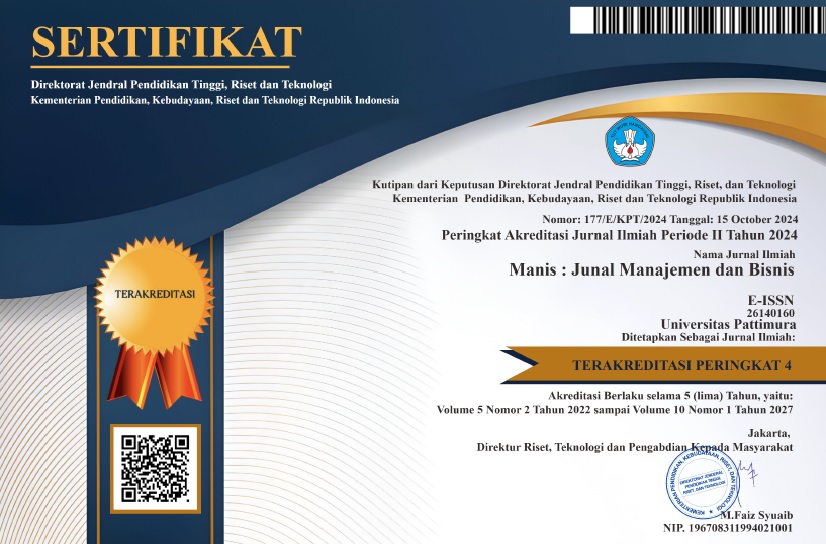
Certificate SINTA
Submit Your Article
Article Template

Journal Menu
Supporting Tools


Visitors
Manis: Jurnal Manajemen dan Bisnis
Published by S1 Management Study Program, Faculty of Economics and Business, Universitas Pattimura, Indonesia
Quick Summary: Manis: Jurnal Manajemen dan Bisnis encourages constructive scholarly discussion after publication to promote academic transparency, scientific integrity, and the continuous improvement of published research. Readers, researchers, and authors may submit evidence-based comments, questions, or concerns regarding published articles. The editorial team evaluates submissions and may invite authors to respond, facilitate scholarly dialogue, or initiate appropriate editorial actions when necessary.
Manis: Jurnal Manajemen dan Bisnis recognizes that scholarly communication continues beyond the formal publication of research articles. Post-publication discussion provides an opportunity for readers, researchers, practitioners, and authors to critically evaluate published findings, exchange academic perspectives, clarify methodological issues, and contribute to the advancement of knowledge in management and business.
The journal supports responsible, transparent, and evidence-based scientific dialogue. All post-publication discussions must maintain academic professionalism, respect intellectual contributions, and comply with established publication ethics.
Editorial Commitment: The journal is committed to facilitating constructive academic discussion while ensuring fairness, objectivity, confidentiality where appropriate, and the integrity of the scholarly record.
Post-publication discussion may address scholarly matters related to articles published in the journal, including but not limited to:
Questions or comments concerning research design, sampling, data collection, analytical methods, and methodological limitations.
Discussion of empirical findings, statistical analysis, theoretical interpretation, and conclusions.
Requests for clarification regarding research procedures, theoretical frameworks, data presentation, and reported findings.
Evidence-based discussions concerning the verification, reproducibility, or robustness of published research.
Constructive perspectives, alternative interpretations, and additional scholarly evidence relevant to published articles.
Concerns regarding possible errors, ethical issues, inappropriate attribution, or other matters affecting the reliability of the scholarly record.
Readers, researchers, and other interested parties may submit post-publication comments or scholarly concerns to the editorial office through the journal's official communication channel.
A submission should contain the following information:
Submission Channel
Editorial Office: Manis: Jurnal Manajemen dan Bisnis
Email: jurnal.manis@mail.unpatti.ac.id
Contact Page: Journal Contact Information
Submissions should be written in a professional and respectful manner. Personal attacks, defamatory statements, discriminatory remarks, unsupported accusations, and comments unrelated to scholarly matters will not be considered for public discussion.
All submitted post-publication comments are subject to an initial editorial assessment to determine their relevance, scholarly merit, factual basis, and compliance with publication ethics.
The editorial team may undertake the following actions:
Editorial Independence: Decisions concerning post-publication discussion are made on the basis of scholarly evidence, relevance, fairness, and publication ethics. The editorial team may decline or request revision of comments that do not meet these standards.
When a post-publication comment raises substantive scientific questions regarding a published article, the editorial team may invite the corresponding author or relevant co-authors to provide a written response.
Authors are encouraged to address comments constructively and provide appropriate explanations, references, additional analyses, or supporting evidence where necessary.
Authors will be given a reasonable opportunity to respond to substantive criticisms or concerns before the journal decides whether and how to publish the discussion. A lack of response does not automatically invalidate the original article.
Post-publication discussions that meet the journal's scholarly and ethical standards may be made publicly available through an appropriate journal communication or publication channel, subject to editorial approval.
Depending on the nature of the discussion, the editorial team may consider:
Transparency Principle: When a discussion results in a formal published notice, the journal aims to maintain a clear connection between the notice and the original article so readers can understand the relevant scholarly developments.
Submission of a comment does not guarantee its publication. Editorial decisions take into account scholarly relevance, evidentiary support, ethical requirements, and the journal's publication procedures.
When post-publication discussion identifies a significant error, a concern about research reliability, or an allegation of publication misconduct, the editorial team will consider the matter under the journal's applicable editorial and publication ethics policies.
Depending on the nature and evidence of the concern, possible actions may include:
Requesting explanations or additional information from the authors or relevant parties.
Publishing a formal correction when a significant error can be addressed without invalidating the main findings.
Informing readers about serious unresolved concerns regarding a published article when warranted.
Retracting an article when findings are unreliable or serious publication ethics violations justify retraction.
Allegations of research misconduct are assessed separately from ordinary scholarly disagreements. The editorial team will consider available evidence, provide appropriate opportunities for clarification, and may contact relevant institutions when necessary.
The journal refers to the principles and guidance of the Committee on Publication Ethics (COPE) when addressing publication ethics concerns.
This policy should be read together with the journal's other editorial and publication ethics policies:
Editorial Contact
Manis: Jurnal Manajemen dan Bisnis
Faculty of Economics and Business
Universitas Pattimura, Ambon, Indonesia
Email: jurnal.manis@mail.unpatti.ac.id
Website: https://ojs3.unpatti.ac.id/index.php/manis
Policy Notice: Manis: Jurnal Manajemen dan Bisnis supports post-publication scholarly discussion as an important component of academic integrity and continuous scientific evaluation. All participants are expected to engage constructively, respect the rights of authors and readers, and contribute to maintaining the reliability and credibility of the published scholarly record.
Certificate SINTA