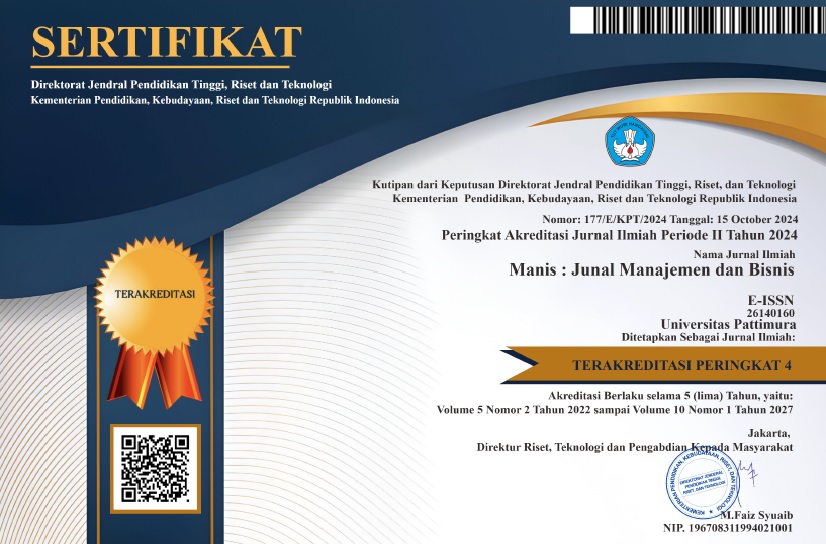
Certificate SINTA
Submit Your Article

Article Template

Journal Menu
Supporting Tools


Visitors

Manis: Jurnal Manajemen dan Bisnis
Published by Department of Management, Faculty of Economics and Business, Universitas Pattimura, Indonesia
Quick Summary: Manis: Jurnal Manajemen dan Bisnis accepts two manuscript types: Original Research Articles and Literature Review Articles. Manuscripts must be original, relevant to management and business studies, methodologically sound, and prepared according to the journal's Author Guidelines and official template.
The journal provides a scholarly platform for empirical research and critical reviews of established and emerging knowledge in management, business, and related fields. All submissions are assessed for relevance, originality, methodological rigor, scholarly contribution, and compliance with publication ethics.
An original study presenting new empirical evidence, analytical findings, or research-based insights.
A structured and critical synthesis of existing scholarly literature that provides meaningful new insights.
Original Research Articles report findings from a clearly defined research problem using an appropriate research design and a transparent analytical approach. Quantitative, qualitative, mixed-methods, case study, and other suitable empirical approaches are welcome.
Essential characteristics:
Suggested structure: Title, Author Information, Abstract, Keywords, Introduction, Methods, Results and Discussion, Conclusion, and References, following the official manuscript template.
Literature Review Articles provide a coherent, analytical, and critical examination of existing research within a clearly defined topic in management or business. A review must move beyond describing individual studies by identifying patterns, disagreements, knowledge gaps, theoretical implications, or opportunities for future investigation.
Review approaches may include:
Uses a clearly documented search, screening, selection, appraisal when relevant, and synthesis procedure.
Offers a critical, conceptually organized discussion and synthesis of a relevant body of research, with a transparent explanation of how literature was identified and selected.
Examines scholarly publication patterns, networks, themes, or research trends using appropriately documented bibliographic data and analysis.
Essential characteristics:
Suggested structure: Title, Author Information, Abstract, Keywords, Introduction, Review Methodology, Findings and Synthesis, Discussion, Conclusion, and References. For systematic reviews, authors should document screening and selection decisions and use relevant reporting guidance where applicable.
Both manuscript types must fall within the journal's focus and scope, including:
For more detail, see the Focus & Scope page.
The editorial team may request additional methodological details or supporting material when needed to assess the submission.
Editorial Note: The acceptance of a manuscript type does not guarantee publication. All decisions are based on relevance, academic quality, peer-review outcomes, and ethical compliance.
Certificate SINTA