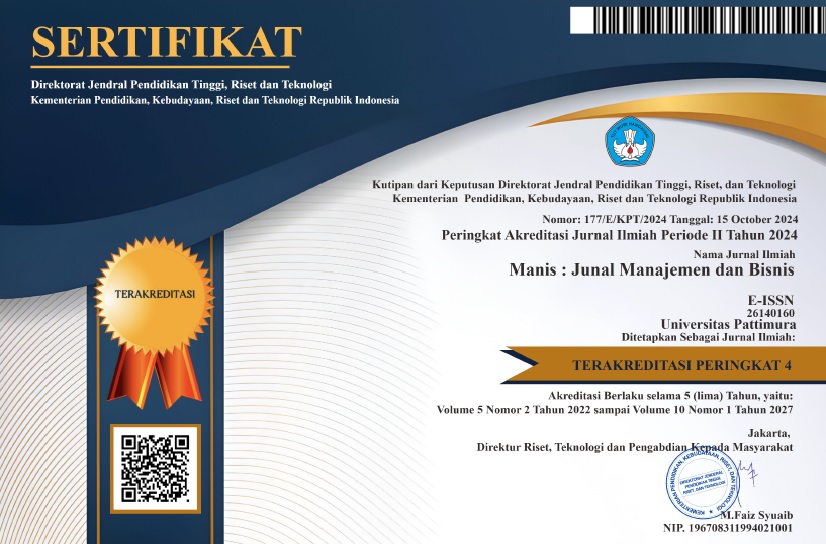
Certificate SINTA
Submit Your Article
Article Template

Journal Menu
Supporting Tools


Visitors
Manis: Jurnal Manajemen dan Bisnis
Published by S1 Management Study Program, Faculty of Economics and Business, Universitas Pattimura, Indonesia
Quick Summary: Manis: Jurnal Manajemen dan Bisnis applies distinct procedures for withdrawal of manuscripts before publication, correction of published articles when errors do not invalidate their main findings, and retraction when serious problems compromise the reliability or integrity of the published record. Each action is assessed by the editorial team and documented appropriately.
Manis: Jurnal Manajemen dan Bisnis recognizes that authors may need to withdraw a submitted manuscript for valid academic, ethical, administrative, or technical reasons. However, manuscript withdrawal must be conducted responsibly and transparently to avoid disruption of the editorial and peer-review process.
Authors are expected to carefully prepare and check their manuscript before submission. By submitting a manuscript to the journal, authors confirm that the manuscript is original, has not been published previously, is not under consideration elsewhere, and has been approved by all authors.
Core Principle: Withdrawal is allowed only through a formal request and must be approved by the editorial team.
Manuscript withdrawal may be considered when there are valid reasons, including:
Authors may request withdrawal before the manuscript is assigned to reviewers. At this stage, withdrawal may be approved if the corresponding author submits a formal request to the editorial office with a clear explanation.
The editorial team will review the request and update the manuscript status in the journal system when the withdrawal is approved.
Withdrawal during the peer-review process is discouraged because reviewers and editors have already spent time evaluating the manuscript. However, the journal may consider withdrawal requests if the authors provide valid and reasonable justification.
The editorial team may contact the corresponding author for clarification before approving or rejecting the withdrawal request.
Important: Authors must not submit the same manuscript to another journal while it is still under review in Manis: Jurnal Manajemen dan Bisnis.
Withdrawal after acceptance is strongly discouraged because the manuscript has completed editorial assessment and peer review. At this stage, the journal may have begun copyediting, layout, DOI registration, metadata preparation, or issue scheduling.
Authors who request withdrawal after acceptance must submit a formal request signed or approved by all authors. The request must clearly explain the reason for withdrawal and will be evaluated by the editorial team.
Once an article has been published, it cannot be withdrawn in the same way as an unpublished manuscript. Published articles become part of the scholarly record. Any serious issue identified after publication will be handled through the journal’s correction policy, retraction policy, or publication ethics policy.
If authors identify serious errors, ethical concerns, or reliability problems after publication, they must immediately notify the editorial office. The editorial team will determine whether a correction, expression of concern, or retraction is required.
Post-Publication Note: Published articles are not removed silently. Any post-publication change must be documented transparently.
Authors who wish to withdraw a manuscript must submit a formal request to the editorial office. The request must be submitted by the corresponding author and must include the following information:
“We, the authors of the manuscript entitled [manuscript title], request withdrawal from Manis: Jurnal Manajemen dan Bisnis. All authors have agreed to this withdrawal request. The reason for withdrawal is [state the reason clearly].”
The editorial team will evaluate each withdrawal request based on the manuscript status, reason for withdrawal, ethical considerations, and the stage of the editorial process.
The manuscript status is changed to withdrawn and the authors are informed by the editorial team.
The editor may ask the authors to provide additional explanation or confirmation from all authors.
The withdrawal request may not be approved when the reason is unclear, unethical, or submitted after publication.
The journal considers the following actions as unethical withdrawal practices:
Editorial Action: The journal may record unethical withdrawal cases and may take appropriate action in accordance with publication ethics.
Manis: Jurnal Manajemen dan Bisnis is committed to maintaining the accuracy and integrity of published articles. When errors are identified after publication, the journal may issue a correction to ensure that readers have access to accurate and reliable information.
A correction is issued when an error affects part of the article but does not invalidate the overall findings, interpretation, conclusion, or contribution of the article. Corrections are intended to clarify, update, or repair the scholarly record without removing the article from publication.
Core Principle: Corrections are made transparently and responsibly to preserve the reliability of the published article and the integrity of the journal archive.
A published article may require correction when one or more of the following errors are identified:
The journal may issue different forms of correction depending on the nature and source of the error.
Issued when an error is caused by the author and requires clarification or correction after publication.
Issued when an error occurs during editorial production, copyediting, layout, metadata processing, or online publication.
Issued when article metadata, such as title, author identity, DOI, page number, or indexing information, needs correction.
Issued when additional explanation is needed to clarify a statement, method, data, or interpretation in a published article.
The correction process is conducted carefully to ensure that the published record remains accurate and transparent.
An error may be identified by authors, readers, reviewers, editors, indexers, or other parties after publication.
The editorial team reviews the reported error and determines whether a correction, clarification, expression of concern, or retraction is required.
The corresponding author may be contacted to confirm the correction and provide supporting information when needed.
If approved, the correction notice is published and linked to the original article to ensure transparency for readers.
When a correction is issued, the journal may publish a correction notice. The notice will clearly identify the original article and explain the correction in a transparent manner.
A correction notice should include the article title, author names, journal name, volume, issue, year, DOI or URL, description of the error, and corrected information.
Transparency Requirement: Corrections must be visible, accessible, and linked to the original article whenever possible.
The published article is considered the version of record. When a correction is made, the journal may update the online version of the article, publish a correction notice, or provide an editorial note explaining the correction.
The journal will not silently change published articles in a way that affects the scholarly record. Any substantive correction will be documented to maintain transparency and accountability.
A correction is not sufficient when the error seriously affects the reliability of the article, invalidates the main findings, or indicates publication misconduct. In such cases, the journal may consider issuing an expression of concern or retracting the article.
Manis: Jurnal Manajemen dan Bisnis is committed to maintaining the integrity, accuracy, and reliability of the scholarly record. Retraction is used as a mechanism to correct the literature and alert readers when a published article contains serious problems that make its findings, data, conclusions, or publication record unreliable.
The purpose of retraction is not to punish authors, but to protect the integrity of scientific communication and ensure that readers are properly informed about articles that should no longer be relied upon.
Core Principle: Retraction decisions are made based on evidence, editorial investigation, publication ethics, and the reliability of the published article.
A published article may be considered for retraction when one or more of the following conditions are identified:
The retraction process is conducted carefully, fairly, and transparently. The editorial team will examine all allegations or evidence before making a decision.
A concern may be raised by editors, reviewers, authors, readers, institutions, or other parties regarding the reliability or ethics of a published article.
The editor examines the allegation, similarity report, data issue, ethical concern, or other evidence related to the published article.
The corresponding author may be contacted and asked to provide clarification, supporting evidence, original data, or an explanation.
Based on the evidence and clarification, the editor decides whether to issue a correction, expression of concern, retraction, or no further action.
If an article is retracted, the journal will publish a retraction notice. The notice will be clearly identified as a retraction and linked to the original article. The original article may remain available online to preserve the scholarly record, but it will be clearly marked as retracted.
A retraction notice should include sufficient information to identify the retracted article and explain the reason for the retraction in a transparent and responsible manner.
The notice identifies the article title, author names, journal name, volume, issue, year, pages, DOI, and URL.
The notice states the reason for retraction, such as unreliable data, plagiarism, ethical violation, or publication misconduct.
The notice is published openly and remains freely accessible to readers.
Not every error requires retraction. The editorial team will determine the most appropriate action based on the seriousness of the problem and its impact on the reliability of the article.
Issued when an article contains honest errors that do not invalidate the main findings or conclusions.
Issued when serious concerns exist but the investigation is still ongoing or the evidence is not yet conclusive.
Issued when the article is seriously unreliable, unethical, duplicated, fraudulent, or affected by major publication misconduct.
Authors may request retraction of their published article if they discover serious errors, ethical problems, or other issues that significantly affect the reliability of the article.
The request must be submitted in writing to the editorial office and must include a clear explanation of the reason for retraction. The editor will evaluate the request before issuing a decision.
After retraction, the article will remain part of the journal’s publication record but will be clearly marked as retracted. The article metadata and retraction notice will remain accessible to maintain transparency and the integrity of the scholarly record.
The journal may notify indexing databases, repositories, and relevant parties about the retraction so that the article status can be updated accordingly.
Requests for withdrawal or correction and concerns about potential retraction should be submitted to the editorial office with the relevant manuscript or article details and supporting reasons or evidence.
Email: jurnal.manis@mail.unpatti.ac.id
Contact: Journal Contact Page
Publication Ethics: Publication Ethics
Certificate SINTA